Travel Shot: The Mechanical Clock

The gentle whirring and the polite clicking sounds coming from the… contraption was fascinating. What is it, I wondered, as I walked around it. What were the ropes for, ropes that ascended to the ceiling? And the slowly moving wheels? And why was it cordoned off with a “Please do not touch” sign?

That July afternoon of 2009, I was at Salisbury Cathedral wondering what this contraption was all. A simple information plaque on one side enlightened me and I did a double take when I read it. This… contraption was a clock? A clock without a face? And that too 700 years old?
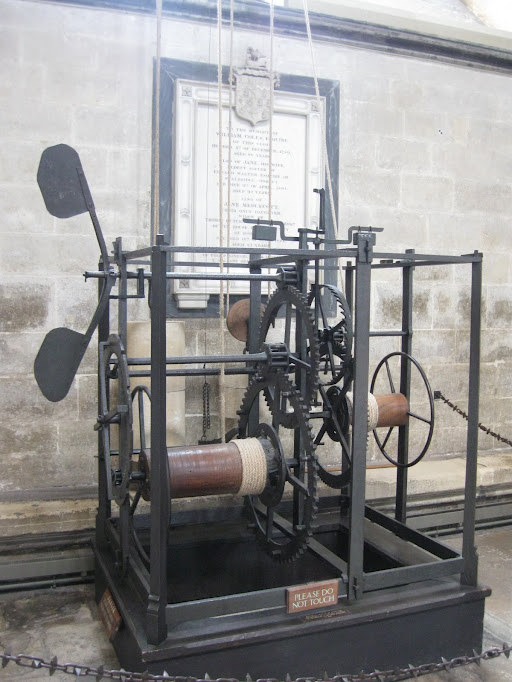
The Mechanical Clock. One of the stone weights can be seen hanging on the left, behind the clock. Note the ropes going out of the frame of this  photo—these are attached to a bell, which strike at the hour every hour.

I was standing before the oldest Mechanical Clock in Europe. There are even claims to this being the oldest working mechanical clock in the world. Dating back to 1386, this clock was re-discovered in the Cathedral in 1928 and restored back to working condition in 1956. Most of the parts of the clock are original as is its wrought iron frame.

A single-strike clock, i.e. it makes one strike for every hour of the day, the power to run it is supplied by two large stone weights. As the weights descend, ropes (which are attached to a bell) unwind from the wooden barrels. Before the weights reach the floor, they have to be wound back up again. For more technical details on the working of the clock, please click here.

Though the Salisbury Cathedral had many other attractions on offer—an impressive 400 feet tall spire and an original copy of the Magna Carta, among others—it is the simple (?) mechanical clock that remains with me after 3 years. A clock that works even today after so many centuries and is accurate to within 2 minutes.

Not bad for a 700-year old clock, eh? 🙂

PS: For more photographs of Salisbury, please click here.

Travel Shot: A view of Greenwich from the river Thames

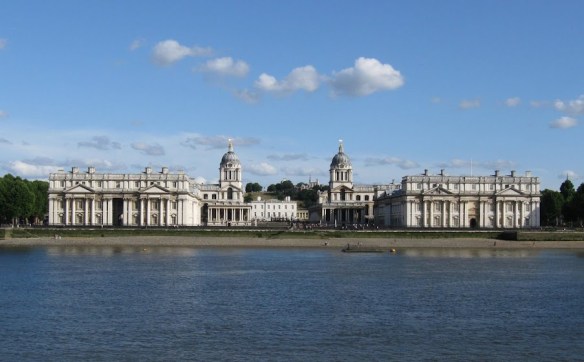
Sometimes, it takes a larger view for things to fall into perspective. Literally. Viewing the former Royal Naval College in Greenwich (pronounced Gren-itch) from across the Thames was one such experience.

I had spent a lovely day spent at Greenwich as part of a guided walk through Maritime Greenwich, a UNESCO World Heritage Site. Of particular interest to me were the two buildings of the former Royal Naval College, which was designed by Christopher Wren, and captured by the famous Italian painter, Giovanni Antonio Canal, better known as Canaletto. Throughout my explorations there, I kept searching for that one view that captured the beauty, simplicity and symmetry of Wren’s design, but in vain.

It wasn’t till I crossed the river Thames to the opposite bank to take the DLR back to London that I realised that I had been searching for Canaletto’s view from the wrong side. When I emerged from the underground foot tunnel, this was the beautiful sight that greeted me.

A view of the former Royal Naval College, Greenwich, from the River Thames

Continue reading “Travel Shot: A view of Greenwich from the river Thames”

Travel Shot: The snake on the ceiling

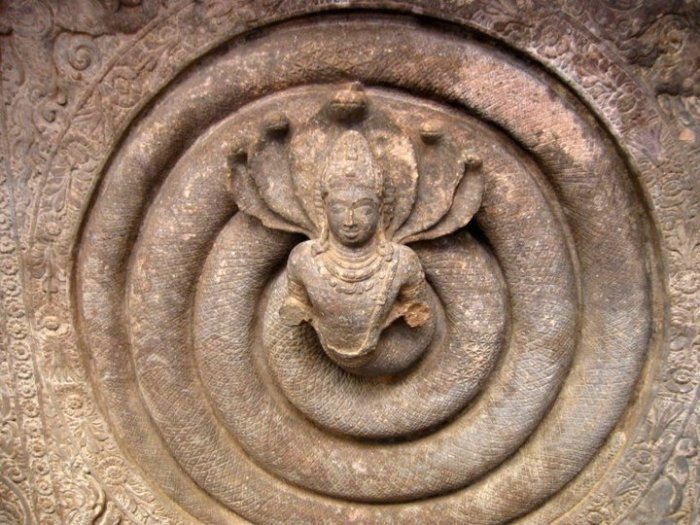
The back of my neck prickled, and an uneasy shiver ran down my spine. I looked around and could see nothing unusual or scary. It was a bright sunny afternoon at the Badami Caves and our tour group was gathered around the guide at Cave Temple 1. There was nothing unusual or strange or eerie there.

Yet, the feeling of being watched persisted and I just could not relax. I still don’t know what made me look up at the ceiling. And when I did look up this is what I saw.

Carving of a snake on the ceiling in Cave 1

Now, I do not have Ophidiophobia, but the huge carved snake on the ceiling gave me a scare. It looked so real that my first instinct was to run away; a couple of people in my tour group actually did leave the cave and walk away when the guide pointed it out to them. To me, it looked like the beautifully carved snake with the multi-hooded head was stretching out its hands towards me. I could not take a photograph right away and this one was taken only after I had visited all the other caves.

Even as I type out this post, I can remember that prickly feeling of unease. I actually looked up at the ceiling to check and found only the ceiling fan whirring away !

Have you come across such realistic looking sculptures during your travels? Do share them with me here. 🙂

Travel Shot: The milk can and the gargoyle

During a day trip to the Cotswolds region in England in August 2009, our tour group stopped for some refreshments at The Old Mill in a village called Lower Slaughter. This arrangement at the entrance to the mill-cum-tea room-cum-ice cream shop-cum-souvenir shop caught my eye.

The Milk Can and the Gargoyle. This is what came to my mind instantly on seeing the arrangement.

What do you think the gargoyle’s thinking? Do you think he hates ice-cream and would rather have a barrel of beer there. My imagination then took over and I thought of a pub named “The Milk Can and the Gargoyle”. And then dismissed the thought instantly, even though English pubs have weird and wonderful names (you can read more about it in one of my earlier posts here), they will not go for the word ‘milk’ for the name of a pub. It defeats the entire purpose, don’t you think so?

But, back to my question. What is the gargoyle thinking?

PS: I had the best ice-cream I have ever had in my life here—some creamy, organic, hand churned butter nut ice-cream. If you ever visit this place, do have some on my behalf and do say hiya to the gargoyle for me. 😀

Travel Shot: The wandering pianist

The candidness of street photography is something that I admire and appreciate. But it is also something that I feel inhibited to try it out myself as I feel very self-conscious about taking such candid shots. That is perhaps one of the reasons why you will rarely find people in my photographs.

But sometimes, people photo-ops are so compelling that my camera is out and the picture taken in no time. Like this wandering pianist I came across in London.

Continue reading “Travel Shot: The wandering pianist”

Travel Shot: The Chinese fishing nets of Cochin

Cochin or Kochi is a beautiful city and a photographer’s delight. I was in the city for 2 days in November in 1998 as part of a larger and a very memorable trip along the West coast of India (you can see a couple of pictures from that trip here and here). Even today, I can vividly recall the sights and smell of Jew town, the spice markets, Cherai beach and of course the strange-looking, but extremely photogenic Chinese fishing nets.

Chinese fishing nets at Cochin

It was late afternoon when we reached the area where the Chinese fishing nets were (I can’t really remember the area now). And what a sight it was. The cozy winter sunlight made everything look soft and dreamy. And the Chinese fishing nets looked delicate as if they were spun out of air and sunlight and sea-foam. The gentle wind made the nets mirror the rippling sea waves. It was a magical sight.

So magical, that I had no recollection of taking this photograph. It is only when I developed the film roll (yes, it was that far back) and saw the photographs that I found out. I discovered this yesterday among some other photographs and decided to share it with you here.

The Chinese fishing nets in Cochin are probably one of the most photographed “sights” in India and that too from all angles and all possible moods. Just type these words in any search engine and you’ll know what I mean. And yet, each photograph is special as it captures the mood through the photographer’s lens. Just like mine. 😀

So tell me, have you photographed the Chinese fishing nets of Cochin? Do share the link in the comments section. I would love to see your images and the mood that you have captured.