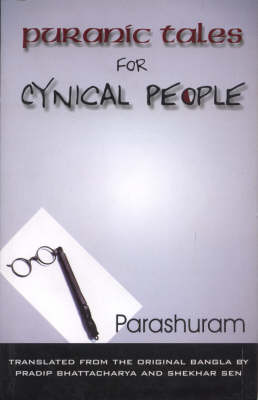
How often do you pick up a book on the basis of its title? I do that sometimes, often to be disappointed. But Puranic Tales for Cynical People (Indialog, 2005), written by Parashuram and translated from the original Bangla by Pradip Bhattacharya and Shekhar Sen, was an exception. I purchased this book in 2005, read it from start to finish, and loved it so much that I was all set to read it a second time. That never happened, and after a while it got shelved with my other books, hidden but not fully forgotten.
Until recently, that is. My brother unearthed it recently during a raid on my bookshelves in search of some reading material. Thanks to him, I was able to once again delight in the book’s sometimes light, sometimes acerbic, and sometimes irreverent humour.
Parashuram was the pen name of Rajsekhar Bose (or Basu, if you please) (1880-1960). Under this nom de plume, he wrote a 100 short stories, which were published in 9 collections. Twenty of these stories have been put together in this collection of Puranic Tales for Cynical People by the translators.
The basic premise of most of these stories revolves around the intriguing possibility of placing “well-known characters from the Puranas in situations that might have been”. In other words, they cater to the question of what happened next or a behind the scene narration of a famous story or incident. For example: what happened to Surpanakha after the Ramayana? Did the celibate Hanuman ever consider matrimony? Did Vishwamitra and Menaka always have a lovey-dovey relationship? Do apsaras always stay young?
 In the process, Parashuram pokes fun at everybody—from the Creators (Hindu, Christian and Muslim) themselves, to venerable sages and other characters that any reader who is even reasonably acquainted with Hindu mythology will be able to identify and relate to.
Some of the lesser known characters that Parashuram breathes life into are Yayati (‘Yayati’s Senility’), Revati (‘Revati Gets a Husband’) and Maharishi Jabali (‘Jabali’). Two of the stories actually make caricatures of two of the crankiest, hot-tempered and feared sages—Durvasa (‘Bharat’s Rattle’), and Vishwamitra (‘The Clay Girdle’).
Two stories explore the possibility of what happens when (i) the creators of the world’s 3 main religions meet (‘Three Creators’); and (ii) the 7 immortal men from the Puranas meet—Ashwatthama, Vyasa, Hanuman, Vibhishana, Kripacharya, Parashuram (the sage that is, not the author), and the Daitya king, Bali—at ‘The Gandhamadan Conclave’. Both these stories are absolutely delightful. While the former hits out at the claim of comparative superiority of one religion over others, the latter story emphasises the fact that all wars are essentially unfair.
Continue reading “Puranic tales for cynical people and humour for all” →
0.000000
0.000000



 My Favourite Things