Stories in Stone: Shiva appeases Parvati


Stories in Stone is all about sculptures — either standalone or entire narrative panels. Each post in this series showcases one such sculpture, looks beyond its iconography and deconstructs the details in an attempt to understand the idea and/or the story it conveys.


The sculpture under discussion in this post has a bit of an identity crisis. The temple it is located in refers to it by one name; I refer to it by another name based on its iconographical details; and a book that I highly respect and refer to frequently refers to it by a third name. What’s in a name, you may ask? Plenty, I say, for in this case, with change in identity, the story and the context changes as well.

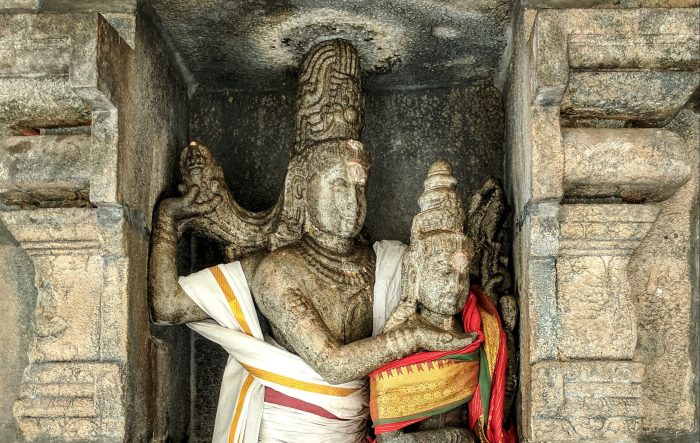
The sculpture in question is that of Shiva and Parvati and is located in one of the external niches of a shrine in the outer praharam or circumambulatory path of the Lalithambigai (also spelled as Lalithambikai) Temple at Thirumeeyachur (or Thirumiyachur) in Tamil Nadu. At this temple, Shiva is known here as Meghanathar and though He is the main deity here, the shrine to Devi or Lalithambigai is more popular

Like most temples, the Lalithambigai Temple too has a sthala puranam or legend associated it. There’s a long version and a short version and since this post is about a particular sculpture and not the temple, I’m going to share the short version with you.

Continue reading “Stories in Stone: Shiva appeases Parvati”

Tranquebar, Trankebar, Tharangambadi, Tamil Nadu, Danish Colony, Colonial Heritage, History, East Coast, Coromandel Coast

Exploring Tranquebar

There are two ways to explore the former Danish colony of Tranquebar (or Trankebar as the Danes spell it) or Tharangambadi (as it is known officially). The first is as a day trip from Pondicherry or Nagapattinam or any of the nearby temple towns and the second is to base yourself at Tranquebar, like I did, and then explore the town at leisure.

Tranquebar, Trankebar, Tharangambadi, Tamil Nadu, Danish Colony, Colonial Heritage, History, East Coast, Coromandel Coast

This coastal town is on the east coast of the southern state of Tamil Nadu, about a 100 km south of Pondicherry. Either way, you will soon discover that the sea and the citadel of Fort Dansborg at Tranquebar are its best known sights.

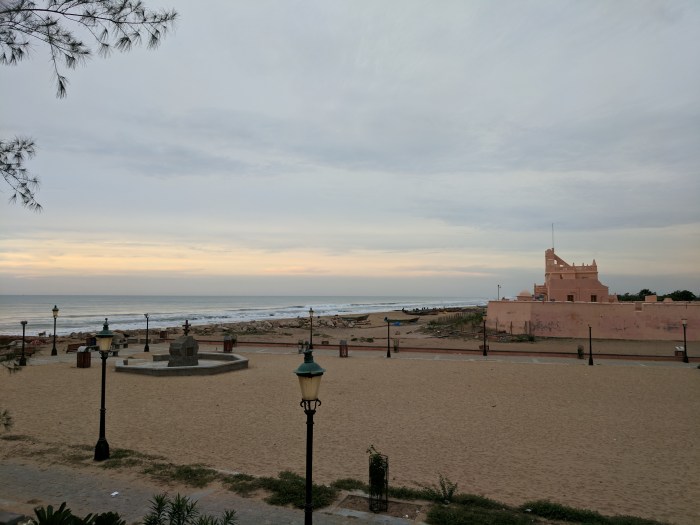
In fact, the first thing a visitor to Tranquebar will see is the Dansborg citadel — to me, it looked like a giant slice of commercial kesar ice cream shimmering (or melting) in the heat.

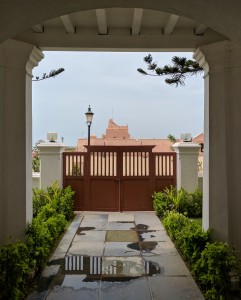
And if you stay at The Bungalow on the Beach, like I did, then a view of the sea and the Dansborg Fort, is a constant (see the header and the photo on the left).

Continue reading “Exploring Tranquebar”

My “now” song: Baisara beera

Do you ever have a song, an idea, a story line, or an image stuck in your head? And it just refuses to go away? For some time at least? I have this with music — it could be a song, an instrumental piece, a jingle, a background score, etc. That particular piece of music becomes my “now’” song, and the “nowness”  (pardon my English here) could remain with me for any length of time.

It was a Sunday and I was at work completing an urgent report. Naturally, I wasn’t too happy to be at work on a Sunday, but the one big advantage of working in an empty office that day consoled me — I could listen to music in the office without earphones, and at full volume as well !

I put on a random playlist on YouTube and got down to work. I work well when there is music in the background, and that day was no different. With no phones to disturb me, I made good progress with the report as I hummed, sang or listened along as the songs in playlist played out one after the other.

Till the haunting strains of a ravanhatta came along. I immediately stopped working on the report and switched tabs on the computer to listen to the song and watch the accompanying video. And then again and once again. And for good measure, a few more times. 🙂 Continue reading “My “now” song: Baisara beera”

A holiday at Wallwood Garden in Coonoor

My first night at Wallwood Garden in Coonoor was a memorable one. I had arrived earlier that evening and was shown to my room immediately by Geetha, the manager. “You must be so tired — first the flight from Mumbai to Coimbatore, and then the drive to Coonoor ! Since you’re a writer and will appreciate some quiet, we have put you in Camphor.”

Writer? Me? I was so chuffed at being called a writer that the rest of Geetha’s words about the room and its amenities didn’t register as I was mentally preening. Till she mentioned the word “room heater”.

I snapped out my self-absorbed reverie to see her pointing towards the said contraption and showing me how it worked. “Surely, I won’t need this, right? I asked. I may also have giggled nervously.

“I’m afraid you will for it gets very cold after sunset. Besides, there are extra blankets and quilts in the cupboard should you need them,” Geetha said seriously. “You did read the mail we sent about the weather and appropriate clothing for Coonoor, didn’t you?” I hadn’t read the mail, but wasn’t going to tell her that.

“Of course, of course,” I said airily, ushering her out of the room.”I’ll be fine and will manage”. That night I needed two blankets + one quilt + the room heater to “manage”. I don’t know when I stopped shivering and went to sleep.

I woke up the next morning to the most awful racket; it took me a few seconds to figure out that the sky wasn’t about to come crashing down on my head and that it was a family of monkeys partying on the roof. And that’s how my holiday at Neemrana’s Wallwood Garden began ! Continue reading “A holiday at Wallwood Garden in Coonoor”

Nigiri Library, ooty, Ootacamund, Udhagamandalam, Libraries of India, Tamil Nadu, Books, Reading, Travel

Travel Shot: The Nilgiri Library

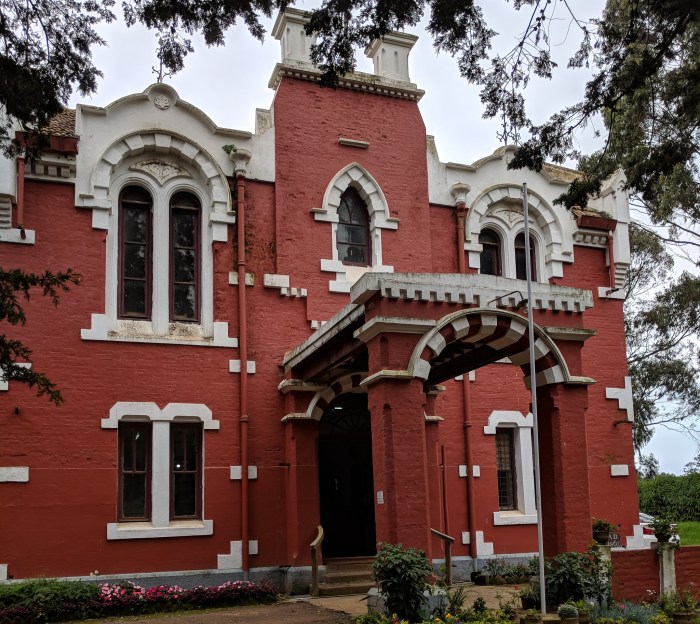
The Nilgiri Library in the hill station of Ooty (also known as Udhagamandalam or Ootacamund) in Tamil Nadu was established in 1859 and moved to its present premises, a handsome red and white Victorian building, in 1867. According to an information board at the Library:

On 28th August 1967, the foundation stone of the main building was laid by the Hon. Mr. A.J. Arbuthnot, then Chief Secretary to the Madras Presidency. A religious ceremony was conducted by Rev. Dr. G.U. Pope. A parchment in the name of the “Holy Trinity” was placed under the stone work… The site on which the Library stands once housed the Jail and Post Office !

I came to know of the Nilgiri Library when I was doing research on Ooty prior to my short #NilgiriMountainHoliday about two months back. Just reading about the library and its collection of over 25,000 books, rare volumes as well as a beautiful reading room was enough to make me head straight to the Library on my arrival at Ooty.

The Members Only sign at the entrance did make my steps falter a bit, but I was confident that I could persuade the Library staff to at least see the reading room, if not their collection.

Continue reading “Travel Shot: The Nilgiri Library”

Stories from my home – 4: Bala’s oil pot


We don’t always have to travel to seek stories; they are right there in our homes too. In “Stories From My Home“, I examine the many objects surrounding me at home and attempt to document and share the memories associated with them, one story at a time. 


This true story begins more than a 100 years ago.

Every morning at dawn, in a small village of Southern Tamil Nadu, little Bala would set off to bathe in the Thamirabharani river with other girls in the street she lived in. She would carry bath oil in a little bronze pot, some payatham maavu (or green gram powder), and a change of clothes. Bathing was a fun and elaborate ritual that also involved play with all the other girls who came to the river with her.

Years went by. Bala grew up and got married and newer responsibilities meant she no longer had the time for the elaborate bathing ritual that she once followed; there was only time for a quick scrub and dip in the river. The oil pot soon fell into disuse and eventually became a plaything for her daughters.
.
Bala’s daughters too grew up, got married and left the village to live in far off cities. The oil pot remained behind, abandoned and forgotten. Years later, while on a visit to the village, Bala’s oldest granddaughter saw it and immediately took a fancy to this oil pot and with Bala’s permission took it back with her. Continue reading “Stories from my home – 4: Bala’s oil pot”