Balasaraswati: Her art and life

Photo Source: http://www.firstpost.com

The background

I did not know what I was getting into when I decided to review Balasaraswati: Her Art & Life by Douglas M. Knight Jr. (Tranquebar Press, 2011). All I was aware of at that time was the fact that I would be reading about a person I “knew”. Let me elaborate here.

Amma (my mother) grew up on a diet of classical music and dance. A student of Carnatic classical music, she was fortunate to watch many musicians and dancers perform, one of whom was Balasaraswati herself. Amma worshipped and idolised her as only a true rasika can. I started attending kacheris (music performances) and dance performances with Amma when I was 5. After each performance there would be a discussion on what we liked or did not like, and we would try sing the pieces we liked. If it was a dance performance that we had attended, the discussion would begin with the dance, then move on to the music, and finally to the inevitable mention of how Balasaraswati would have performed a particular dance item. By the time I was 6 or 7, I knew who Balasaraswati was, what her dance was like, and how she danced—all this without ever having seen her dance. But thanks to Amma’s vivid descriptions, and whenever Amma herself sang, I could and would imagine Balasaraswati dancing to them ! Such was her impact on me.

Continue reading “Balasaraswati: Her art and life”

Ladies compartment, 8.47 local: Book release function and review

Sometime early last month, Mumbai experienced a few days of gloomy, cloudy, rather funny weather.Though this type of weather was quite uncharacteristic for Mumbai, it was  typically London weather. And suddenly I was remembering and missing my days in London. On a whim, I put a status update on my Facebook wall about missing London, which elicited some responses. One of the responses I got was this:

You really miss England, don’t you? Go back, Sudha. Steep yourself in the legends and the history, touch the old walls and let them flow up your finger-tips into your heart, let the lakes and the streams and the little sudden springs soak into your soul, let the 40 shades of green fill your eyes and mind, let the cathedrals and the quaint corners whisper forgotten secrets and fervent prayers to you. Then come back home again.

As I read these beautiful lines, I did “travel” back to England, experience all that it said I should and came back “home” rejuvenated. And excited. Excited, because these lines had been written and posted by Suma Narayan, whose first book I had agreed to review. If these lines were a preview of what Suma’s writing would be like, I knew that the book would be a good read.

Continue reading “Ladies compartment, 8.47 local: Book release function and review”

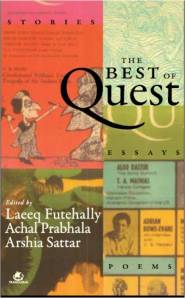
The Best of Quest: A review

The book

Once upon a time there existed a magazine which was a “quarterly of inquiry, criticism and ideas” and fittingly enough called Quest. It had very clear-cut guidelines for the content it carried: everything and anything published in the Quest had to have “some relevance to India. It was to be written by Indians for Indians” (p.xix).

It was because of these guidelines that Quest was able to publish highly original writing in English in the form of essays, opinions, book reviews, film reviews, critiques, stories, poems, memoirs, etc. The writers were a mix of the new and the established, academicians and journalists, politicians and poets — Rajni Kothari, Nirad Chaudhuri, Kiran Nagarkar, Ashis Nandy, Khushwant Singh, and Neela D’Souza, to name a few.

Published from Bombay, Quest was born in 1954 with Nissim Ezekiel as its first editor. After Ezekiel, A.S. Ayub and Dilip Chitre took on the role of editors of Quest, and both of them stayed true to the founding vision of publishing works relevant to India. In spite of this, or perhaps because of it, Quest died an untimely death with the imposition of the Emergency about 20 years later. In the decades that followed, Quest got relegated to the realm of nostalgic memories of people who were associated with it, or in wooden boxes stored in lofts and attics. Some forgot about it and some like me did not even know about the existence of Quest. Till recently, that is.

Continue reading “The Best of Quest: A review”

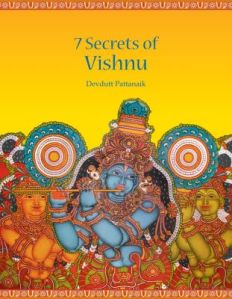
Book Review: 7 Secrets of Vishnu

The Background

Hindu mythology can be quite confusing for a non-Hindu. Why, it can be confusing and for a Hindu too. The different and contradictory world views that co-exist and even support and complement one another can bewilder even the most dedicated scholar or devotee.

According to Devdutt Pattanaik, author of the 7 Secrets of Vishnu (and the book under review here),

In mythology, all forms are symbolic. (pg.7)

This one sentence, in my opinion, is the key to understanding and appreciating not only this richly illustrated book, but also Hindu mythology and Hinduism itself. The 7 Secrets of Vishnu (Westland, 2011) has nearly half of its 220 pages devoted to images from calendar art, paintings, sculptures, etc. “to make explicit patterns that are implicit in stories, symbols and rituals of Vishnu” (p.xi).

Continue reading “Book Review: 7 Secrets of Vishnu”

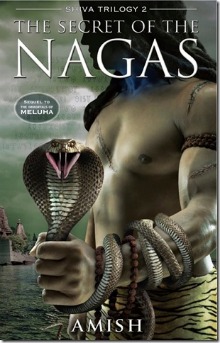
The secret of the Nagas: A review

The background

The Secret of the Nagas (Westland, pp.396, Rs.295) is the second book in the Shiva Trilogy by Amish. The Trilogy is based on the premise that Shiva was not a mythical God, but an ordinary human being who became a God because of his karma. The 3 books in the Trilogy trace the journey of Shiva from a human being to that of a God.

The Immortals of Meluha is the first book in the series. It follows the journey of Shiva from his beginnings as a Tibetan tribal leader to that of an immigrant to Meluha (the area that we now know was the site of the great Indus Valley Civilization) to becoming aware of the extraordinary destiny that awaits him and his first attempts at fulfilling that destiny. For more on the first book, you can read my review right here.

The story

The second book begins in Ayodhya with yet another skirmish between Shiva and Sati, and the Naga, who Shiva suspects was responsible for the death of his friend, Brihaspati. Yet again, the Naga escapes. By now Shiva is obsessed with hunting down the Nagas (an ostracised community of deformed beings with extraordinary skills, power and strength), and particularly that one specific Naga.

Continue reading “The secret of the Nagas: A review”

The immortals of Meluha: A review

The background

Shiva. Lord Shiva. The Destroyer. One of the Hindu Trinity. Mahadev. Nataraja. Husband of Parvati or Sati. The Supreme Yogi.

Most Indians, and certainly all Hindus, know Shiva in all these forms and then some more. For millions he is a revered God, an ishta devta, worshipped in his myriad forms. Probably, that’s why many of his devotees do not think of Shiva’s origins — perhaps, the fact that Shiva is a God and is, therefore, eternal inhibits them from thinking about his beginnings.

The author of The Immortals of Meluha (Westland, pp.412, Rs.195), Amish, has no such inhibitions. The first book in the Shiva Trilogy, it introduces Shiva as an ordinary human being with an extraordinary destiny in store for him. A destiny which makes him a saviour and a god, and whose arrival has been prophesied in an ancient legend.

The story

It is the year 1900 BC in the area that the world today knows as the site of the Indus Valley Civilisation. But the people living there at that time call it Meluha, a near-perfect, disciplined society that lives by the rules laid down by Lord Rama himself. A caste-based society where every member’s place is determined not by birth, but by his/her abilities.

A society that is almost immortal due to the availability of somras, an anti-ageing potion, for all its members. This is the society of the Suryavanshis or descendents of the sun.

Continue reading “The immortals of Meluha: A review”