The Mumbai Monorail ride

On 1 February 2014, the Mumbai Monorail, the city’s newest (and third form of) public transport was inaugurated. Or rather the first leg (Chembur to Wadala), of the first phase of the Mumbai Monorail was inaugurated. A much-anticipated addition to Mumbai’s public transport system, the Monorail saw 20,000 people queuing up for a ride on the first day itself. The days following the inauguration saw newspaper reports with pictures of long queues of people patiently waiting for their turn to take a ride as well as experiences of people who had managed to go on one. Though I had wanted to take a ride during the initial period, I decided to wait till the novelty wore off and the crowds lessened.

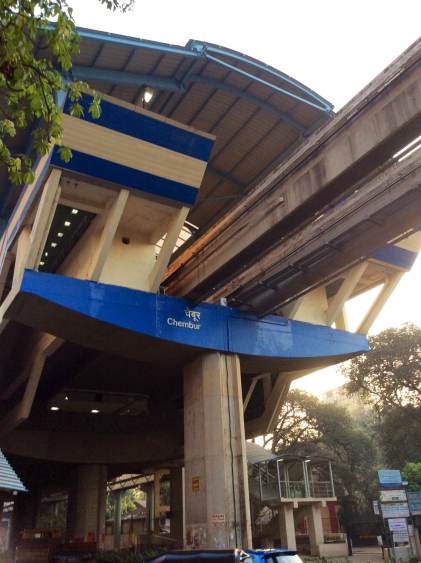
And then on 11 March 2014, I read a newspaper report that claimed that the Mumbai Monorail ridership had fallen to 92,771 per week. This meant that only regular commuters were using the Monorail now, except perhaps on weekends when people still came out to “check out” the Monorail. So, two days later and at 7.30 in the morning, I was standing outside the Chembur Monorail station and looking up in anticipation of the ride to follow. Join me as I take the ride to Wadala and back on the Monorail and check out its efficiency and efficacy.
Mumbai Monorail, Public Transport, Mumbai
The Chembur Monorail Station

Continue reading “The Mumbai Monorail ride”

The Mahim Fort

“And this is the view from the bedroom,” says Rama, throwing open the window and gesturing at me to look out. “It’s not the same as the view of the sea from the living room, but it’s lovely in the evenings, when the sun is setting and the whole place takes on a soft orange glow.”

Rama is a friend (and also a fellow travel blogger) who has just shifted to Mumbai from Delhi, and she is giving me a tour of her apartment on the 15th floor of a building in Bandra, and also the accompanying views from the various windows.

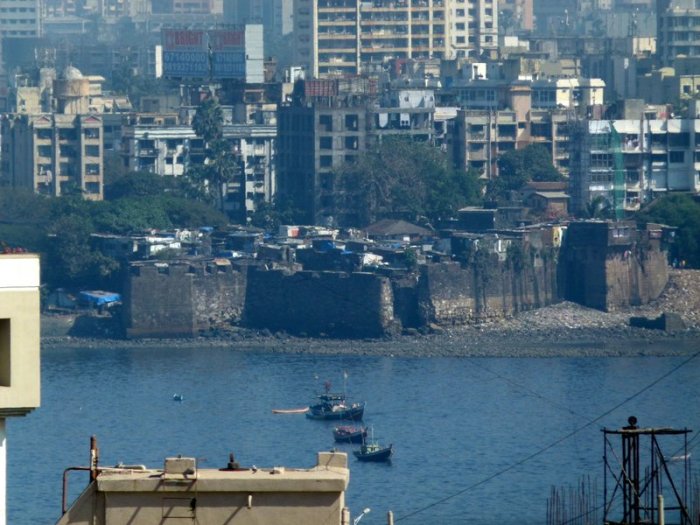
“Hmm…,” I reply, as I look at the view. The sun is a long way from setting and the light is quite harsh on the buildings, slums, the Mahim bay, and… then, something else. Something I had not expected to see. Was it what I thought it was?

“My camera ! I need my camera. Where’s my bag?” I rushed to the living room to retrieve my bag.

“Why? What happened?”, asked Rama in a slightly alarmed voice. “What is it?”

“Wait. I’ll show you,” I said as I switched on my camera and zoomed in to show her this.

Mahim Fort, Mahim Bay, Mumbai, 7 forts of Mumbai

“Rama,” I announced rather grandly, “meet Mahim Fort, one of the 8 existing forts of Mumbai.”

Continue reading “The Mahim Fort”

Harbour, docks & lighthouses: Re-discovering Mumbai

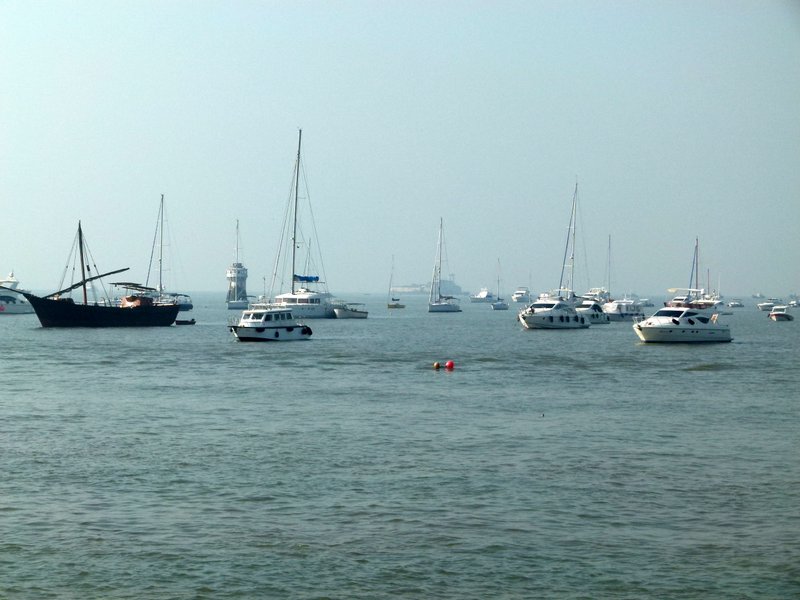
It is only 9.30 am, but the sun is quite intense and if not for the sea breeze would have been quite unbearable. I am on the upper deck of a launch berthed at the Gateway of India in Mumbai trying to peer through a haze that has dulled the shimmer and sparkle of  sunlight on water. In front of me, and as far as the haze-driven visibility allows, are ferries, fishing boats, luxury yachts, launches, security vessels… The sea looks like one big parking lot. 🙂

Mumbai Port and Harbour Tour, KGAF, Mumbai Harbour
The parking lot in the sea.

On board the launch, my co-passengers indulge in some gentle jostling for prime spots to photograph, discuss whether the haze would play spoil sport for photography, and generally chat about what is it that we are likely to see in the next couple of hours. As we wait for the launch to leave the jetty, anticipation for the upcoming trip grows. An anticipation for the first of its kind tour of Mumbai’s Port and Harbour organised by the Kala Ghoda Arts Festival 2014, in association with the Mumbai Port Trust (MbPT).

Mumbai Port and Harbour Tour, KGAF, Gateway of India, Taj Intercontinental, Taj Palace Hotel

Our tour guide is Dilip Vishwanathan from the MbPT and his narrative takes us through the pre-maritime history of Mumbai, its natural harbour, the seven original islands of Mumbai, the coming of the Portuguese, then the English and the East India Company, construction of the docks, and present day Mumbai Port and Harbour. Mumbai’s natural harbour and port was known to seafarers and traders from as early as eighth century BC or even before. Though it wouldn’t have looked like the view in the photo above to them !

Though I am familiar with some part of the history, it is always nice to hear it from someone else’s perspective. As the tour guide outlines the route for the trip, I am excited to find that we will be passing through areas that are out-of-bounds to the public.

Join me aboard the launch for this tour. I must confess that it is going to be a long one that will take you Mumbai’s maritime history and my own memories.

Continue reading “Harbour, docks & lighthouses: Re-discovering Mumbai”

The Jewish heritage of Mumbai

Somewhere in Basra, c. 1831

The room was dark and the only light, feeble as it was, came from a flickering oil lamp placed in a corner of the room. But it was enough for the fortune-teller to recognise the man being ushered in by his son.

“Salaam, Master,” the fortune-teller greeted the robed man.

You know who I am, ” the robed man said. It was a statement and not a question.

“Who doesn’t know you, Master?” said the fortune-teller. “Everyone knows you and about you.”

“Then you also know why I have come here.”

“I can guess, Master,” the fortune-teller bowed.

“I have no choice but to leave this region. Where should I go? London? China? Where does my future lie?”

The fortune-teller was silent for a long time. Just when the man was about to ask him again, the fortune-teller said.

“Your should leave immediately for Bombay in Al-Hind [Arabic for India]. A bright future and fortune lies awaits you there.”

The robed man was surprised with the response, but he knew better than to ignore the fortune teller’s advice. After paying him handsomely and thanking him, the robed man left. His mind was already planning for the move to Bombay.

And sometime later in 1832, the man arrived in Bombay and over the next 32 years made a phenomenal contribution to the city that Bombay was developing into. That man was David Sassoon

Continue reading “The Jewish heritage of Mumbai”

The SoBo art trail: Exploring Mumbai’s art district

It never ceases to amaze me how much I unconsciously internalise popular perceptions without even realising it. Take for instance, Mumbai’s art scene.

Till about 3 weeks back, if somebody had asked me about Mumbai’s art scene, I would have said how it was not very vibrant, unlike Delhi. Or Bangalore. Or Chennai. I might have cited the absence of good art galleries, beyond the couple of famous ones that I knew. I  would have also said something about the Kala Ghoda Arts Festival, and then probably ended by mumbling something about not knowing much about my city’s artscape.

All I can say of the above para is that only the last line is correct — I really don’t know anything about my city’s art scene. As for the rest, I was only repeating the general impression about Mumbai’s art scene based on what I read and discussions with like-minded people.

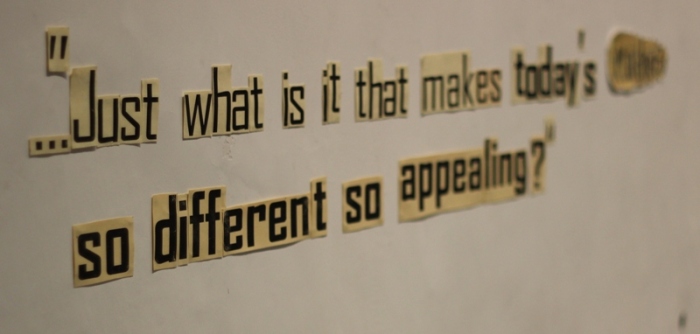
I realised how misplaced my knowledge was when I received an invitation from Pia of Good Homes India to participate in a blogger art trail (essentially a guided tour of 5 of South Bombay’s prominent art galleries) as part of their Public Art Week initiative. The invite was intriguing enough, but what caught my attention were these lines:

The galleries we are looking at covering are Gallery7, Sakshi art gallery, Gallery Maskara, 1/29 Studio Gallery and Art Musings. The mix is interesting and so is the art.

With the exception of Sakshi Gallery (which I had never been to), I hadn’t even heard of the other art galleries. And to think all these galleries were concentrated in South Bombay (SoBo), also known as the city’s art district. This I had to see for myself !

I had no hesitation in accepting the invitation even though it was at such short notice necessitating taking half-a-day off from work. So, on November 28th, a mixed group of 10 odd design, food, art and travel bloggers gathered at The Pantry for high tea before setting out on the art trail.

Art Trail, Gallery Maskara, Mumbai

Continue reading “The SoBo art trail: Exploring Mumbai’s art district”

The Elephant of Elephanta

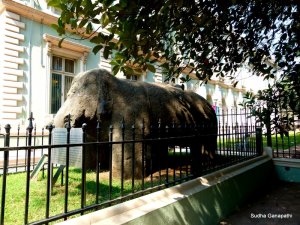
Elephanta Elephant, Mumbai, Bhau Daji Lad MuseumIn a fenced enclosure outside the Dr. Bhau Daji Lad Mumbai City Museum (formerly known as Victoria & Albert Museum) at the Jijamata Udyaan (formerly known as Victoria Garden) in Mumbai, is an Elephant. Not a flesh and blood elephant, mind you, but a stone elephant with a long and interesting history to share.

Carved in the 6th century from a single piece of rock at one of the many entrances to the island known as Gharpuri, the Elephant saw many a king come and go for over a 1000 years. Then one day, in early 16th century, the Elephant saw the first European colonisers — the Portuguese — to the region. The Portuguese were so awed by him that they promptly named the Gharpuri after him — the Elephanta Island, a name it has been known as since then.

When the Portuguese relinquished their rights over the region to the British 150 years later, the Elephant was witness to this as well. The new colonisers were also impressed and awed with him. In fact, the English were so impressed with the Elephant, that they wanted to take him home to England. But this was no easy task and it took them nearly 200 years to put their wish in action.

On a sunny day in 1864, a crane was brought to the Island to lift the Elephant from his rocky home and transport him to ship that would then take him to a new home at a museum in England. This was no easy task and the local people and the English Officers directing this operation watched with bated breath as the crane huffed and puffed, and finally managed to lift the Elephant.

And as the arm of the crane swung around with its elephantine cargo, disaster struck. The crane snapped sending the Elephant crashing down and breaking him into pieces.

Continue reading “The Elephant of Elephanta”