It’s quite amazing, you know, of the things one notices, but does not really see. Take for instance the subject of this post. I must have passed it a countless number of times, glancing at it idly but mostly ignoring it. You might have noticed it too, if you are travelling on the Lalbaug flyover towards Byculla, which looms up about 100 metres before the exit on your left.
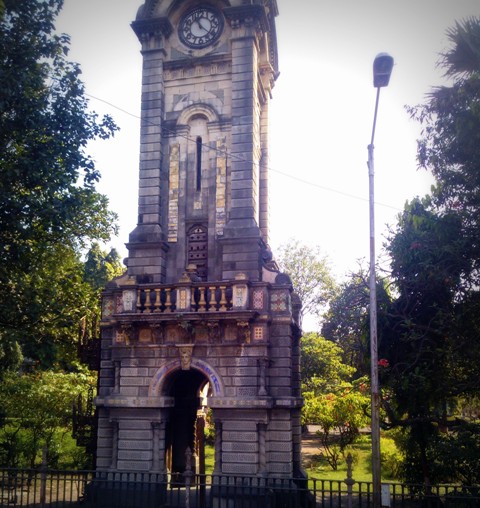
That day, when I was passing by this structure I felt I was seeing it for the first time. And indeed I was for the slender and elegant clock tower glowed in the mid-morning winter sun in spite of the very obvious look of neglect that it had and stones blackened due to pollution.
The Clock Tower at the entrance to Jijamata Udyan and photographed from the Lalbagh flyover
Situated at the entrance to the Jijamata Udyan (formerly known as Victoria Gardens and also known as Rani Baug) and among trees, this beautiful clock just begs to be explored. When I attempted to do just that, I found that it is closed to the public with a several “Keep Out” signs placed all around. There is no information board on the clock tower and I had to be content walking around the barrier erected and look at the details through my camera lens. And what did I find? Continue reading “The clock tower at Jijamata Udyan”→
I love museums, and I can spend hours inside them pottering about and looking at their varied collections. And yet strangely, for some inexplicable reason, I have never really explored the museums in my city of Mumbai. Of course, I have visited them as a child but not really visited them, if you know what I mean.
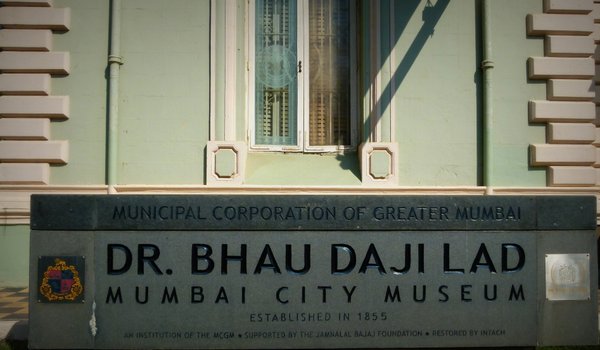
So one rainy day in August last year, I took the afternoon off from work to see the Bhau Daji Lad Mumbai City Museum (BDLM). This was a museum that I had never visited, but one that I had heard about a lot from Appa. I went without a camera as I automatically assumed that, like most Indian museums, photography was not allowed. Big mistake. Non-flash photography was allowed in the Museum, though they don’t really advertise the fact.
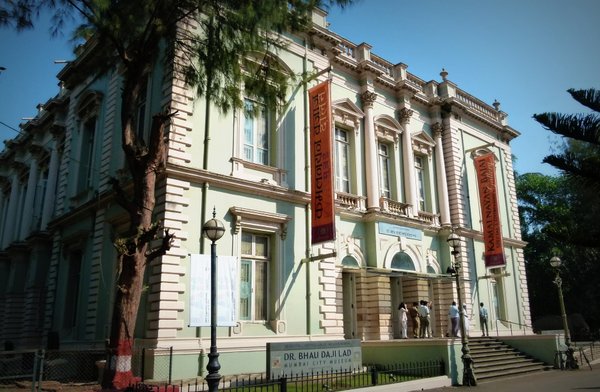
The dazzling 3-hour BDLM visit was a visual treat all the way — right from the stately Museum building to its grand interiors (that reminded me of a ballroom) to its tastefully displayed collection — and one that stayed with me longer than the time I spent there. I knew that I didn’t just want to write about the BDLM’s artefacts in my Museum Treasure series, but write an entire post on the Museum itself. And since I wanted to include photographs, I had to wait for an opportunity to visit the BDLM once again. And last month, I got that chance and when the Museum opened it’s doors that Friday morning, I was the first to enter with a big smile and my camera. 🙂
The entrance to the Bhau Daji Lad Mumbai City Museum
It’s a beautiful Saturday morning in Mumbai and I am standing at the foot of the stairs leading up to the Sion Skywalk at the Sion Circle exit. The skywalk’s stairs are so close to the adjacent building that they appear to be an extension or appendage of the building itself! In fact, I can just lean over and tap on the windows from the stairs if I want to.
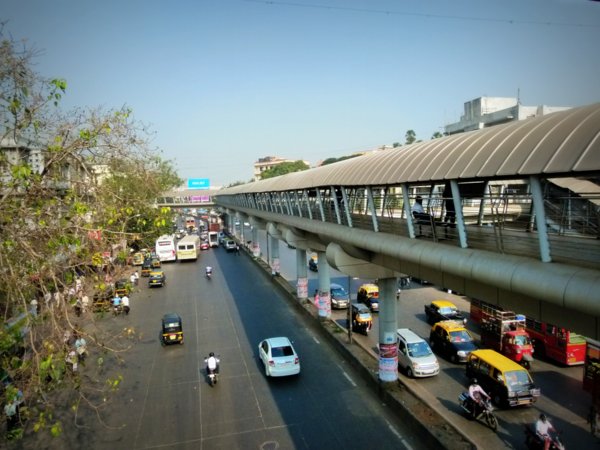
Once on the skywalk, I just take a moment to pause and look around. I like skywalks in general as I like the pleasurable feeling of being suspended in mid-air and watching the world go by. I also like the perspective that skywalks offer, almost like a bird’s-eye view. But the first thing I notice here is not the view, but the relentless noise — a combination of the roar of traffic and incessant honking. And this is a sound that threatens to bring on a headache at 9.30 am in the morning !Don’t be fooled by the almost empty road below the Sion Skywalk ! The traffic noise was unbearable
The Sion Skywalk, which stretches from Sion Circle to Sion Railway Station, is built at a major interchange, where traffic from Mumbai’s Western and Central suburbs meet. Inaugurated just over 2 years back, the Sion Skywalk is built in the shape of an exaggerated and a squiggly “Y” with 6 exits, of which one leads directly into the Our Lady of Good Counsel School (OLGCS). It was built keeping in mind the many schools, offices and commuters in the area and with the expectation that 50,000 commuters would use it everyday.
And does the Rs. 6 crore skywalk live up to that expectation? Let’s see…
“Lets go for a walk. You can see a different side of Mumbai that way,” I said to a friend who was visiting Mumbai from Delhi on work and wanted to experience the city in a zara hatke way.
“A walk? In Mumbai?,” she asked incredulously.
“Of course,” I replied.
She laughed herself silly over my suggestion and then asked, “But where is the space to walk in this city? And what about the weather, the crowds, the traffic, the pollution, etc.?”
“The weather is not too bad in Mumbai now. Besides, if we go for a walk on a Sunday, the crowds, the traffic and the pollution will be manageable,” I responded.
“Er… what is there to see in Mumbai, apart from the not-so-clean beaches, the Marine Drive, the Siddhi Vinayak Temple, the Haji Ali Dargah, and houses of film stars?” she asked a little too politely.
Since this was the first time that my friend was visiting Mumbai, and was only repeating what she had heard from others, I guess she could be forgiven. But still, it was a matter of pride for me to present my city to a visitor in a way that only an insider can. “You and I are going for a walk this Sunday. No ifs and buts or whats and wheres. No arguments. Meet me outside Platform 1 at CST station at 8.00 am. And try not to be late, will you?”
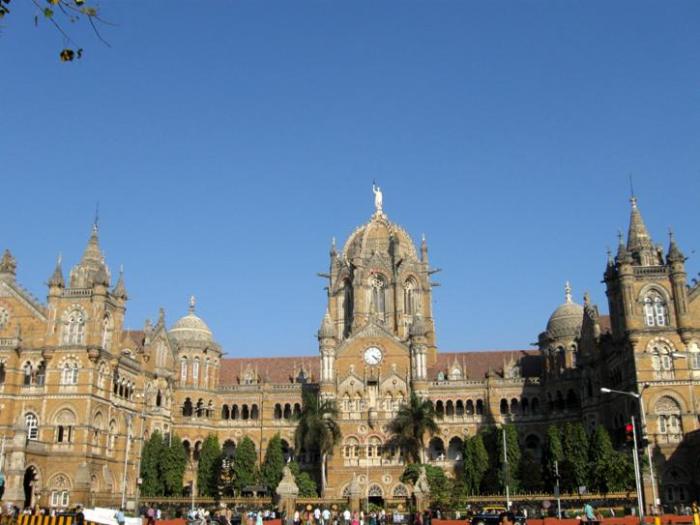
The front façade of the UNESCO World Heritage site and Central Railway Headquarters, Chhatrapati Shivaji Terminus
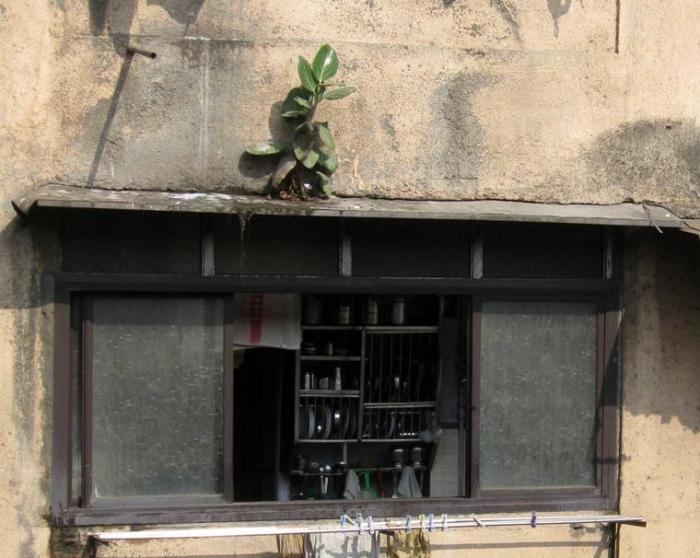
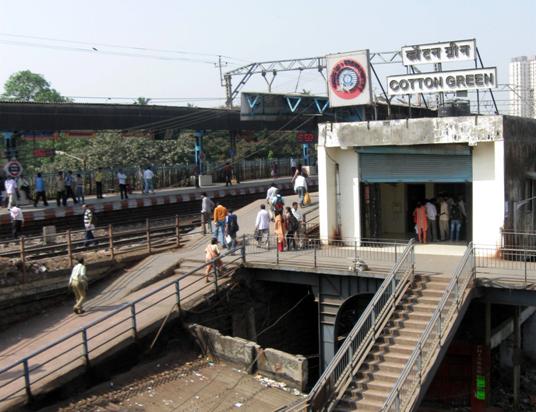
An article titled “Walking all over locals’ lives” in today’s The Times of India talks about how the construction of (some) skywalks in Mumbai has led to the loss of privacy for residents who live along the skywalks as passers-by on the skywalk can look into the houses level with the skywalk. My recent visit to the Cotton Green Skywalk underscores this observation. Take a look at the picture below.Looking in, not looking out
Now, the Cotton Green Skywalk does not really pass within handshaking distance of the houses like the ones mentioned in the article, but it is still uncomfortably close. Without any effort whatsoever, I was able to hear every cuss word hurled between two neighbours quarreling over something (over and above the traffic din); and saw a man tying his pajamas, and another one reading his morning newspaper. And no, tempting as it was, I didn’t photograph any of these. I felt guilty enough witnessing this!
Last Saturday I went skywalking at Cotton Green. Till very recently what I knew about Cotton Green could actually fall within the 140 characters of a Twitter update—it is an eastern suburb of Mumbai, a station on Central Railway’s suburban Harbour line, and home to the stunning art noveau Cotton Exchange Building, that I would always look out for whenever I crossed the station. That’s it. It was not really interesting enough to get off and go exploring.
“I couldn’t tear myself away from the image of the Maheshmurti. It was so beautiful. So mesmerising. Elephanta was so nice,” gushed Iskra, an exchange student from Bulgaria.
I listened to Iskra’s description of her visit to Elephanta Caves with part fascination and part envy. The reason? In spite of having lived in Mumbai for nearly 23 years, I had never been to the Elephanta Caves. Listening to Iskra, and that too a foreigner, rave about them needled me into resolving to visit the caves at the earliest opportunity.
And would you believe it? The opportunity presented itself to me the very next day, almost as if it was just waiting for me to make up my mind. My Facebook wall announced that Girls on the Go (GOTG), a women’s only travel club, was conducting a guided day trip to the Elephanta Caves on 13 March 2011. Would I be interested? Not one to let go of an opportunity like this, I signed up for the trip within seconds of seeing the intimation. 😀
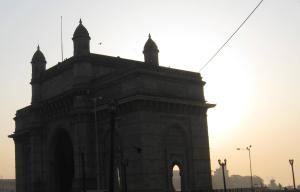
Gateway of India
So, on D-Day, I was at the Gateway of India much before the reporting time of 7.45 am. While waiting for Piya Bose, the founder of GOTG, and the rest of the group to assemble, I tried to recall what I knew about the Caves. They were … um… really old rock-cut caves, were located in Elephanta Island some distance away from Mumbai, could be accessed only by boat, and was a UNESCO World Heritage Site. In short, I knew nothing about the Caves. Of course, by the time the tour got over I was a little wiser thanks to Lakshmi Kishore, our guide, and a booklet on the Elephanta Caves that I purchased from the ticket office.
Elephanta Island has traces of habitation from 2nd century BC in the form of remains of a Buddhist stupa, reportedly built by Emperor Ashoka himself. But what the Island is really famous for are 7 rock-cut caves, whose age is not well established due to absence of written records. Various theories exist as to the age of the caves as well as to who built them, and according to the Archaeological Society of India’s (ASI) booklet, the caves were excavated during the middle of the 6th century, during the rule of the Konkan Mauryas.
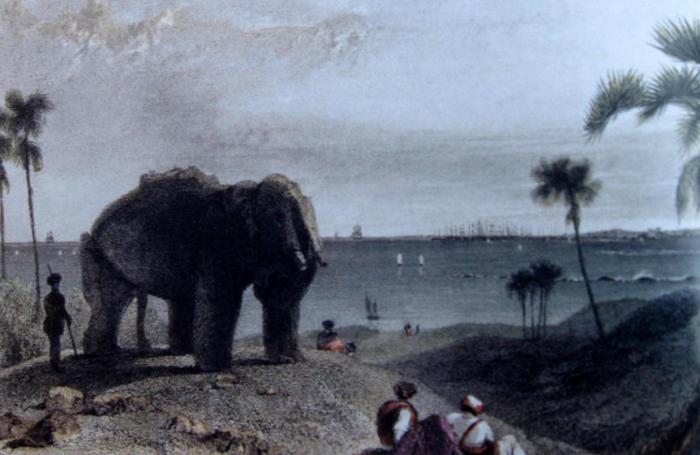
Locally, Elephanta Island is known as Gharpuri and is located about 11 km from Mumbai. It was called Elephanta by the Portuguese, who found a stone statue of an elephant at one of the entry points to the Island. Though they tried their best to destroy the statue, they only succeeded in severely damaging it and today the restored elephant is installed at the Bhau Daji Lad Museum in Mumbai.
Aquatint of the Stone Elephant by Thomas Daniell and William Daniell, 1786. Photo Courtesy: Elephanta by George Michell






 My Favourite Things