The perils of punctuality

Punctuality is often considered to be a virtue. But in my experience, punctuality has been a curse and a bane, as I belong to that category of people who are punctual by nature. Though I am pretty easy-going about many things, punctuality is not one of them. Add to this the general Indian concept of Indian Stretchable Standard Time and I have a ready-made recipe for palpitations.
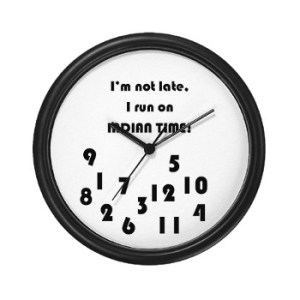
Image Source: http://www.blog.offshoring.se

It begins simply enough. Let’s say, I am meeting a friend at a pre-decided venue at 5.30 pm. I am at the venue by 5.15 pm. By 5.20 pm, I start looking out for my friend, even though there is still 10 minutes to rendezvous time. By 5.35 pm, I have worked myself into a frenzy of self-doubt—is this the correct place and time? By 5.45, I have doubts about the date and by 6.00 pm, I start having palpitations and wonder if there was even a meeting in the first place ! This is usually when the friend I am waiting arrives and says, ”Oh! Were you waiting for long? You poor thing. Come, let’s go and have something to eat. I’m starving.” There are a few variations to this theme, but this is how it happens most of the time. Without fail.

Continue reading “The perils of punctuality”

Conversations and encounters in a hospital

It is almost 7.00 pm when I enter the hospital. Appa (father) is in hospital once again (the third time in as many months) and I am hurrying to relieve my eldest brother who has done the “day shift”; I will be doing the “night shift”. The huge lobby is packed with people and the place actually looks and sounds like a railway station sans luggage. There is a group of about 30-40 people waiting to meet a patient and from their looks and body language, I presume that this is a happy occassion—probably the birth of a baby. The  harassed security guards are having a tough time turning away the rush of visitors as visiting hours are long over.

One of the security guards, who by now recognises me from my numerous visits to the hospital, mutters to me in an exasperated undertone, “Visitors!” I smile sympathetically at him, while recalling a conversation I had many years ago about hospitals and visitors.

“Madam, I want to leave early today.”

I look up from my work to see my department peon, Purushottam, standing at my desk.

“I have to go to the hospital, madam, ” he continues.

“Is everything all right?” I ask.

“I am fine. My cousin’s father-in-law’s sister’s husband has been admitted to the hospital and I have to go there.”

“Purushottam, the patient is not even related to you. Why do you want to go to the hospital? If it is that important, you could visit him once he has been discharged.”

Purushottam is shocked. “It doesn’t matter that the patient is not a close relative. He is from our biradari (clan), and everybody from our biradari will visit the hospital. If I don’t go, it will not be taken well. And anyway, I will also visit him after he is discharged.”

I change my tactic. “Won’t the patient need rest? He is hospitalised, after all, and with your entire biradari visiting, he’ll end up getting tired.”

“Oh I may not actually see him per se; I don’t even need to. I will meet his son or wife and give my best wishes for a speedy recovery. What is important is to show solidarity and support at this time.”

Continue reading “Conversations and encounters in a hospital”

Steps and stairs

I have to admit that when I held a camera in my hands for the first time in the summer of 1992, it wasn’t an earth-shattering moment. In fact, it felt very awkward to hold one. At that time, if I didn’t need one for my dissertation, I would probably never have picked up a camera. It was only later, in 2008, when I got a digital camera, that I really got interested in photography. A digital camera gave me the chance to experiment.

Within a month of sharing the first results of my experiments with a digital camera with friends and family, the feedback started rolling in. Predictably, some of it had to do with the quality of my photographs and suggestions for improving the same. But most of the feedback was on the choice of the subject of my photographs. Till the feedback came in, I did not even realise that the subject of most of my photographs were that inanimate objects like doorscars, stations, public transport, etc.

I periodically try to make sense of the vast collection of photographs that I have by ordering them into collections. Not only does this help in streamlining my photo library, it is also a great stress buster. This time around, I was able to identify and tag a trend of photographing steps, stairs and escalators. Presenting some of the interesting ones from my collection 😀

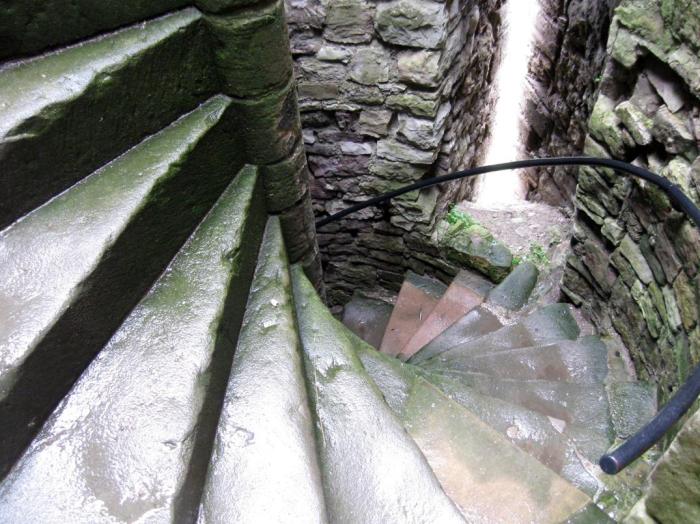
Chepstow Castle

Continue reading “Steps and stairs”

Loss of privacy vs. Loss of dignity

Till about a few years back, we did not have any domestic help at home—either full-time or part-time. It was not because we could not afford one; on the contrary, it was because my mother, who is an intensely private person, could not bear to have any help afoot at home. She abhorred the inevitable gossip that came as a package deal with the domestic helps. We once had a domestic help called Kashibai, who would step into our house and start off on the goings on in the other houses she worked in. Even if we told her that we did not want to hear about the affairs of other houses, she would continue with absolute relish. We were quite sure when she worked in the other houses, she would be speaking about the goings on in our house !

Image Source: http://crnano.typepad.com

All this led to Amma preferring not to have any domestic help and do all the household work herself. The rest of us would pitch in whenever she let us help her. But with advancing age, this state of affairs could not go on for ever and about 8 years ago, Amma finally agreed to have someone to clean the floors. Then, about 2 years back, she agreed to appoint someone to clean our windows, and recently, she agreed to have part-time help in the kitchen. Each appointment was made after battles galore with Amma, where I simply wore her down with my nagging. Today, Amma has learnt to just about tolerate this intrusion into her privacy for the little time that the domestic helps are there in our house every day. Then about 2 months back something happened that upset this little equilibrium of having part-time domestic help at home.

Continue reading “Loss of privacy vs. Loss of dignity”

From B&W to 3D colour

This post won an IndiSurprize at the HP Take Flight with Colour Contest

Source: Microsoft Cliparts

Imagination is such a wonderful thing isn’t it? We all use it in our own unique ways. I use most of mine to give colour, form and shape to characters, places, and scenes described in books.

I was very fortunate to be smothered surrounded by all sorts of books growing up (and I still am—that is, both growing up and surrounded by books ;-)), which gave ample scope for my imagination. Even today, whenever I read something—even something as dry as a research paper that I am copy-editing—the B&W words on the paper immediately transform into an image matching the description, but shaped my imagination. This whole process is so instinctive and automatic that all I have to do is to pick up something and start reading for the B&W words to coalesce in my mind to form 3D images in full colour. This image could be static or moving; as I continue reading, the images flicker, change, or transform keeping pace with the narrative.

I find it easier to conjure up images of some words and narratives than others. Predictably, familiar contexts and settings, particularly those that I have experienced, are easy to imagine and visualise, but unfamiliar ones present a challenge. But, hey, that’s what a colourful imagination is for, right?

Continue reading “From B&W to 3D colour”

RTE: Right to Education, Elitism or Exclusion?

Maha delay in notifying RTE Rules: State’s Slowness Has Ensured That Destitute Kids Won’t Get Admission In Pvt Schools This Year.

This was the headline of an article in the Times of India of June 13, 2011, the day all the State Board schools in Maharashtra re-opened. According to the article, along with  15 other states and union territories of India, Maharashtra had yet to notify the norms of the Right of children to free and compulsory Education Act (RTE), 2009. The RTE Act, which came into operation on April 1, 2010, has the same legal status as other rights enshrined in the Indian Constitution. Two of the defining rules of the Act say that (i) every child from 6 to 14 years of age has the right to free and compulsory education in a neighbourhood school, and that (ii) private schools must take in 25% of their class strength from “weaker sections and disadvantaged groups”, who will be sponsored by the government.

The RTE is a much discussed Act with its share of supporters and critics; one can find many critiques of the Act—you can read an excellent one by Parth Shah here and this blog that is entirely devoted to the RTE. Most of the critiques that I have come across discuss the lack of clarity (particularly with regard to the economics involved) in the rules of the Act as well as its implementation. In an article in Mint Lounge on how an English-medium education is a way out of life in the slums for many, Aakar Patel weaves in how the RTE Act could be used to achieve this goal. He also discusses as well as the possible hurdles in achieving it—hurdles that are not just economic, but social, i.e. those related to caste, class, etc.

In my opinion, the RTE Act is noble and idealistic in intent, but completely un-implementable in letter and spirit. Like Aakar Patel, I too believe that the reasons are not economic, but social due to the class-ridden and casteist nature of our society—a society that very clearly propagates differentiation of an “us” and “them” at every level. I draw from my experience to support this opinion. Let me elaborate.

Continue reading “RTE: Right to Education, Elitism or Exclusion?”