100 kilometres from Mumbai

Have you heard of a place called Nevrepada?

Chances are that you haven’t. Even I hadn’t heard of this place till I visited it about a month back. A visit that I think about even today, a visit that opened my eyes to realities I had only read about in newspapers or seen on TV. It is a visit I invite you to join me in as I write this post.

Nevrepada is a hamlet near Aghai Village in  Shahapur Taluka, Thane District, about a 100-odd kilometres from Mumbai. We drive down the Mumbai-Nashik Road and when we cross the dusty town of Shahapur, there is an underpass which takes us to Atgaon Station on the Mumbai-Kasara line. As we drive by Atgaon station, we see—with part horror and part bemusement—Tata Sumos, Traxs’ and an assortment of four wheelers stuffed with people outside the station. In addition to the people sitting inside the vehicles, some are seated on the luggage rack above these vehicles, while some are perched on the side ledge, calmly hanging on to the windows for dear life. That’s when we realise that these vehicles are probably the only mode of transport in the area.
Forest land

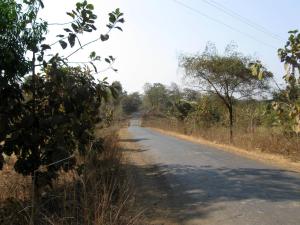
Driving on, we soon pass a board announcing that we are on the forest department’s land. The dried up brown earth sprouting dried up brown trees and shrubs is a forest? Is an occasional green tree enough for the area to be called a forest? If such a term as an arid forest exists, then this is the perfect illustration of that term.

We look around bleakly at the various shades of brown, hoping for some change in the landscape. This comes in the form of an ugly square building with an entrance board announcing it to be a retreat for some religious organisation. We pass more such plots earmarked for other religious organisations. Construction on forest land, we ask aloud? Would we soon be seeing other commercial establishments coming up here as well?

Continue reading “100 kilometres from Mumbai”

Learning Arabic

I love languages. I love everything about them—their sound, grammar, script, variations across regions, its provenance, accents, colloquial usage, swear words… everything (and no, SMS language is not included here!). It’s no surprise then that languages were my favourite subjects in school.

My fascination with languages continues even today long after I have finished school and college. But somehow I did not attempt to enroll for any language course, Indian or foreign, after my formal education. There were a couple of failed, informal attempts to learn Urdu, but they never really took off.

Arabic Calligraphy on an artefact in the Islāmic Room of the British Museum in London

Around the time I started working, I got interested in calligraphy art and through that I got introduced to the beautiful Arabic script. Its flowing script, the fluid patterns it made, not to mention that it was written from right to left only fuelled my fascination for and the desire to learn the language. My attempts at trying to find an Arabic teacher in Mumbai were not really successful, in the sense that I did find teachers willing to teach me Classical Arabic (which would have helped me read the Qur’an), but not Standard Arabic (that is everyday Arabic), which is what I wanted to learn.

Then one day, in August 2008, the opportunity to learn Arabic literally arrived at my doorstep, or to be more specific in my inbox. I won a scholarship to do a Master’s programme in a London-based university. Among the various information packs that I was bombarded with received from the university, before I left for London in September 2008, was one on studying a foreign language there. And guess, which was one of the languages being offered? ARABIC:-)

After I had registered for the Arabic language course and on the eve of my first class, the long-awaited anticipation of learning Arabic wavered due to some serious doubts about my own ability and expectations. Learning a language as a child and learning it as an adult are two entirely different processes. Would I be able to manage? Would I have a good teacher? Would I enjoy learning Arabic? What if I hated it?…

Continue reading “Learning Arabic”

India’s Republic Day celebrations: Time for a change

Another Republic Day has come and gone. India’s 62nd, to be precise. This one has been no different from its previous ones, at least the ones I have been observing for the last 25 years or so. For example,

  • The run-up to the Republic Day saw the print and electronic media competing with each other in reporting the achievements of the country.
  • There were interviews with key armed forces personnel, academicians, ministers, investors, NRIs, and other stakeholders for a “holistic” view of India.
  • There were interviews with the kin of freedom fighters (there aren’t any freedom fighters left now, I guess) in the media. A couple of interviews with retired armed forces personnel were also thrown in for a little variety.
  • The President’s speech (yawnnn…) was boring as usual and had nothing inspiring in it.
  • The Republic Day parade was beamed live on Doordarshan, the national television.

I think that even for those who did not watch the parade (either in New Delhi or the live telecast), like me, could imagine what it would have been like. This is because the parade has been following a set pattern year after year and does not deviate from it for even an inch.

So I knew that there would be an impressive display of India’s military might through its arms and ammunition, various regiments and divisions of the armed forces, the BSF camels, the CRPF, the Coast Guard, etc. Then there would be tableaux from the states and union territories of India, as well as performances by school children and folk dancers.

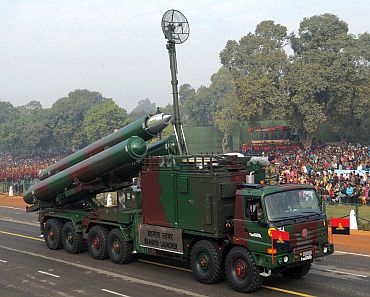
The evening news on TV and the Republic Day coverage on various news websites confirmed that my visualisation of India’s 62nd Republic Day celebrations was spot on. Some images from this year’s Republic Day parade at New Delhi are presented below (all images are courtesy of www.rediff.com).

Brahmos Missile Launcher

Continue reading “India’s Republic Day celebrations: Time for a change”

Nostalgia time: The 2011 ISH alumni reunion in Mumbai

I have always wondered about alumni reunions, you know. Particularly since I have never attended one in spite of having studied in 8 schools, one college, and two universities. To be honest, I have never felt the need to as I have been in touch with special friends from school/college/university. Besides, I have found many of my batchmates over the years, courtesy Facebook.

At least that is what I told myself. Whenever I heard people talking about attending read accounts of alumni meets, I always felt a twinge of envy.

I no longer feel that twinge as I finally attended my first alumni reunion the day before yesterday. It was not an alumni reunion of any of the schools/college/universities I have studied in; rather, it was of a place I had stayed in — the International Students House (ISH), London. The alumni reunion is special as ISH is probably the only organisation in the world, outside of an educational institution, to have an alumni association.

When I received the email invite a few weeks back, I instantly went into a rewind mode to the year spent at ISH in London.

Continue reading “Nostalgia time: The 2011 ISH alumni reunion in Mumbai”

Kahat Kabir suno bhai saadho …

Every Indian child, at least the ones who learn Hindi, knows about Kabir—the mystic poet, saint, and philosopher. Kabir ke dohe or Kabir’s couplets were a part of my school life too. Not only did I read his poetry in my Hindi textbooks, I was also exposed to his philosophy through the Government of India initiated “National Integration Campaign” during my school years in the eighties as Kabir’s philosophy and background—which appealed to Hindus, Muslims and Sikhs alike—made him the perfect symbol of national integration.

Kahat Kabir suno bhai saadho…, which appears like a signature line in most of Kabir’s compositions, was probably the most recognised phrase during my school days. Yet, once I left school, I also left Kabir behind. Over the years, I had fleeting encounters with Kabir through a occassional article in a newspaper or magazine or through snatches of a song heard on TV or the radio.

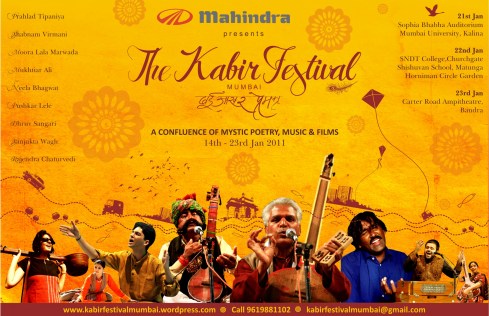
So, when I heard about the Kabir Festival being organised in Mumbai, I knew that this was a chance to renew my acquaintance with Kabir. According to the Festival’s twitter page, “The aim of The Kabir Festival Mumbai is to introduce Mumbai to the message of Kabir which is perhaps even more relevant today than it was in his time.” The Kabir Festival Mumbai is a “confluence of mystic poetry, music, dance and films”, with the main festival being held from 21–23 January, and the run-up events from 14–20 January 2011.

Continue reading “Kahat Kabir suno bhai saadho …”

The social movements calendar 2011

Yesterday morning, when I came in to work, I found an over-sized grey envelope on my office desk with the words “Social Movements Calendar 2011” printed on it. Now, there was nothing unusual about receiving a calendar as my office receives quite a few calendars this time of the year. However, the calendars come rolled up and tied with a string and not enclosed in an envelope. Intrigued, I opened it immediately.

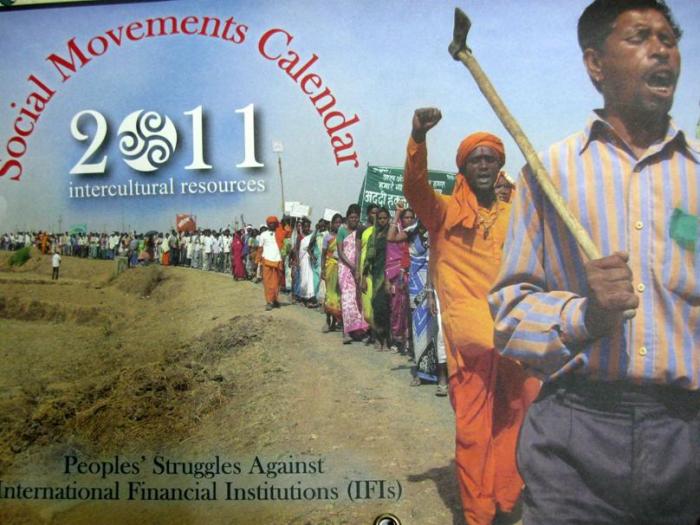
The cover of the Social Movements Calendar 2001

 The Social Movements Calendar (SMC) 2011 is a themed calendar on “peoples’ struggles against international financial institutions(IFIs)”. Right from the cover (see photo above), which is a rally of protesters against land acquisition for mining in Jharkhand to the list of resources on this topic, each page of the calendar reflects the theme.

Continue reading “The social movements calendar 2011”