A competition, two surprises and a Sunday

Last Sunday, instead of waking up late and pottering about the house the whole day doing that and this, I did something different. I co-judged the city-level Classmate Ideas for India 2010 competition held in Mumbai.

An initiative of the ITC as part of its centenary celebrations, the Classmate Ideas for India 2010 competition has youth in the 14–21 years category present their ideas for the “betterment of India”. These ideas are in the fields of Science and Technology; Environment Protection; Education for All; Encouraging Social and Religious Tolerance; Infrastructure for a Better Tomorrow; and Emerging India.
The first round of the competition saw the competition receiving over 60,000 ideas from all over India. These ideas were then evaluated on the basis of originality, feasibility, practicality, and impact factor and then whittled down to 500 ideas equally divided over 10 cities and their surrounding regions. For example, the Mumbai Idea Presentation had entries from Maharashtra and Goa. Each city’s Idea Presentation would pick out a winner for the National Finals to be held later this year in December. The entire event is being managed by KrayOn, an event management company for kids and youth events. They were the ones who contacted me to judge the Mumbai event.

Continue reading “A competition, two surprises and a Sunday”

Happy Diwali

It’s the night before Diwali (sorry for the completely unoriginal beginning). It is 10.30 pm and I am at home savouring the calm after a week of hectic house cleaning and shopping and helping my mother make some sweets and savouries.

The house is fragrant with the til (sesame) oil that my mother has just heated with some herbs and spices for the ritual oil bath tomorrow. The new clothes that my parents and I will be wearing tomorrow are stacked in a beautiful bronze tray for my father to hand out after the morning oil bath. The Diwali sweets (theratipal and okkarai) and the savouries (tenkozhal and cornflakes chivda) are also laid out with the leghiyam, a spicy ginger preparation, which is supposed to be a cure against the effects of gluttony that one normally indulges in during Diwali. The rice kolam has been drawn at the entrance to our house, and the clay diyas have been lit and all is well with the world. Well almost. This is the calm before the storm—the storm of firecrackers.

To most Indians, Deepavali or Diwali is not about new clothes, an endless orgy of eating, holidays, and gifts—it is about bursting firecrackers, and the louder they are the better it is. And this is the reason why I hate dislike Diwali so much. I am petrified of firecrackers.

I recall some Diwalis spent crying non-stop and other Diwalis trying to cope and manage with a brave face. As I grew older, the crying bouts gave way to sullen anger and sulking episodes during Diwali. I must admit here that this is something that I have not got over completely, even today.

Like every year, this year too, I have made a conscious effort to not let the firecrackers get to me. It hasn’t been smooth sailing though—a sudden burst of crackers at the market place, where I was buying vegetables yesterday, almost had me bursting into tears. The children in my building, who have been busy with their bagfuls of firecrackers throughout the day today have also severely tested my resolve.

Continue reading “Happy Diwali”

Stories from my home – 1: Meenakshi’s lamp


We don’t always have to travel to seek stories; they are right there in our homes too. In “Stories From My Home“, I examine the many objects surrounding me at home and attempt to document and share the memories associated with them, one story at a time. 


When a Tamil Iyer girl gets married, she is given brass and silver lamps, or vilakku as they are known in Tamil, to aid her in the many rituals and ceremonies associated with her being an Iyer wife, an Iyer daughter-in-law, etc. It is a tradition that is followed even today by many Iyer families, the community that I belong to.

When my paternal grandmother Meenakshi N (1910–1989) got married in 1922, she too was given her own brass and silver vilakku. Among the 6–7 vilakku given to her, is the one featured here in this blog post. Nearly 3 feet tall, this bronze vilakku was not bought off the racks in a store, but was specially commissioned and made at her house. That is, the lamp-maker came to Meenakshi N’s father’s house with his implements and made it as per the specifications given to him.

My mind still boggles at how this must have been done and the preparation that would have gone into making the vilakku. To begin with, an auspicious day and time would have been set after consulting the panchangam or the almanac. A coconut would have been broken before the start of the lamp-making process, prayers offered… As for the lamp-making process itself, I wouldn’t even know where to start imagining!

Meenakshi’s Lamp

Continue reading “Stories from my home – 1: Meenakshi’s lamp”

Happy Independence Day!

It is not often that one gets to hear or see one’s favourite singers singing together or sharing space in a single frame. But then I came across this version of Vande Mataram rendered by four of my favourite singers—Sanjay Subrahmanyan, S Soumya, P Unnikrishnan and Bombay Jayashri. And what better occasion than India’s Independence Day on 15th August, to share it with you.

Happy Independence Day, India !

A walk of faith: Palkhi

I wonder about the concept of “faith” sometimes. Faith in a belief, faith in a religion, faith in people, faith in relationships, faith in God… Faith. An abstract, nebulous concept for some; yet, a strong, clear path for others.

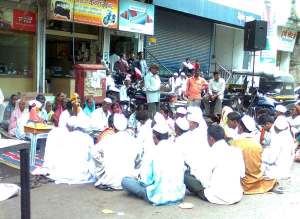
My faith in the concept of  faith was tested during my recent trip to Pune, when the annual Palkhi Festival of Sant Tukaram and Sant Dnyaneshwar passed through the city on 5-6 July 2010. The palkhi or palanquin of Sant Dnyaneshwar carries his footwear on a silver bullock cart; I am not sure what the palkhi of Sant Tukaram carries.

A group of varkaris singing abhangs (devotional songs) around an idol of Sant Dnyaneshwar

According to the Maharashtra Tourism website, the Palkhi Festival is a 1,000 year old tradition where devotees/pilgrims, known as varkaris accompany the palkhis on foot to Pandharpur over 22 days in June (the Hindu month of Jyeshta)–July (the Hindu month of Ashada). The Palkhi Festival ends on Ashada Ekadashi.

Thousands of devotees make this annual trip every year. This year, the ToI has estimated that 3 lakh varkaris joined the 2010 Palkhi Festival. On the day the palkhis pass through Pune, roads get blocked, traffic diverted, and schools and colleges declare a holiday.

Continue reading “A walk of faith: Palkhi”

A Pune tradition

Each time I visit Pune, I follow a tradition. It begins with my boarding the 7.00 am Shivneri bus from Vashi highway at Navi Mumbai.

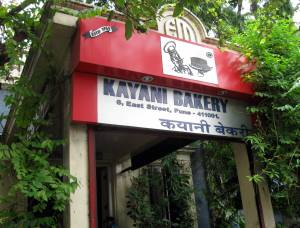
I reach Pune station by 10.00 am. Then I hop into an auto rickshaw and head straight to Kayani Bakery at East Street in the Camp area.

Kayani Bakery

I always enter Kayani with a prayer on my lips, and rightly so, as I have often had to go back empty-handed because their products have been sold out.

I love Kayani’s cakes (sponge cake, mawa cake), biscuits (Shrewsbury, ginger and wine), and bread and make sure to fill up my backpack.

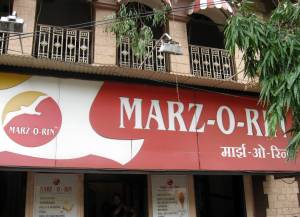
My next stop is Marz-o-Rin on Main Street or M.G. Road, a 5-minute walk from Kayani Bakery.

Marz-o-Rin Bakery

Continue reading “A Pune tradition”