Travel, travellers and travel blogging… Some thoughts

We live in a super-specialised world and the world of travel and travellers is no different. It’s not enough to just say that “I like to travel” or that “I am a traveller”. One has to qualify what kind of travel you like or what kind of traveller you are. You’d be considered boring otherwise !

Don’t believe me? Well then, just see some of the words I picked up from the Twitter and Facebook bios of travel bloggers on my TL, which describes the kind of travel they do or the type of travellers they are.

Solo. Couple. Family. LGBT. Gay. Luxury. Heritage. Road. Backpacker (you can add variations in spelling here like backpakker, bacpacker, bakpakker). Nomadic. Wandering. Itinerant. International. Different. Newly wed (I kid you not!). Budget. Flashback. Mountain. Himalayan. Beach. Food. Frugal. Happy-Go-Lucky. Culture. Nature. Environmental. Rural. Eco. Weekend. Slow. Lazy. Grumpy. Happy. Lost. Spiritual. Religious. Ethical. Independent (really wonder what this means). Immersive. Adventure. Long-term…

One would think that the “variety” in travel / travellers would have automatically translated into variety in travel writing or blogging as well. Surprisingly, I have found that this is not the case. Sure, a lot of destinations get written about, but they are usually in the form of listicles, guides, travel tips, sponsored articles or articles espousing the cause of a particular type of travel (read the above para for examples). First-person accounts of travel experiences — which in my opinion is what any travel writing/blogging should be about — are comparatively few.

And therein lies my problem with travel blogging. As someone who blogs about travel (among other things), I know how important it is to read well in order to write well. The operative word here is ‘to read well’. Unfortunately, more often that not, whenever I read a travel blog post, I’m left with a feeling of “this is not about travel / this is not what I want to read in a post on travel”.

Let me elaborate with some examples the reason I’m peeved with the state of travel writing / blogging today.

Continue reading “Travel, travellers and travel blogging… Some thoughts”

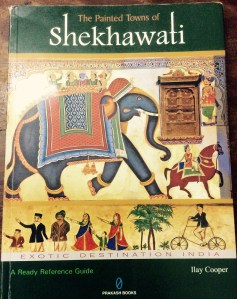
Book Review: The Painted Towns of Shekhawati

I am usually inspired to read about a place after a visit there; I have also been known to pick up something to read once I have decided to visit a place. As for packing my bags and heading to a destination after reading about it? Never, though I have added a destination to a mental list of places to visit.

Did I just say never? Actually, that has now changed to ‘just once’ when I visited the Shekhawati region in Rajasthan after reading a book about its painted havelis or mansions in January this year. The Painted Towns of Shekhawati by Ilay Cooper was a serendipitous find, and I want to first share how I found the book with you before telling you what the book is all about.

The Painted Towns of Shekhawati, Book Art Book, Ilay CooperIt was a rainy August day in 2014 and I was feeling quite sorry for myself at that time. All my travel plans were falling through for some reason or the other, which meant that I hadn’t travelled anywhere that year.
A casual twitter conversation with a friend on the Jaipur Literature Festival (JLF) got me thinking about attending the festival in 2015 and maybe combining it with some travel to places around Jaipur.

A simple Google search threw up Shekhawati as a possible place to visit. A little deeper search and book on The Painted Towns of Shekhawati popped up. Though I was aware of the painted havelis in Shekhawati, I was more than a little sketchy on the details. The book intrigued me enough to place an order and the book was in my hands a few days later.

The first thing I did after reading the book was to apply for leave at work, write out a tentative itinerary, and book the hotel and flight tickets (not necessarily in this order). Yes, I had decided to go to Shekhawati after reading the book.

So what was in the book that got me all set to travel to Shekhawati?

Continue reading “Book Review: The Painted Towns of Shekhawati”

When I got spooked by Kali !

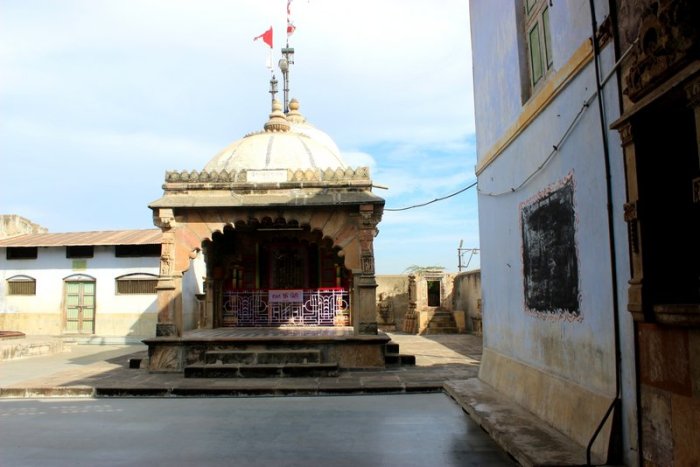
The door to the Amter Mata Temple opens noiselessly and I hesitate before stepping into a large courtyard. It is three in the afternoon on a windy day in December last year and the temple, which is in Vadnagar (Gujarat), is officially closed at that time. But the shopkeeper outside the temple urges me to go in saying that nobody would mind.

There is no one to be seen inside; I am not really surprised for it is siesta and relaxation time before the evening worship begins. As I look around, I feel an uneasy prickling sensation at the back of my neck — the kind when you feel that someone’s watching you. I look around but cannot see anyone or detect any movement.

I call out once and then again, but get no response. It appears that I’m alone in the temple. Or am I? The sensation of being watched grows and I feel that the gaze is hostile, angry, even malevolent.

I don’t scare easily, but I must confess that I’m feeling quite spooked. As I wonder if I should leave, I spot a large sculpture placed against the wall behind the main shrine at the far end of the temple. I can’t make out what the sculpture is, but something about it gives me the shivers. I decide to explore further and as I walk towards the sculpture I feel waves of anger wash over me.

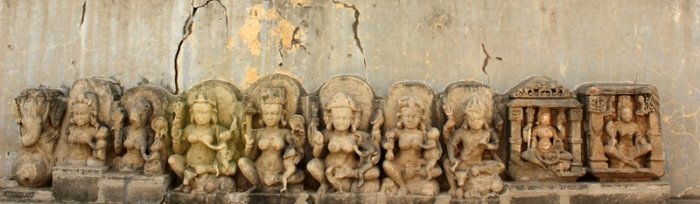
Kali idol, Amter Mata Temple, Vadnagar, Travel, Tantric
The courtyard of the Amter Mata Temple. The sculpture can be seen placed against the wall between the main shrine in the centre of the picture and the smaller shrine on the right.

Continue reading “When I got spooked by Kali !”

Vadnagar, Solanki Dynasty, City Gate, Gujarat, Amter Mata Temple

Discovering Vadnagar

I visited Vadnagar because of a photograph.

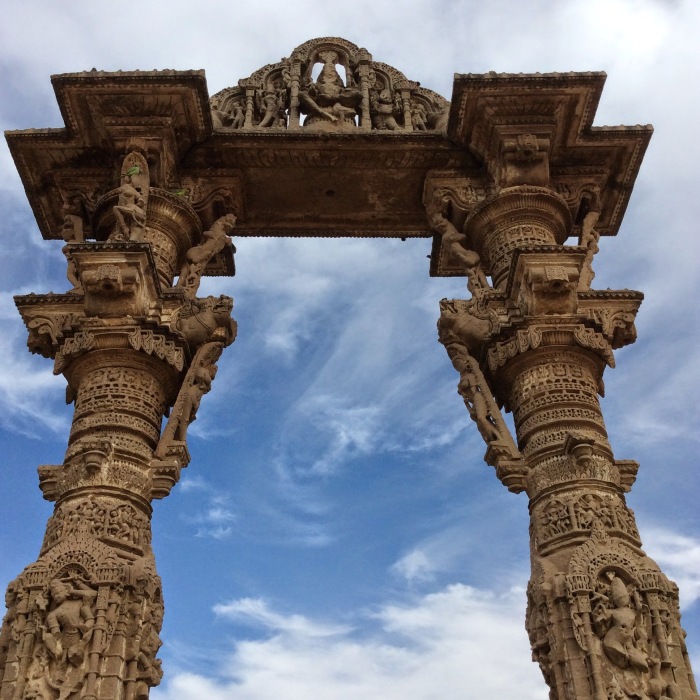
Yes, really. It was a random photograph that had popped up when I was browsing through an equally random photo-stream. The photograph was of a grand and towering toran or a decorative arch with the caption, “Kirti Toran, Vadnagar”.

My first reaction was where is Vadnagar? I mean, I knew that Vadnagar was in Gujarat and also that it was India’s Prime Minister Narendra Modi’s native town, but where was it? When a location search revealed that it was only about 40 km from Mehsana, I was stunned, for at that time, I was planning my North Gujarat trip in December 2014 at that time. And Mehsana was to be my base ! I took this happy coincidence as a sign that I needed to visit Vadnagar. 🙂

And visit I did, but without realising at that time that what I thought would be a quick trip to see the Kirti Torans would turn into something more. Vadnagar, Solanki Dynasty, Kirti Toran, Gujarat Continue reading “Discovering Vadnagar”

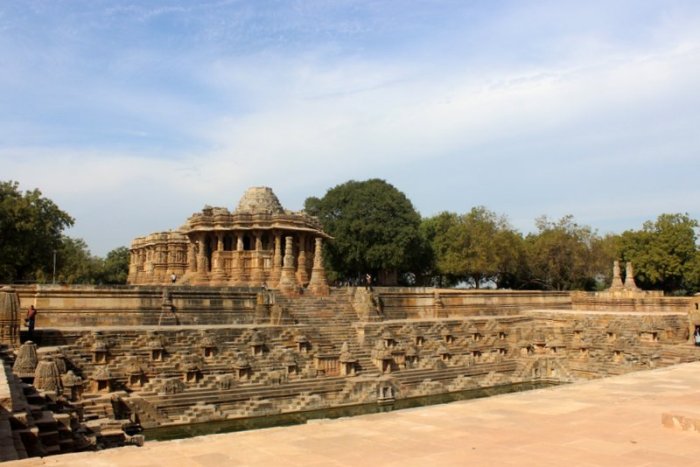
Modhera, Sun Temple, Bhimdev I, Solanki Dynasty, Surya Kund,

The Sun Temple of Modhera

I visited the Sun Temple at Modhera on the last day of my North Gujarat trip in December 2014. It was a much-anticipated visit and I had spent the weeks prior to the trip salivating over the many photographs available online. I was so excited at the prospect of finally visiting the Sun Temple that I was awake much before the morning alarm rang.

I wanted to be at the Sun Temple by 9 am, but both the checkout at the hotel and breakfast got delayed. By the time the shared private jeep from Mehsana dropped me off at Modhera village, it was 9.30 am. A helpful villager pointed the path that would lead me to the Sun Temple and 10 minutes later, I was at the ticket office queuing up to buy my tickets.

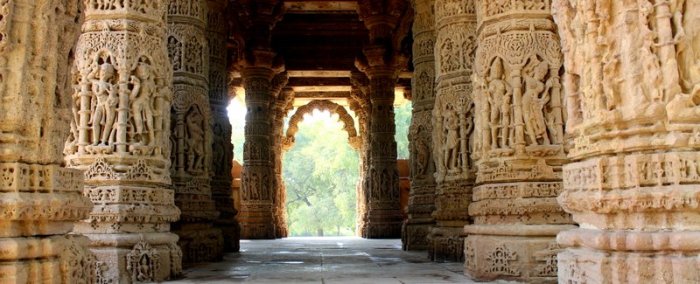
It seemed to be a busy day for there were quite a few international tourists already making their way out of the temple complex, while bus loads of school children were entering it. Once I bought my ticket and a booklet on the Sun Temple, I entered the complex where a path lad me through well-manicured lawns, a museum before the Sun Temple came into view with a large stepped tank before it. And my first thoughts were that all the photographs do not do justice to the monument. It is far bigger and grander and more magnificent, dear reader, and do keep that in mind as you read further !

Modhera, Sun Temple, Bhimdev I, Solanki Dynasty, Surya Kund,

Continue reading “The Sun Temple of Modhera”

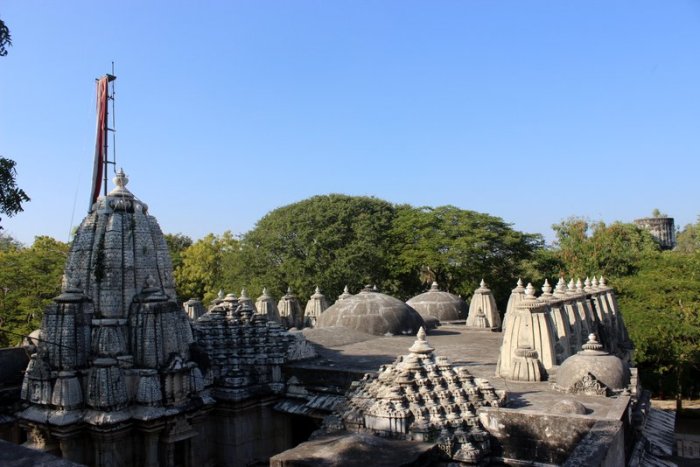
Ambaji, Kumbharia Jinalaya, Jain Temples, Gujarat, TRavel

The legends and temples of Ambaji

Ambaji is a temple town located in the Aravalli ranges of North Gujarat, just 10-15 km from the Rajasthan State border. The town gets its name from the Arasuri Ambaji Mata Temple or the Ambaji Temple, one of the 51 (or 52 or 64, depending on which list you follow) Shakti Peeths located in the sub-continent. The name ‘Arasur’ itself is derived from ‘aaras’, the local name for marble which is available in plenty. In fact, the ancient name for Ambaji was Arasan Nagar.

When I first put together a plan to visit North Gujarat in December 2014, Ambaji didn’t figure in the list. It was later, while checking road distances and connectivity between the various destinations that I intended to visit, that I discovered the fact that Ambaji was just 125 km from Mehsana, my base for the trip. Considering Gujarat’s excellent quality of roads, I knew that Ambaji could be visited as a day trip. And that’s exactly what I did.

Ambaji, Road Trip, Palanput to DantaIt was a cold and windy December morning when I set off from Mehsana at 8 am. Since there were no direct buses to Ambaji around the time I left I had to break journey at two places.
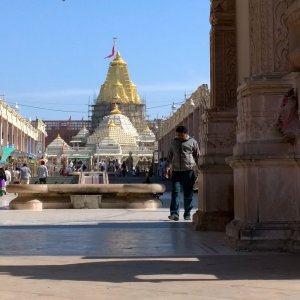
First, I took a shared private jeep to Palanpur, and then to Danta, and finally completed the last leg of my journey to Ambaji in a Gujarat State Transport bus. It was a picturesque journey throughout along tree-lined roads. The change in landscape from flat to hilly, as well as the climb from Danta to Ambaji was particularly enjoyable.

Amter Mata Temple, Ambaji, Gujarat, Travel, Shakti PeethIt was around 11 am when I got off the bus at the Ambaji bus stand and headed straight for the Ambaji temple. I didn’t have to ask for directions; all I had to do was to follow the people shouting Jai Mata Di. Within 10 minutes I was at the temple gates and could see its golden spire beyond the entrance arch.

Due to security reasons, visitors are not allowed to carry their bags or any electronic item into the temple and lockers are provided for storing bags and valuables. As the caretaker of the locker room stored my backpack in the locker and handed the keys to me, he casually said: “I think you should hurry up. The temple closes at 11.30.”

I looked at my watch. It was 11.20 am.

Continue reading “The legends and temples of Ambaji”