The Ellora Caves: A showcase for Indian sculptural art

You know what they say about saving the best for the last? Well, Ellora Caves doesn’t believe in that !

The first thing that visitors to Ellora Caves see on entering the complex is its most famous monument. It is the monument that writers have written paeans about, the monument that is a photographer’s delight, the monument that leaves visitors awestruck, and the monument that everyone knows as Kailasa Temple, but is officially known as Cave 16.

When I walked in after buying my entry ticket and saw the richly carved entrance to the cave, familiar from so many photographs, I actually rubbed my eyes in disbelief !
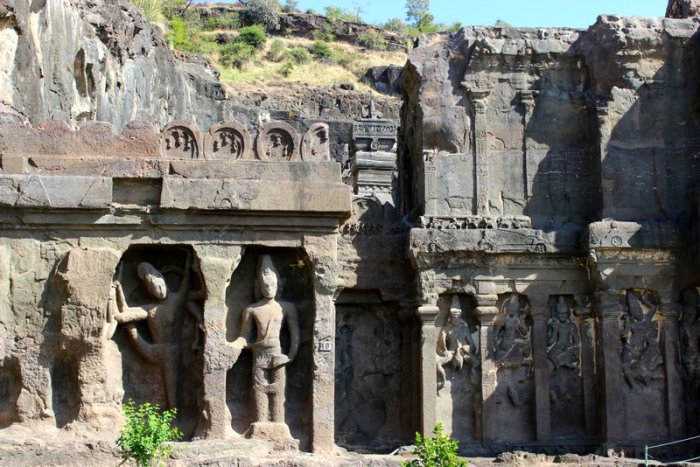
Ellora Caves, Sculptures, Indian Art, Aurangabad, UNESCO World Heritage Site
The entrance to the Kailasa Temple or Cave 16

My impulse was to explore Kailasa first, but better sense prevailed. Tempting as it was to explore Cave 16, I decided to begin with Cave 1, which was a short distance away. It turned out to be a good decision for if I had explored the Kailasa Temple first, I would probably not have seen any of the other 33 caves at Ellora!

Once again, as it happened at the Ajanta Caves and then at Daulatabad Fort, no guides were available when I arrived at the Ellora Caves at noon, one day in December 2013. There was also no literature on Ellora available at the ticket office. But, as I found out later, the information boards placed outside each cave provided adequate information.

Continue reading “The Ellora Caves: A showcase for Indian sculptural art”

The Fort at Daulatabad

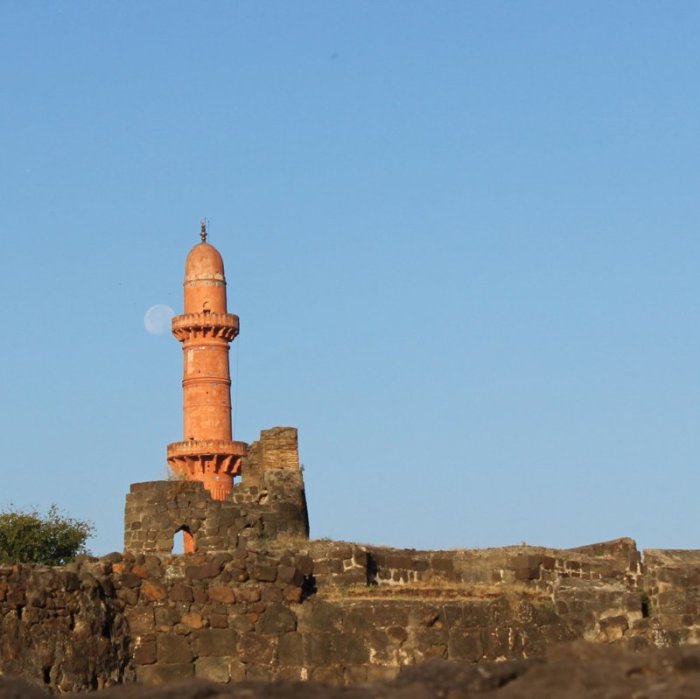
The first thing I noticed when I arrived at Daulatabad Fort that December morning in 2013 was this slender, terracotta pink minaret rising above the walls of the Fort. And a pale silhouette of the moon nestled next to it. Needless to say, it was quite a sight and one that I will never forget. It was only later that I found out how lucky I was to have seen both the moon and the minaret together, for the tower is called Chand Minar or moon tower.

Daulatabad Fort, Forts of Maharashtra, Chand Minar, Travel, Incredible India
The ‘chand’ and the minar 🙂

I had arrived early at Daulatabad Fort, so early that the only company I had for some time were the sweepers cleaning the Fort and some security guards. Even the guides were not there ! According to the ticket clerk, the guides were scheduled to arrive an hour later, just before the first busload of tourists were expected to descend upon the Fort. Therefore, in the absence of any guide or any available literature on the Fort at the ticket office, I relied on the couple of information boards put up at the Fort to guide me.

It was an interesting experience to just meander through the Fort at my pace and spend a wonderful morning at a place that has not got the attention it deserves. Continue reading “The Fort at Daulatabad”

Ajanta Caves: Where all the fine arts converge

The world-famous, rock-cut Ajanta Caves is one of those places where background reading or research doesn’t help. At least, it didn’t help me.

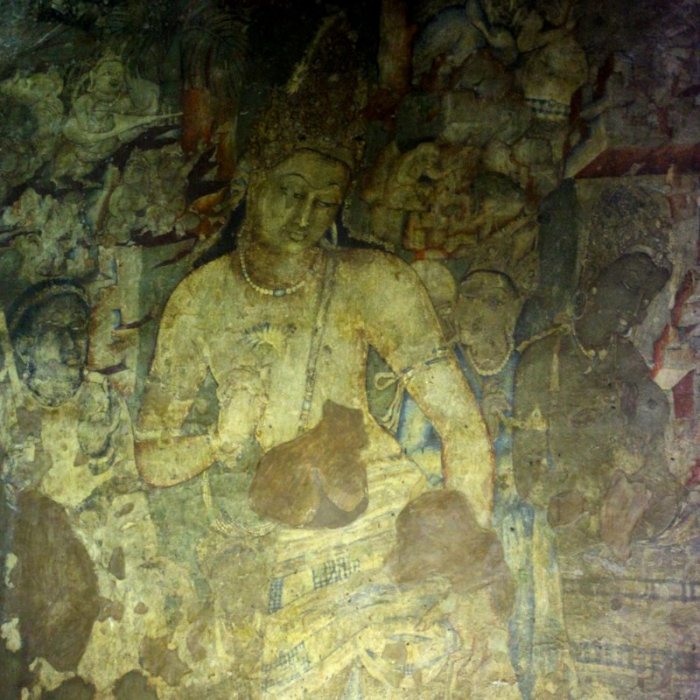
Prior to visiting the caves in December 2013, I had read up on the best time to visit, the must see paintings in the caves, etc., but my first look at the Ajanta Caves spread out before me like an arc, and I forgot all that I had read. So, when I walked into Cave 1 and saw the shimmering painting of Bodhisattva Padmapani (see photo below), I was surprised and delighted. Arguably, the best known Ajanta painting, I was as surprised and delighted as the 3 villagers who were standing next to me, and who had perhaps neither seen a picture nor read anything about the Ajanta cave paintings before.

Ajanta Caves, Buddhist paintings, Murals
Bodhisattva Padmapani

The Ajanta Caves is also one of those places, which has been very difficult to write about. More than a year and countless drafts later, I finally wrote this post — my nth attempt. I have written it with the full knowledge that it does not do justice to what I saw and experienced. Hopefully, the photographs in this post will try to convey what my words cannot.

Continue reading “Ajanta Caves: Where all the fine arts converge”

Aurangabad: Rock-cut caves, Bibi ka Maqbara, Panchakki

“Do you want to go left first or right?” the auto-rickshaw driver asks me as we approach a T-junction.

“I don’t know. Whichever takes me to Aurangabad Caves“, I reply, a little confused by the question.

“Both turns will take you to the Caves. Part of the Caves is on the left and part is on the right. I asked since you have to begin somewhere.”

“Umm… in that case, take the left.”

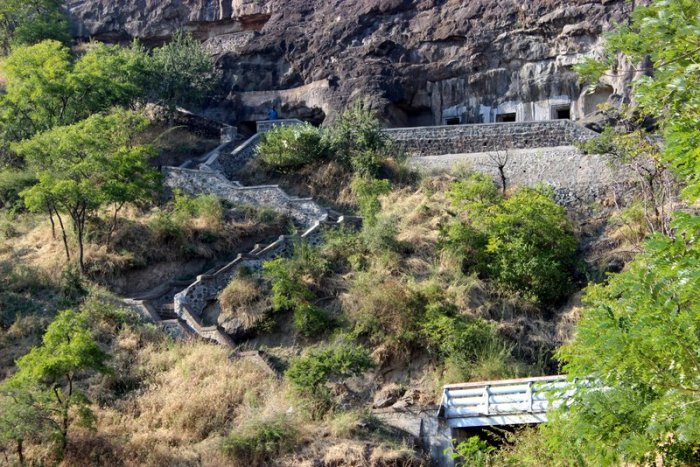
About 10 minutes later, I’m at the foot of a flight of steps that will lead me to the Westernmost part of the Aurangabad Caves.

Aurangabad Caves, Aurangabad, Buddhist Rock Cut Caves

I have very carefully stowed the entry ticket away in my backpack as I will need it to visit the other, Eastern, set of Aurangabad Caves, which is over a kilometre away according to the ticket clerk. There aren’t too many visitors around on that pleasantly warm December afternoon of 2013. The few who are there are Buddhist devotees dressed in white and carrying offerings of white flowers. The climb is an easy one and I reach the entrance to the first of the Caves in no time. Continue reading “Aurangabad: Rock-cut caves, Bibi ka Maqbara, Panchakki”

The ‘mysterious’ step-well at Lonar

Our happiest moments as tourists always seem to come when we stumble upon one thing while in pursuit of something else. ~ Lawrence Block

I first saw the step-well on my way to the hotel from Lonar bus stand from the auto rickshaw.

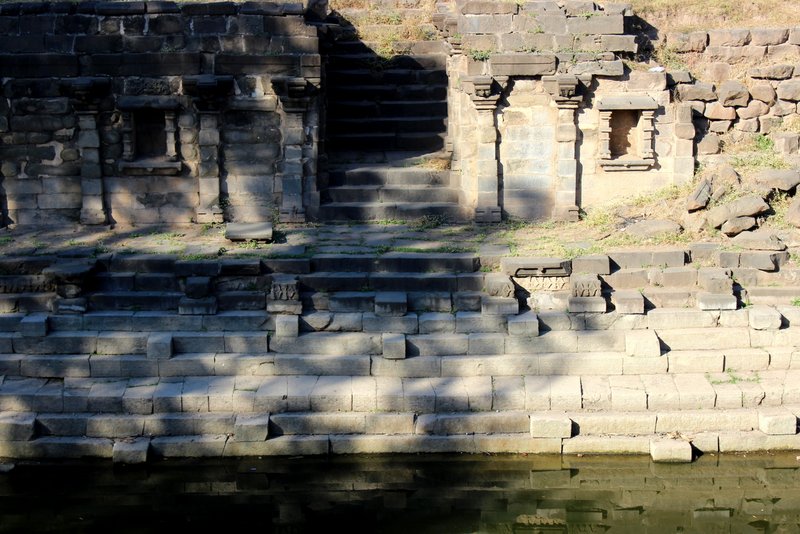
A sunken structure in black basalt, I think I was lucky to notice it in the first place as the step-well is not on the road itself, but a little inside. I also think I noticed it because of the sudden break between the rather drab looking houses on the road and because it was so different from everything around it. From the quick look that I had in a passing rickshaw, I guessed it to be a water body of some sort. Maybe a step-well or at least an old  water tank?

I immediately asked the driver of the auto rickshaw I was travelling in. “What’s that place we passed just now?”

“What place?”

“The place with the black coloured stone and the one that looks really old.” (Yeah, I know, a very clever and lucid description indeed :-P).

“That thing? It’s a water tank. Nobody uses it or goes there.” These words were uttered with such a tone of finality that I didn’t dare ask him anything more.

Later that evening, after a day spent exploring Lonar, I told the guide about the step-well  / water tank that I had seen earlier that day. The guide was equally dismissive saying that it was a broken down structure, and not really interesting and why should I want to see something as boring as that?

That did it. The word “boring”. I decided that I wouldn’t leave Lonar till I had paid a visit to the step-well / water tank. So next morning, before I left for Aurangabad (my next destination), that’s what I did.

And the first thing I realised when I saw it is that it was not a water tank, but a step-well. Not an elaborate one, but a step-well nevertheless.

Lonar, Maharashtra, Stepwell, water tank, Ancient, Limbi Barav Continue reading “The ‘mysterious’ step-well at Lonar”

Lonar: Geology, mythology, history and today

I eyed the steep and stony descent with some trepidation. The trail, or what passed off as one, appeared to be made for goats, not humans.

“It’s okay. The path is perfectly safe. Nothing will happen to you,” said Rajesh, my guide.

“That’s easy for you to say,” I told him, as I placed my camera in its protective case and put it in my backpack. As an afterthought, I also put my cellphone in as well, not willing to take any chances with it while climbing down..

“Are you sure this trail is safe?” I asked.

“Not only is it safe, it is also the quickest way to descend.”

“That’s what I’m worried about,” I muttered to myself, as I looked around to see the vista spread out before me. Beyond the goat trail that is.

Lonar, Lonar Temple, Travel, Maharashtra, Kamalja Devi, Meteoric Crater, Alkaline Lake
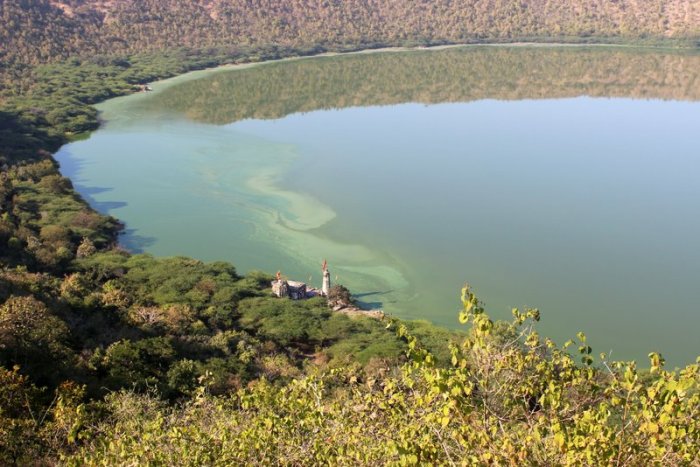
The orange flags of the Kamalja Mata Temple can be seen as a speck

An almost circular lake, tranquil and pretty as a picture — ringed with a thick green cover and dotted with temples around its periphery — stretched out below me. This is the Lonar Crater Lake, which was created when a high-speed meteorite slammed into the basaltic lava flows about 52,000 years ago. The meteorite is believed to be buried deep within the lake.

Though the Lonar Crater was ‘discovered’ in 1823 by a British military officer, C.G. Alexander, it wasn’t until 1973 that it was found that the Lonar Crater was a one-of-its-kind. It remains the only meteorite impact crater in basalt in the world.

Continue reading “Lonar: Geology, mythology, history and today”