Snow in May: Memories of an Alpine rail journey

A great white expanse of pristine, white snow greets me as I step off the train. Snow in May? My used-to-Mumbai’s-muggy-weather-in-May mind wonders if I am dreaming or hallucinating or both. I bend down and touch the snow and rub a little onto my face. It is   snow and I am not dreaming or hallucinating.

And I am not in Mumbai, I am in Switzerland. 🙂

Snow in May !

From as far back as I can remember, I have always wanted to experience the Alps via a rail journey. My wish came true on 13th May 2009, when I made a day trip from Geneva to Kleine Scheidegg in the Jungfrau region of Switzerland. I love train travel, and this was one of the most scenic journeys I have ever undertaken. The clean and fresh mountain air was invigorating as was the super efficient and punctual train journey.  It was a trip that took me 5 hours one way with train changes at Bern, Interlaken Ost and Lauterbrunnen / Grindelwald, and a trip that I am going to take you on here.

So hop on abroad the train with me at Interlaken Ost and leave behind the muggy, sticky hot Indian summer behind to journey to the cool climes of Switzerland. 🙂

Continue reading “Snow in May: Memories of an Alpine rail journey”

A morning at Marina Beach

The Guest Post Series onMy Favourite Thingshas contributions by those sharing my interests in travel, books, music, and on issues that I am passionate about. Though the guest posts are not always by fellow bloggers, the guest authors are always those who have interesting experiences to share.

Today’s guest post is by a fellow blogger, Puru of Shadows Galore, who writes about his travels, photographs, memories and more. I eagerly wait for Puru’s travel posts as he is always visiting and writing about places that I have wanted to visit. My favourites are his posts on Sri Lanka and Angkor Wat. His series on Learning Photography is simple, easy and with instructions that actually work. In this post, Puru presents a photo essay on a morning spent at the Marina Beach in Chennai.

My last few days in Chennai saw me exploring the city and going to places where I had always thought of going but never actually did. So today I went to Marina Beach, the third longest beach in the world and the largest in Asia. Of all the beaches in Chennai, it happens to be the most dynamic and hence the most well known.

So early at 4:30 AM, I woke up and started for the beach with my camera. It was quite dark yet and the horizon had just started turning a few shades lighter. As the sun rose, I took a lot of photographs and I am sharing some of them here for you:

A crow signals the day break

Continue reading “A morning at Marina Beach”

When paintings came to life… A visit to Constable Country

Every place that I have travelled to has been memorable for different reasons. Some of the places have had a mythological significance attached to them, others have had historical reasons and still others have been memorable for literary reasons. Each of these visits have been memorable as they saw my imagination of the written word I had read or the oral narratives heard about these places come alive. Then there have been places that have made an impact on me visually through photographs, paintings and movies. And again, seeing them come to life when I visited some of the places has been memorable. But none have been as memorable as a visit to Constable Country, the place that inspired one of the greatest painters of English landscapes—John Constable.

John Constable (1776-1837) was born in East Bergholt in the Suffolk region of England. He was brought up in the countryside and his deep love for the local landscape led him to record its beauty, its light, its atmosphere, its colours and its textures in his paintings. Though Constable’s genius is acknowledged throughout the world today, in his own lifetime he struggled for recognition as landscape painting was considered unfashionable. He was more acclaimed in France and sold more paintings there than in England, whose rural landscape he loved so much. Indeed, he had this to say to a friend:

I should paint my own places best, painting is but another word for feeling.

He received recognition in England only about 8 years before his death and the countryside that he made so famous through his paintings came to be known as Constable Country.  Every stile, every tree, the fields, the river Stour, the watermills, the cornfields… found an expression in his paintings.

The Hay Wain (1821) by John Constable

I saw a John Constable painting for the first time on the cover of a book on the life and times of the artist. The painting was a detail from The Hay Wain (see picture on the left), which is considered to be Constable’s masterpiece. What attracted me to painting was the detail and the different textures visible in spite of the scaled down size of the painting in the book. I bought the book, read it from cover to cover, feasted on the paintings and added Constable Country to the list of places I wanted to visit. This was in 1994 and I had to wait for 15 years for that wish to realise.

Continue reading “When paintings came to life… A visit to Constable Country”

That trip to Greece !

The Guest Post Series on “My Favourite Things” has contributions by those sharing my interests in travel, books, music, and on issues that I am passionate about. These posts are not always by fellow bloggers, and the guest authors are always those who have interesting experiences to share.

Today’s guest post is by Aditi, who writes about a trip she made to Greece last summer. At that time, she was on a year-long stay in Belgium as a Rotary exchange student from India, and the Greece trip was one of the many organised by the Rotary Club for exchange students in Belgium. These days, Aditi is eagerly waiting to turn 18 and travel to see the Taj Mahal. These days she also prefers not to think about her 12th Std. results which will be declared in a month or so.

Flashback to April 2011. Tenth of April 2011 to be precise.

My bags were packed, my passport and Identity Card were safely put away in my purse. I hadn’t slept the previous night, and yet wasn’t the least bit tired as I was so excited. I was waiting in the living room, impatiently shaking my legs for my host mother to get ready. Why? Because she was going to drive me to Trois-Ponts railway station from where I would take the train to Liège station. And why was I going to Leige station? Because that’s where I was meeting all the Rotary exchange students. Why? Because we were all going on a trip to GREECE !

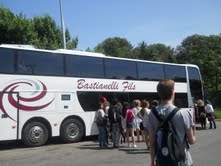
Did you think that we flew to Greece from Belgium? Actually, we didn’t. We took a bus. Yes, a double-decker bus and then a ship. The road part sounds like a nightmare, doesn’t it? And actually it was to begin with. But in hindsight it was worth it because all the Rotary exchange students got to bond with one other. And by the end of the trip, we had become the best of friends with each other. I was always happy to be with the other exchange students as I saw myself in all of them. I never thought of myself as just “Indian”. I was Indian, American, Canadian, Australian, Mexican, Venezuelan, Taiwanese, Japanese—all at the same time. And of course, Belgian. Even today, I have a bit of all these countries in me.

Continue reading “That trip to Greece !”

The nosy co-passenger

It was going to be a long journey to Mumbai, I told myself, as I surveyed my co-passengers in the train compartment. A family of four, comprising an elderly woman, a young man, a young woman, and a toddler (along with 4 large suitcases and 5 bags), were struggling to adjust their luggage under the seats and themselves on the seats. The elderly woman was the boss. No argument there. She decided how and where the luggage was to be placed, the seating and sleeping arrangements for her family, etc. She bullied the man (her son), was quite nasty to the woman (her daughter-in-law), and kept calling the child (her granddaughter) an idiot. She picked a fight with the coolie and shouted him down with the choicest abuse and sheer volume. She had a “Lalita Pawar” (for information on who she was, click here) kind of look about her with a screechy voice to match, and it didn’t take me long to name her that.

Yes, it was going to be a long journey to Mumbai in a Sleeper Class coach of the Mumbai-bound Madras Express. It was the year 1997 and a beautiful November morning in Chennai and a perfect day for travel. But somehow with the arrival of my Lalita Pawar,  the day just didn’t seem so beautiful any more.

Once settled, Lalita Pawar turned her attention to her co-passengers. And that was my cue to hastily bury my nose in a book. It was a look that I had seen many-a-times during my travels. It was a look that promised to dig out personal information from a co- passenger, particularly a young woman travelling alone. In fact, I could almost see Lalita Pawar rubbing her hands with gleeful anticipation when she saw me. Though I could feel her eyes boring into me, I did not look up from my book.

Continue reading “The nosy co-passenger”

Agra’s other Taj: The tomb of I’timad-ud-Daulah

The guide was sulking, the mid-day sun was relentlessly hot and I could feel my skin burn. But I was oblivious to all but the shimmering marble structure in front of me—the tomb of I’timad-ud-Daulah, with the local sobriquet of Baby Taj or Mini Taj.

The tomb of I’timad-ud-Daulah

Located on the western bank of the Yamuna river, the tomb complex was built by Noor Jehan (queen of Emperor Jehangir, the fourth Mughal Emperor) for her father, Mirza Ghiyas Beg and mother. Mirza Beg started off as an accountant in the Mughal court and rose to the rank of Lord High Treasurer or I’timad-ud-Daulah. And therein lies the name of the tomb, which was built between 1622 and 1628.

The tomb is rather squat and broad in appearance with hexagonal towers in each corner. Built on a low sandstone platform with marble inlay work on all four sides, like all Islamic structures, this one too is symmetrical. It is the presence of the two very different-sized and shaped trees on either side of the tomb that lessens the severity of the symmetry and actually gives it a slightly quirky look.

Continue reading “Agra’s other Taj: The tomb of I’timad-ud-Daulah”