The Pattadakal Temples: Where kings were crowned and villagers dwelled

The Ganges or the River Ganga is considered to be holy to Hindus. And in Varanasi or Benares, the Ganga is considered to be at its holiest. Do you know why? It is because the Ganga’s flow is uttarabhimukhi or from South to North there, as against the usual West to East, or the less common East to West. I learnt about this piece of trivia when I visited Pattadakal.

Pattadakal is a small village in North Karnataka, situated on the banks of the river Malaprabha. It is a rather unremarkable looking, dusty village, made remarkable for one thing—the Malaprabha is also uttarabhimukhi here. This unique feature was considered an auspicious sign by the rulers of the Chalukya dynasty, thereby singling it out for royal attention.
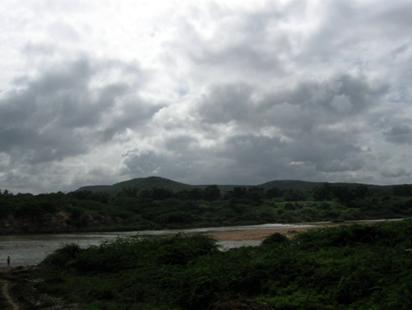
The North-flowing Malaprabha River at Pattadakal

And what an attention Pattadakal got ! The Chalukya Kings chose Pattadakal as the site for their coronation ceremonies. Being lovers of art and culture, they also chose Pattadakal as the site for building a unique temple complex that would blend the architectural and artistic traits of the northern and southern styles of temple-building that was in vogue in the 8th century. Eight temples were built on one site as a group, while two other temples were built some distance away in Pattadakal. This group of monuments at Pattadakal are designated as a UNESCO World Heritage Site.

Continue reading “The Pattadakal Temples: Where kings were crowned and villagers dwelled”

An enchanted evening at the Agastya Teertha & Bhootnatha Temple

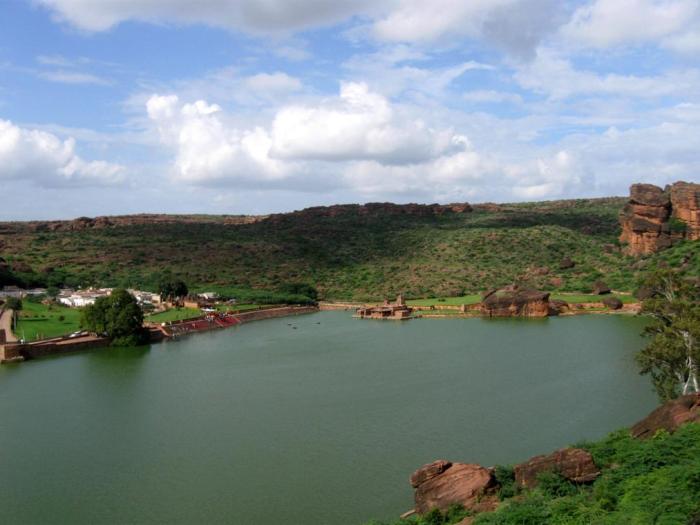
The two Bhootnatha Temples of Badami are located in one of the most picturesque settings that I have seen in my travels. In the photograph below, the Agastya Teertha or lake is spread out with the Bhootnatha Temple on the eastern bank visible somewhere near the centre of the photograph. Though I had seen pictures of the Agastya Teertha and the Bhootnatha Temple in a similar setting, the feeling of “Wow” is quite different when you see it yourself, than the “Wow” you feel when you see a photograph.

The Agsatya Teertha and the Bhootnatha Temple on its eastern bank

The Bhootnatha Temples are dedicated to Lord Shiva—Shiva in the form of the God of souls, spirits and ghosts. Built out of red sandstone probably sourced from the surrounding hills, the two temples are placed opposite one another at the eastern and western banks of the Agastya Teertha. The approach to the Agastya Teertha and the Bhootnatha Temples from Badami Caves is via a narrow and winding path that passes through a village.

It was around 5 pm when we arrived at the banks of the Agastya Teertha. From there we could see both the Bhootnatha Temples. The sun, which had been playing hide and seek with the clouds and us the whole afternoon, came out for a brief while. Almost on cue, the strains of a shehnai began, probably played from western Bhootnatha temple. The strains soon grew louder and discernible as Raga Sarang.

Continue reading “An enchanted evening at the Agastya Teertha & Bhootnatha Temple”

Badami rocks !

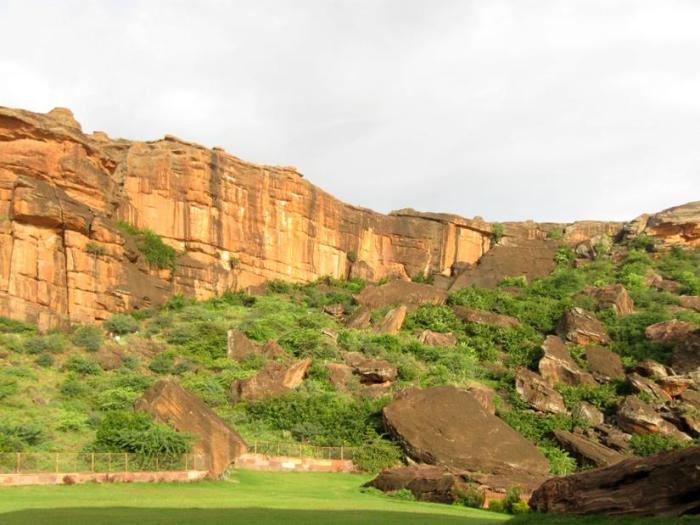
The first time I heard about Badami was in my undergraduate Geology class nearly 20 years back. It was a class on the Geological Time Scale and we were being shown slides from various parts of India and the world as examples of different geological time periods. I still remember the Badami slide from that class—the sheer red sandstone cliffs, silhouetted against a deep blue sky. It was love at first sight.

Red Sandstone Cliffs of Badami

At that time I had absolutely no idea that Badami was also the location of rock-cut cave-temples dating from the 6th century. I got to know about this only a couple of years back, when one of my brothers visited the cave-temples of Badami and shared his photographs. Now, it was love at second sight!

When the opportunity to visit Badami, along with other heritage places in North Karnataka, as part of an organised tour group came up, I grabbed it with both hands. I applied for leave from work a full month in advance, juggled deadlines, prayed hard, etc., etc.

Bijapur was our first halt and after an overnight stay in that town, we left early next morning for Badami, with a short halt at the Almatti Dam Gardens. By noon, the red sandstone cliffs of Badami appeared in the horizon. There is an interesting reason as to how Badami got its name. Someone in the historical or mythological past, and I don’t know who, felt that the red stones were the colour of  badam or almonds. And hence, the name!

Continue reading “Badami rocks !”

Bijapur: A hidden heritage

I visited Bijapur as part of an organised tour of heritage places in North Karnataka in the first week of September. When our tour group stepped outside Bijapur railway station, there was no indication that we were in a place of any significance—no rickshaws or tour guides trying to hard sell a “good deal” to the sites in the town. There were only some tongas and a few people wandering about here and there. It was so quiet and peaceful that I wondered if we were in the right place at all !

Bijapur was the seat of power for the Adil Shahi dynasty which ruled from 1490 to 1686. The town was established in the 1oth–11th century by the Chalukyas, though it was then known as Vijaypura or the “city of victory”. Though the Chalukyas were renowned for their temple architecture, there is nothing to show for their presence in the town today. What it has to offer is some stunning examples of Islāmic architectureGol Gumbaz, Ibrahim Rouza, Jama Masjid, Darbar Hall, etc. Indeed, Bijapur is one of the few places in South India, where you get to see Islāmic architecture.

Bijapur is identified with and is almost synonymous with the Gol Gumbaz, the mausoleum of Muhammad Adil Shah II, who is buried here along with his two wives, his son, his daughter, and his mistress. That is perhaps the only reason all tourists gravitate towards the Gumbaz and for our group too, this was the first stop.

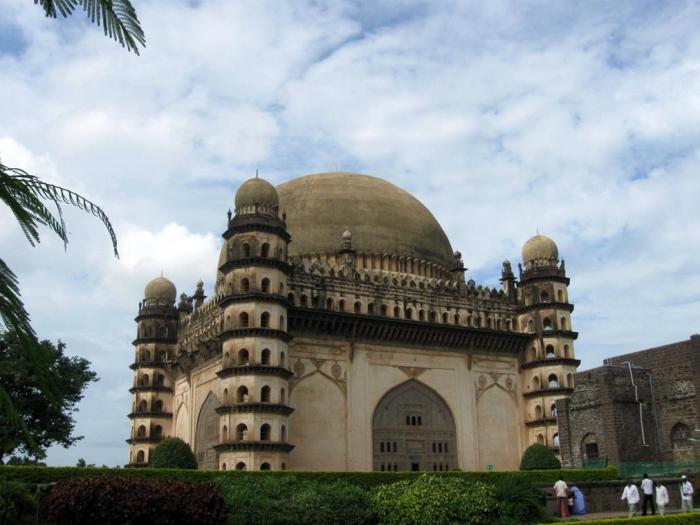
My first impression of the Gumbaz was not very favourable—its rather squat proportions of a plain dome atop a cube with slender seven-storeyed towers at each corner seemed too symmetrical and boring. Its size, though, was impressive, and why not—the dome is reportedly the second largest dome in the world, next only to St. Peter’s Basilica at Vatican City.

The Gol Gumbaz

Continue reading “Bijapur: A hidden heritage”