The nosy co-passenger

It was going to be a long journey to Mumbai, I told myself, as I surveyed my co-passengers in the train compartment. A family of four, comprising an elderly woman, a young man, a young woman, and a toddler (along with 4 large suitcases and 5 bags), were struggling to adjust their luggage under the seats and themselves on the seats. The elderly woman was the boss. No argument there. She decided how and where the luggage was to be placed, the seating and sleeping arrangements for her family, etc. She bullied the man (her son), was quite nasty to the woman (her daughter-in-law), and kept calling the child (her granddaughter) an idiot. She picked a fight with the coolie and shouted him down with the choicest abuse and sheer volume. She had a “Lalita Pawar” (for information on who she was, click here) kind of look about her with a screechy voice to match, and it didn’t take me long to name her that.

Yes, it was going to be a long journey to Mumbai in a Sleeper Class coach of the Mumbai-bound Madras Express. It was the year 1997 and a beautiful November morning in Chennai and a perfect day for travel. But somehow with the arrival of my Lalita Pawar,  the day just didn’t seem so beautiful any more.

Once settled, Lalita Pawar turned her attention to her co-passengers. And that was my cue to hastily bury my nose in a book. It was a look that I had seen many-a-times during my travels. It was a look that promised to dig out personal information from a co- passenger, particularly a young woman travelling alone. In fact, I could almost see Lalita Pawar rubbing her hands with gleeful anticipation when she saw me. Though I could feel her eyes boring into me, I did not look up from my book.

Continue reading “The nosy co-passenger”

Mumbai Lens: The Shoe House

This blog post was featured in the “Around the Blog” section of the DNA newspaper published on February 27, 2012 (pg.6).

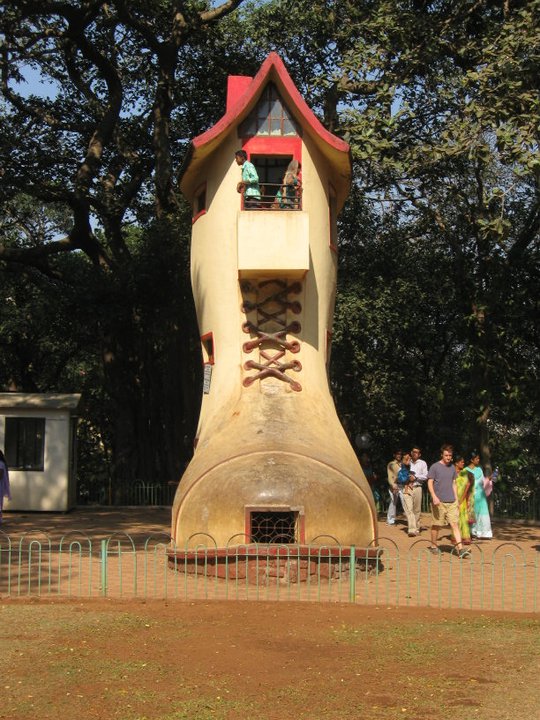
I did my first 4 years of schooling in Mumbai and without fail the annual school picnic followed the same pattern—a visit to the Byculla Zoo, followed by lunch in the grounds there; then a quick visit to the Gateway of India; and finally a drive along the Marine Drive to the Kamala Nehru Park at Malabar Hill. This is part that we kids would be waiting for—a romp in the grounds and a visit to the Shoe House in the Park (and not necessarily in that order).

The Shoe House, which is supposedly inspired by the nursery rhyme “The Old Woman who Lived in the Shoe”, was the star attraction for us. A larger than life shoe-shaped house, painted a bright yellow with red shoe laces, a red roof and red chimney—it was every kid’s dream house. We would climb the narrow stairs in twos and threes to the balcony and wave out to the other classmates and feel that the Shoe House and the world belonged to us ! Ah the thrill and joy that little climb gave us.

The Shoe House at Kamala Nehru Park, Mumbai

Continue reading “Mumbai Lens: The Shoe House”

Twitter + Literature = Twitterature?

Classics and bestsellers are rarely left to ..er.. rest on their popularity. The moment they become popular, an entire line of copycat books (which also hope to become a classic one day, or at least the next bestseller) are published. Then come the attempts to make a film or a TV serial (or both) based on the classic/bestseller. Parodies of the classics are not too far behind in getting published or filmed. Then you have the critiques and the re-interpretations of these popular books. And with the social media boom, it is not surprising that some of these books are being tailored or re-written to fit that criteria (for example, click here to read a Facebook version of the Mahabharata, and here to read a  Facebook version of the Ramayana).

With the Twitter boom, can its influence on literature be far behind? Not at all, and this is where two teenagers, Alexander Aciman and Emmet  Rensin, rewrote over 80 classics and some recent bestsellers as a series of tweets. And thus was Twitterature: The World’s Greatest Books Retold Through Twitter born.

Twitterature (Penguin Books, 2009, pp. xiv + 146) is an attempt at “facing and understanding … the greatest art of all arts: Literature” through Twitter. The authors, both 19-year-old students at the University of Chicago at the time of publication of the book, wrote it with the intention of mastering “the literature of the civilized world, while relieving [the reader of] the burdensome task of reading it” in its original form. In other words, Twitterature is a retelling of literature in the form of tweet stories in Twitter language.

Continue reading “Twitter + Literature = Twitterature?”

The Kala Ghoda Arts Festival 2012

Today is the last day of the 2012 edition of the Kala Ghoda Arts Festival (KGAF) in Mumbai. This much-awaited, one-of-its-kind annual festival comes like a breath of fresh air to a city that is starved of events like this. The week-long KGAF packs in programmes and performances in literature, theatre, films, music, and dance. In addition to this, there are heritage walks, street art exhibitions as well as street performances, and workshops on various topics for adults and children alike.

While I attend quite a few of the ‘cultural’ performances and participate in a heritage walk or two every year, what I really look forward to every year are people-watching and the handicraft melas. The latter brings in artisans and their art and craft from all over the country, and is an opportunity for me to stock up on gifts for friends and family. I also look forward to seeing the installation or street art at Rampart Row, the venue of the main KGAF, not because I love installation art, but because I am always amazed at the creativity that gets shown year after year. Just see a sample from this year’s KGAF.

Continue reading “The Kala Ghoda Arts Festival 2012”

Happy 200th birthday, Charles Dickens !

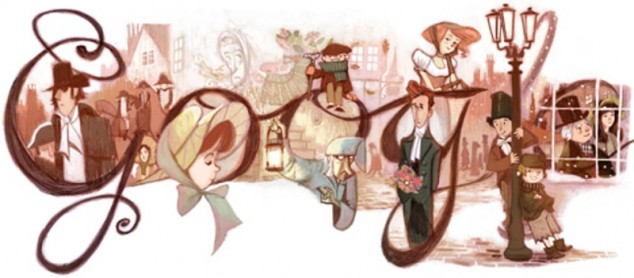
Yesterday was the 200th birth anniversary of Charles Dickens, and not surprisingly Google came up with a doodle to commemorate the occasion.

Google Doodle on 7 February 2012, in memory of Charles Dickens’ 200th birth anniversary

This charming doodle evoked the era and times of the world that the characters from Dickens’ books inhabited. Surely one can see the ghost from A Christmas Carol as well as Fagin from Oliver Twist, and Nell from The Old Curiosity Shop in the doodle? And is that an adult David Copperfield in the curve of the second ‘g’ in the doodle? Or is it Nicholas Nickleby?

I love and loathe Charles Dickens or rather his characters in equal measure. David Copperfield is one of my favourite books, and I love the curmudgeonly Miss Copperfield, just as I loathe Fagin from Oliver Twist. When I read The Old Curiosity Shop, I cried over Nell’s fate and her loneliness. I found Great Expectations tedious and Nicholas Nickleby boring and worthy of a Bollywood film ! A Tale of Two Cities was incomprehensible the first time I read it; it took me a second reading of the book to appreciate the nuances and the plot. Love him or loathe him, one can never be indifferent to Charles Dickens.

That is the reason that there are so many museums and festivals dedicated to Charles Dickens across the world. One such place is  Rochester, in the Kent region of England, which hosts a Summer Dickens Festival every May, and a Dickensian Christmas every December. The Festivals give an opportunity for the townspeople to dress up in Dickensian costumes and have a good time. There is a lot of street entertainment, folk music, Punch and Judy shows, and readings from Charles Dickens’ books. In addition to this, the Swiss chalet like house that Dickens lived in while based in Rochester is open to the public.
All this makes Rochester a perfect place for tourists to visit. I was fortunate to visit Rochester in May 2009 on the last day of the Summer Dickens Festival. Some memories from that visit: Continue reading “Happy 200th birthday, Charles Dickens !”

Travel Shot: The “spooky” organ of St. Pierre Cathedral

One of my favourite instruments is the church organ, and I never miss an opportunity to listen to a performance. It is not just the organ’s music, but also the mechanics of the instrument that intrigues and fascinates me. The grandness of the organ never fails to thrill and always sends a delicious shiver down my spine. No visit to a church or a cathedral is complete without me checking out the “resident” organ.

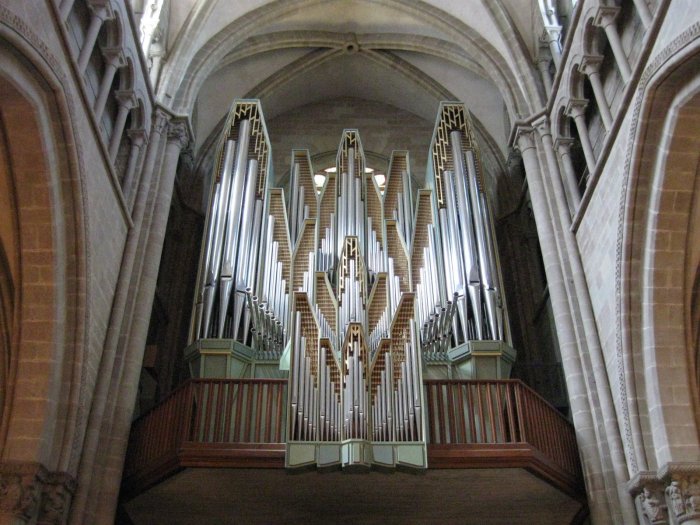
When I checked out the organ at the Cathédrale St. Pierre at Geneve or St. Pierre’s Cathedral at Geneva, Switzerland, a shiver did go down my spine, but for entirely different reasons !

The “spooky” looking organ in the St.Pierre Cathedral at Geneva

Continue reading “Travel Shot: The “spooky” organ of St. Pierre Cathedral”