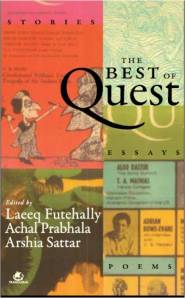
The Best of Quest: A review

The book

Once upon a time there existed a magazine which was a “quarterly of inquiry, criticism and ideas” and fittingly enough called Quest. It had very clear-cut guidelines for the content it carried: everything and anything published in the Quest had to have “some relevance to India. It was to be written by Indians for Indians” (p.xix).

It was because of these guidelines that Quest was able to publish highly original writing in English in the form of essays, opinions, book reviews, film reviews, critiques, stories, poems, memoirs, etc. The writers were a mix of the new and the established, academicians and journalists, politicians and poets — Rajni Kothari, Nirad Chaudhuri, Kiran Nagarkar, Ashis Nandy, Khushwant Singh, and Neela D’Souza, to name a few.

Published from Bombay, Quest was born in 1954 with Nissim Ezekiel as its first editor. After Ezekiel, A.S. Ayub and Dilip Chitre took on the role of editors of Quest, and both of them stayed true to the founding vision of publishing works relevant to India. In spite of this, or perhaps because of it, Quest died an untimely death with the imposition of the Emergency about 20 years later. In the decades that followed, Quest got relegated to the realm of nostalgic memories of people who were associated with it, or in wooden boxes stored in lofts and attics. Some forgot about it and some like me did not even know about the existence of Quest. Till recently, that is.

Continue reading “The Best of Quest: A review”

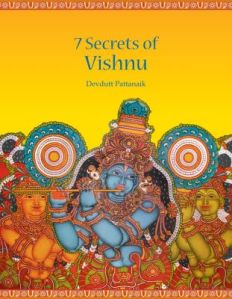
Book Review: 7 Secrets of Vishnu

The Background

Hindu mythology can be quite confusing for a non-Hindu. Why, it can be confusing and for a Hindu too. The different and contradictory world views that co-exist and even support and complement one another can bewilder even the most dedicated scholar or devotee.

According to Devdutt Pattanaik, author of the 7 Secrets of Vishnu (and the book under review here),

In mythology, all forms are symbolic. (pg.7)

This one sentence, in my opinion, is the key to understanding and appreciating not only this richly illustrated book, but also Hindu mythology and Hinduism itself. The 7 Secrets of Vishnu (Westland, 2011) has nearly half of its 220 pages devoted to images from calendar art, paintings, sculptures, etc. “to make explicit patterns that are implicit in stories, symbols and rituals of Vishnu” (p.xi).

Continue reading “Book Review: 7 Secrets of Vishnu”

The secret of the Nagas: A review

The background

The Secret of the Nagas (Westland, pp.396, Rs.295) is the second book in the Shiva Trilogy by Amish. The Trilogy is based on the premise that Shiva was not a mythical God, but an ordinary human being who became a God because of his karma. The 3 books in the Trilogy trace the journey of Shiva from a human being to that of a God.

The Immortals of Meluha is the first book in the series. It follows the journey of Shiva from his beginnings as a Tibetan tribal leader to that of an immigrant to Meluha (the area that we now know was the site of the great Indus Valley Civilization) to becoming aware of the extraordinary destiny that awaits him and his first attempts at fulfilling that destiny. For more on the first book, you can read my review right here.

The story

The second book begins in Ayodhya with yet another skirmish between Shiva and Sati, and the Naga, who Shiva suspects was responsible for the death of his friend, Brihaspati. Yet again, the Naga escapes. By now Shiva is obsessed with hunting down the Nagas (an ostracised community of deformed beings with extraordinary skills, power and strength), and particularly that one specific Naga.

Continue reading “The secret of the Nagas: A review”

The immortals of Meluha: A review

The background

Shiva. Lord Shiva. The Destroyer. One of the Hindu Trinity. Mahadev. Nataraja. Husband of Parvati or Sati. The Supreme Yogi.

Most Indians, and certainly all Hindus, know Shiva in all these forms and then some more. For millions he is a revered God, an ishta devta, worshipped in his myriad forms. Probably, that’s why many of his devotees do not think of Shiva’s origins — perhaps, the fact that Shiva is a God and is, therefore, eternal inhibits them from thinking about his beginnings.

The author of The Immortals of Meluha (Westland, pp.412, Rs.195), Amish, has no such inhibitions. The first book in the Shiva Trilogy, it introduces Shiva as an ordinary human being with an extraordinary destiny in store for him. A destiny which makes him a saviour and a god, and whose arrival has been prophesied in an ancient legend.

The story

It is the year 1900 BC in the area that the world today knows as the site of the Indus Valley Civilisation. But the people living there at that time call it Meluha, a near-perfect, disciplined society that lives by the rules laid down by Lord Rama himself. A caste-based society where every member’s place is determined not by birth, but by his/her abilities.

A society that is almost immortal due to the availability of somras, an anti-ageing potion, for all its members. This is the society of the Suryavanshis or descendents of the sun.

Continue reading “The immortals of Meluha: A review”

84 Charing Cross Road: A second-hand love affair

It was at a cousin’s wedding that an uncle gave me his copy of 84 Charing Cross Road with a crisp, “Read it. It’s good”. Now, I don’t know about you but long drawn-out weddings are not my cup of tea, and I always look for avenues to keep sane at such events. This book provided me with that perfect opportunity to escape from cope with the wedding festivities.

So, I read the book while getting my mehendi done, while helping my cousin’s trousseau to be packed, in the middle of the night under torchlight, when I couldn’t bear the collective grunts and snores of so many aunts in the hall we were sleeping in, between the many wedding ceremonies, etc. By reading a few pages at a time, I managed to finish the 100-odd pages of the book over 3 days and return it to my uncle. I was just in time to congratulate the newlyweds after the wedding ceremony, and then run out to try to obtain my very own copy of the book.
So what is 84 Charing Cross Road (by Helene Hanff) all about? I found the book’s blurb—an extract from its review in the Daily Telegraph—tantalising.

This book is the very simple story of the love affair between Miss Helene Hanff of New York and Messrs Marks and Co, sellers of rare and second-hand books at 84 Charing Cross Road, London. It is unmitigated delight from cover to cover.

Continue reading “84 Charing Cross Road: A second-hand love affair”

The Emerald Route: One book, many narratives

What would you call a book that

(a) is primarily a travelogue,
(b) is also a concise literary, spiritual, religious, mythological, and political history of the region,
(c) is part autobiographical, and
(d) includes a description of taming wild elephants, a folk tale and a one-act play.

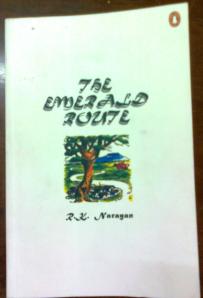
The cover illustration is by R.K. Laxman

The book that I am talking about here is R.K. Narayan’s (RKN) The Emerald Route, which is the outcome of the author’s travels along with R.K. Laxman, his brother and the famous cartoonist, through the length and breadth of Karnataka.

First published in 1977 by the Director of Information and Publicity, Government of Karnataka, and then by Penguin India in 1999, I recently bought the latter edition on the recommendation of Smeedha, a friend.

RKN chose to title his book “The Emerald Route” for one important reason—he did not encounter even a single dry patch during the first phase of his tour from Mysore through Hunsur and Hassan and back. He says:

Continue reading “The Emerald Route: One book, many narratives”