Museum Treasure: The golden throne of Maharaja Ranjit Singh

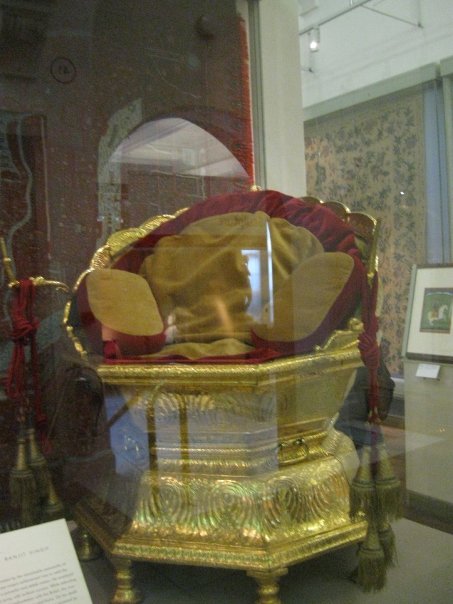
The Victoria and Albert Museum (or the V&A) in London has a fantastic collection of artifacts from India, that includes textiles, jewellery, paintings, weapons, etc. While many of these have been purchased by the V&A, some of the exhibits have been acquired during annexation of the princely states of pre-independent India by the British. One such exhibit is the Golden Throne of Maharaja Ranjit Singh, which was acquired as State property in 1849 on the annexation of Punjab.

The golden throne of Maharaja Ranjit Singh

Continue reading “Museum Treasure: The golden throne of Maharaja Ranjit Singh”

The social movements calendar 2012

The Social Movements Calendar (SMC) is back !

The 2012 edition of the SMC is dedicated to the “saga of labour struggles from colonisation to globalisation”, and is yet another effort to document peoples’ struggles in the last few decades in the country and provide a one stop source for references on social movements on this theme. Originally conceptualised by the late Smitu Kothari and published by Intercultural Resources India, the 2012 SMC Calendar is the fourth edition.

The cover page of the Social Movements Calendar 2012. Source: http://icrindia.wordpress.com

Continue reading “The social movements calendar 2012”

Travel Shot: Sunrise at Kovalam Beach

In the winter of 1998, a friend and I embarked on a trip along the West Coast of India beginning at Honnavar (Karnataka) and ending at Thiruvananthapuram (Kerala) 10 days later. It was a hop on, hop off trip, one of the best trips I have ever undertaken, and a trip that I remember for various reasons.

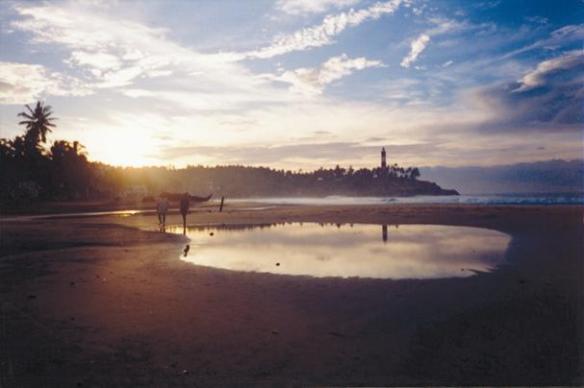
While in Thiruvananthapuram, we took a spur of the moment decision to spend the night at one of the hotels on Kovalam Beach. That turned into quite an experience—being the only Indians staying back, being the subject of countless stares and comments, and dealing with plate-sized spiders in our room. After a sleepless night (you didn’t really expect us to sleep with the spiders around, did you?), we stumbled out of our room at daybreak—all red-eyed and cranky—to see a glorious sunrise.

Sunrise at Kovalam Beach, Thiruvananthapuram

Continue reading “Travel Shot: Sunrise at Kovalam Beach”

The Best of Quest: A review

The book

Once upon a time there existed a magazine which was a “quarterly of inquiry, criticism and ideas” and fittingly enough called Quest. It had very clear-cut guidelines for the content it carried: everything and anything published in the Quest had to have “some relevance to India. It was to be written by Indians for Indians” (p.xix).

It was because of these guidelines that Quest was able to publish highly original writing in English in the form of essays, opinions, book reviews, film reviews, critiques, stories, poems, memoirs, etc. The writers were a mix of the new and the established, academicians and journalists, politicians and poets — Rajni Kothari, Nirad Chaudhuri, Kiran Nagarkar, Ashis Nandy, Khushwant Singh, and Neela D’Souza, to name a few.

Published from Bombay, Quest was born in 1954 with Nissim Ezekiel as its first editor. After Ezekiel, A.S. Ayub and Dilip Chitre took on the role of editors of Quest, and both of them stayed true to the founding vision of publishing works relevant to India. In spite of this, or perhaps because of it, Quest died an untimely death with the imposition of the Emergency about 20 years later. In the decades that followed, Quest got relegated to the realm of nostalgic memories of people who were associated with it, or in wooden boxes stored in lofts and attics. Some forgot about it and some like me did not even know about the existence of Quest. Till recently, that is.

Continue reading “The Best of Quest: A review”

Mumbai Lens: The Asiatic Library

This blog post was featured in the “Around the Blog” section of the DNA newspaper published on December 7, 2011 (pg.7). 🙂

The iconic building of the Asiatic Library of Mumbai, also called Town Hall, was recently in the news for a rather sad reason. Renovation work, which had begun in 2008–2009, had been stalled due to unpaid bills amounting to nearly 2 crores ! (You can read more about this here). When I had last walked by this beautiful building one August morning earlier this year, there was scaffolding on the sides, scraped and chipped paint on the ground, and blue protective sheets covering the exposed parts. Sounds of repair work could be heard even over the traffic.

The entrance to the Asiatic Society Library

Continue reading “Mumbai Lens: The Asiatic Library”

Remembering Satyendra Dubey

Today is 27/11. A day that is almost over at the time of publishing this post. For many, it may have been a day like any other. For some, it may have been a day marking a personal or professional milestone. But 27/11 is no ordinary day. It is a day that no Indian should forget for it was on this day, 8 years ago, that the issue of entrenched corruption in India was brought to the forefront like never before. It was the day that Satyendra Dubey was killed for exposing corruption.

Source: http://www.rediff.com/news/dubey.htm

Satyendra Dubey was a bright young engineer and project manager of the Golden Quadrilateral, one of India’s most ambitious road-building projects undertaken by the National Highway Authorities of India (NHAI). In a letter to the Prime Minister’s Office in May 2003, he exposed  the corruption and irregularities in the road building contracts issued by the NHAI for this project. In the same letter, he also requested for his identity to be kept a secret. The contents of the letter and his identity were ‘leaked’ by the Prime Minister’s Office and on 27 November 2003, he was shot dead in Gaya, Bihar. His murder sparked off an unprecedented public outrage in a country that is quite thick-skinned and immune to such callousness. It would not be incorrect to say that Satyendra Dubey’s was probably the first martyr against corruption in recent times

Continue reading “Remembering Satyendra Dubey”