What comes to your mind when you think of Mirabai (or Meerabai, depending on your choice of spelling)?
The 16th century princess-turned-poet from Rajasthan who was a devotee of Krishna? The rebellious Rajput princess who refused to worship any other god, but Krishna? The widow who was harassed by her in-laws because she refused to become a sati? The pious saint whose soulful compositions we hear now and then through the renditions of Lata Mangeshkar, Kishori Amonkar, M.S. Subbalakshmi, and others? An incident from Mirabai’s life in a school text-book? The Amar Chitra Katha comic book that narrates her entire “life story”?
I am thinking about all this as I wait for a documentary on Mirabai to begin at the RR Theatre of Films Division (FD) at Peddar Road in Mumbai. An initiative of The FD Zone, this screening is part of a curated two-film package: the first is the film on Mirabai titled A Few Things I Know About Her and the second film is Narayan Gangaram Surve.
Helmets, chain mail, daggers, guns, arms, ammunition and other macho stuff are not really my kind of thing and it is this section in a museum that I breeze through or prefer to give a miss. So that day at the British Museum in London, should actually have seen me ignoring Meskalamdug’s helmet, but for two things—it was made of gold, and it had the cutest ears I had ever seen. 🙂
The gold helmet of Meskalamdug
This helmet, dates back to about 2600-2400 BC and was found in the tomb of Meskalamdug, a Sumerian prince, in the ancient city of Ur (now in present day Iraq). The top of the helmet has a wavy design (probably to mirror hair) and at the back is a little hollow bump, perhaps to accommodate Meskalamdug’s hair bun. And yes, the helmet also has these really cute and life-like ears and ear holes carved on them. Though the helmet is designed to look like a battle helmet, it was reportedly worn by Meskalamdug for only ceremonial purposes. Gold symbolises strength and power, and Prince Meskalamdug had both.
Meskalamdug’s helmet at the British Museum London is an electrotype of the original which is or rather was at Iraq Museum in Baghdad. In the pillaging and sacking of the city that followed the fall of the Saddam Hussein government, the gold helmet was one of the many artefacts looted from the Iraq Museum.
When I saw this artefact in London, the enormity of the fact that the original had been lost, perhaps for ever, did not sink in. It’s only as I write this post that I realise that the electrotype at the British Museum may be the only piece available for the world to view and admire.
A very sobering thought indeed !
The Museum Treasure Series is all about artifacts found in museums with an interesting history and story attached to them. You can read more from this serieshere.
You see, ever since Indiblogger announced its latest travel writing contest, I’ve been thrown into a bit of a tizzy because of the contest guidelines which say: “Tell us about the experiences you would love to bring back from Melbourne . . . . ” Normally, writing about my travels has never been a problem. But this time I’m stumped — how do I write about a place that I have never visited?
When I whined about told this to Neena, a friend, colleague and someone who’s been to Melbourne, she said, “So what if you have not been to Melbourne. Just use your imagination and let the anticipation of visiting a new travel destination shape your words; the rest will follow.” And that is just what I did. With some help from Google, Melbourne-specific websites, a couple of books, and chats with friends who have been to Melbourne.
This post is all about that perfect trip to Melbourne born out of my imagination and based on the activities I would love to do there keeping in mind my interests. Read on about what my trip to Melbourne will be like, the sights I will see, and the activities I will undertake to experience the history, heritage, art, architecture and contemporary culture that Melbourne has to offer, as well as its unique and famed natural history. So without further ado, presenting to you a no-holds barred account of how I want to experience Melbourne unhampered and unhindered by budgetary or tour itinerary constraints, but fuelled by my imagination 😉
The Melbourne skyline as viewed from the Rialto Observatory on Collins St. Source: Diliff, wikimedia.org
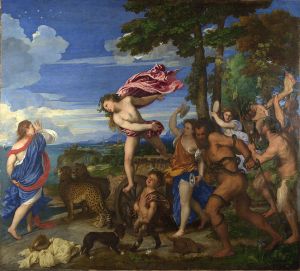
Sometimes, we miss the forest for the trees. And sometimes, we miss the trees for the forest. Let me give you an illustration. Take a look at the painting below (click on the picture to see a larger view).
Source: The National Gallery, London
The painting is called “Bacchus and Ariadne”. It was painted by Titian sometime between 1520 and 1523. It depicts a tale from Roman mythology where Bacchus (the God of Wine) sees the mortal Ariadne and falls in love with her at first sight. He is so smitten that he jumps out of his cheetah-drawn chariot towards her. The painting has captured Bacchus in mid-leap as Ariadne shies away from him in alarm.
I saw this painting at London’s National Gallery in 2009. I duly noted the story that the painting conveyed, the various characters in it, the lovingly painted animals, Titian’s trademark use of bright colours… and moved on to the next artwork. It was a nice painting, but not particularly impressive. Or so I thought. Today, I bitterly regret at only looking at the painting, but not seeing it closely enough. In only looking at the painting, I had completely failed to see the colours themselves, particularly the brilliant blue of the sky — a blue which came from the ultramarine paint made from the semi-precious lapis lazuli mined hundreds of miles away in the Sar-e-Sang valley (in present day Afghanistan).
The lapis lazuli from these mines would have travelled through ancient trade routes to the colour maker in Italy, who then transformed it into the very expensive ultramarine paint through a laborious process. First, the lapis lazuli would have been finely powdered and kneaded into a dough along with resin, wax, gum and linseed oil for 3 days, after which it would have been put in a mixture of lye and water. This mixture would have been kneaded again, this time with sticks, to draw out the blue of the lapis lazuli into the liquid. The blue-coloured liquid would have been be collected in bowls and allowed to dry, leaving behind a powdery blue pigment, the ultramarine blue. The process would have been repeated with the “dough” to get different qualities and shades of blue (pg.290-291). These days making the ultramarine paint is not so laborious as it is made synthetically.
I read about all this and much more in Colour: A Natural History of the Palette (2004, Random House, pp.448) by Victoria Finlay. The book can be considered as a travelogue; it can also be considered as a book on art history. But for me, it is a book on the micro-history of colour as explored through an artist’s paintbox holding the colours of the rainbow and then some more — violet (or purple), indigo, blue, green, yellow, orange, red, ochre, white, black and brown.
In her attempt to trace and draw out the stories of how natural dyes, paints and colours were made for a European artist’s paintbox, Finlay travelled to Australia, England, China, Chile, Italy, India, Iran, Spain, Afghanistan and Lebanon. As each story, myth, legend of the colours come into life, we realise that:
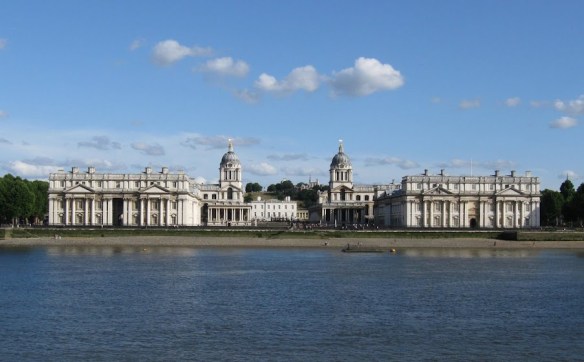
Sometimes, it takes a larger view for things to fall into perspective. Literally. Viewing the former Royal Naval College in Greenwich (pronounced Gren-itch) from across the Thames was one such experience.
I had spent a lovely day spent at Greenwich as part of a guided walk through Maritime Greenwich, a UNESCO World Heritage Site. Of particular interest to me were the two buildings of the former Royal Naval College, which was designed by Christopher Wren, and captured by the famous Italian painter, Giovanni Antonio Canal, better known as Canaletto. Throughout my explorations there, I kept searching for that one view that captured the beauty, simplicity and symmetry of Wren’s design, but in vain.
It wasn’t till I crossed the river Thames to the opposite bank to take the DLR back to London that I realised that I had been searching for Canaletto’s view from the wrong side. When I emerged from the underground foot tunnel, this was the beautiful sight that greeted me.
A view of the former Royal Naval College, Greenwich, from the River Thames
Do you ever have a song, an idea, a storyline, or an image stuck in your head? And it just refuses to go away? For some time at least? I have this with music—it could be a song, an instrumental piece, a jingle, etc. This becomes my “now’”song, and the “nowness” (pardon my English here) could be for any length of time.
With August 15th just a couple of days away, desh bhakti of different types is in the air. Excited plans for an extended weekend vacation thanks to Independence Day and Id holiday in the bus; plastic and paper tricolour flags at traffic signals, shop windows dressed up in white, green and saffron; a sudden rise in the popularity of “desh bhakti geet” on TV and the radio… yes, its that time of the year. Even my customised YouTube page had Independence Day recommendations for me. One of them was D.K. Pattammal (1919-2009) singing the Jana Gana Mana:
D.K. Pattammal (DKP) would have been 28 when India attained Independence on in 1947. I wonder what it must have meant to her as a young, trailblazing musician. For someone who was well-known for her renditions of Mahakavi Bharatiyar’s nationalist songs, did she see the songs coming to life with India’s freedom
Maybe she did, for the joy and pride in singing the national anthem is so evident in the video that it would take a cynic or a real pessimist to not be moved by her expressions. For a change, I love the video more that the actual rendition of the song itself and it’s all because of DKP.

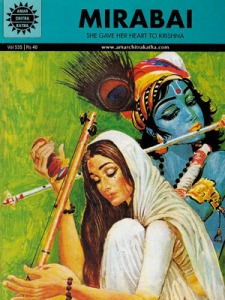 The 16th century princess-turned-poet from Rajasthan who was a devotee of Krishna? The rebellious Rajput princess who refused to worship any other god, but Krishna? The widow who was harassed by her in-laws because she refused to become a sati? The pious saint whose soulful compositions we hear now and then through the renditions of Lata Mangeshkar, Kishori Amonkar, M.S. Subbalakshmi, and others? An incident from Mirabai’s life in a school text-book? The Amar Chitra Katha comic book that narrates her entire “life story”?


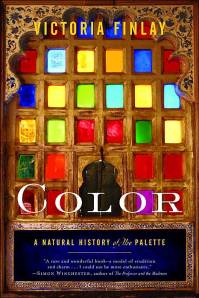 I read about all this and much more in Colour: A Natural History of the Palette (2004, Random House, pp.448) by


 My Favourite Things