Mumbai Lens: The garlanded cross

This blog post was featured in the “Around the Blog” section of the DNA newspaper published on August 27, 2012 (pg.7).

That rainy day, I was at Hill Road in Bandra on a gastronomical expedition busy stuffing my face and bags with cakes, quiche, and other baked goodies. My eyes or rather nose was trailing the various aromas coming out of the many bakeries that line the road. And that’s when a flash of yellow-orange momentarily distracted me, the yellow-orange of a string of marigolds garlanding a cross.
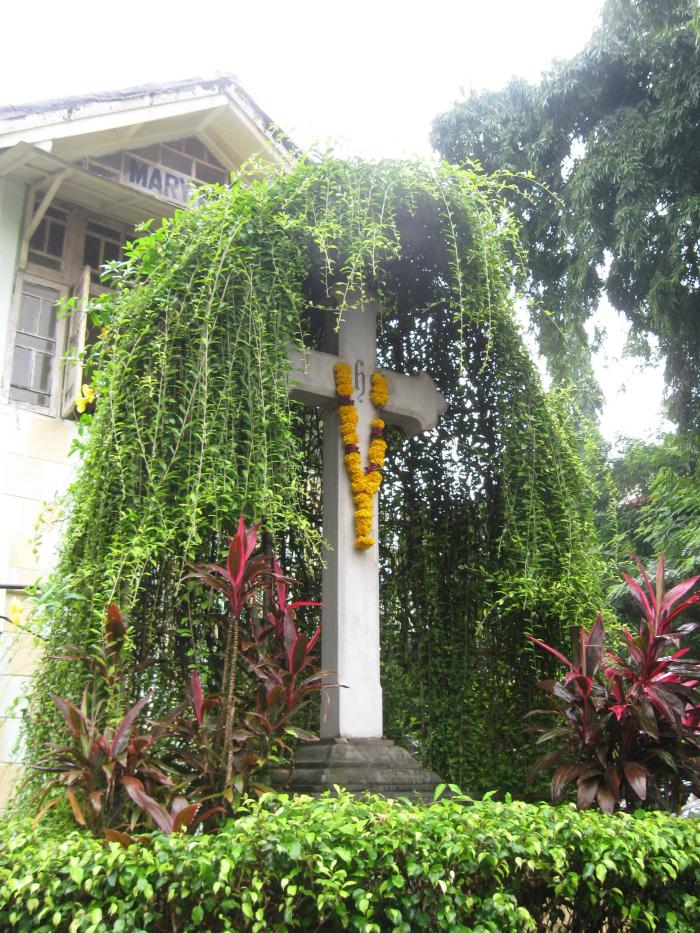
The garlanded cross

This large cross is somewhere on Hill Road (I can’t remember the exact location). Together with the beautiful veil like green and leafy canopy, the garland really lit up the cross.

I love the way people take something and adapt it to fit their uniquely local culture, be it food, clothes, music…. The sambhaar powder added to the tamarind paste used to make bhelpuri in Chennai, kurtis teamed up with jeans, Carnatic classical music on Western instruments like the mandolin and violin…, And the way we have “Indianised” Chinese cuisine is legendary !

But what I love the most is the way this adaptation plays out in religion. Recently, on a visit to Chennai, I saw a statue of Jesus standing on a lotus with peacocks at his feet. I have heard of aartis in churches, I have seen non-Hindus at the Sringeri and Brihadeeshwara Temples. But this was the first time I saw a cross “decorated” with a garland.

Academics call such expressions of adaptation syncretism; I call it making it our own. 😀

Mumbai Lens is a photographic series which, as the name suggests, is Mumbai-centric and is an attempt to capture the various moods of the city through my camera lens. You can read more posts from this series here..

Haiku: Poetry ancient and modern


“A book on haiku? You bought a book on haiku?” I asked AS, my colleague.

AS, who had just ripped open the packaging and was drooling over the book in question, looked up and answered, “Yes. Why? You don’t like haiku or what?”

“No. I don’t like haiku,” I said. And added for good measure, ” At all.”

“Why?” AS queried.”Haiku is so brilliant.”

“Maybe. It’s also too abstract for me,” I said.

“Abstract? Of course it is. It is minimally abstract and therein lies its beauty,” AS retorted.

“I don’t have a problem with minimal. Or abstract, ” I replied a tad defensively. “It’s just that the whole haiku thing is so vague.”

“I just think you’ve read the wrong type of haiku, Sudha. Here, read this. Then tell me you don’t like haiku.” Saying this, AS passed the haiku book to me.

And that’s how, dear readers, I ended up with Haiku: Poetry Ancient and Modern, an anthology edited and compiled by Jackie Hardy (2008, MQ Publications, 256 pages, Rs.325/-). Ended up holding it, opening it, flipping through it and finally reading it.

Continue reading “Haiku: Poetry ancient and modern”

Blue, green, yellow, red and white…

Recently, Anu Shankar of A Wandering Mind tagged me in the Capture the Colour contest organised by TravelSupermarket.com. The contest brief is, well, quite brief and simple:

… to publish a blog post with a photo that captures the following 5 colours – Blue, Green, Yellow, White and Red.

Hmmm… till about 4 years back I didn’t even give colours a second thought or glance. I took it for granted as growing up in India, they were always around me. But a year’s stay in London showed me how much colours mattered to me, and changed my very perception and understanding of colours.

I arrived in London at the onset of winter and its (in)famous winter weather. But the grey and damp weather didn’t bother me; neither did the sunless days affect me. But a monochromatic London of black and grey coats, hats, scarves, gloves and boots drove me crazy. That’s when I started noticing colours in the world around me, rather than only on people. Colourful shop fronts, buildings, pub exteriors, cars, tube stations, a stained glass window … took on a whole new meaning. I learnt to look at, appreciate and enjoy colours in a very different way.

It had to convince myself to participate in the contest as I don’t really consider myself as a photographer. But the idea of digging into my digital photo library was tempting and I had a great time choosing 5 of them—one for each contest colour. So presenting my blue, green, yellow, red and white photographs as well as my take on each of them. Continue reading “Blue, green, yellow, red and white…”

Museum Treasure: The suit of spades

It is the year 1678 in London and an uneasy religious calm and simmering tensions prevails in the city. Indeed, this is the prevalent mood across England and Wales. Though it has been 150 years since the English Church split from the Roman Catholic Church bitter differences remain between the Protestant majority and Catholic minority. The reigning monarch, Charles II, is a worried man as his successor and brother, James II is a Roman Catholic.

On the morning of 12 October, the magistrate of Westminster and strong supporter of Protestantism, Sir Edmund Berry Godfrey receives a report of an alleged Catholic plot to assassinate the King. On October 17, Godfrey’s body is found on Primrose Hill; it is automatically assumed that he has been killed by the Catholic plotters. This discovery sets off a wave of anti-Catholic sentiments and a chain of arrests and executions follow.

This event, which becomes part of the larger Popish Plot, is widely documented and recorded. One of the more unusual ways it has been documented is in a pack of cards now displayed at the British Museum, London !

The suit of spades from a pack of Popish Plot playing cards

Continue reading “Museum Treasure: The suit of spades”

The Docklands Light Railway and the London Docklands

The London Docklands is the name given to some areas of eastern and south-eastern London. Till the middle of the 20th century, the Docklands was where the various docks and dockyards used to be. Though the docks were originally built and managed by a number of private companies (for example, East India, West India, etc.), it was not till 1909 that it all came under the management of the Port of London Authority.

Redeveloped London Docklands near Canary Wharf. For those used to seeing a predominantly Georgian London, this view of the city can come as a bit of a surprise !

Today, the area is a mix of the commercial and the residential, and old housing estates and newer steel and glass structures as a result of massive efforts at redevelopment of an area that used to be predominantly labour class. The introduction of the Docklands Light Railway or DLR in 1987 fulled the development of an area that did not have good transport connectivity. The Docklands area has always been a trade hub for centuries; today, it is a hub of a different kind—the central business district of London is located here.

Tower Gateway DLR Station

The DLR is a fully automated light metro or light rail system to exclusively serve the Docklands area of London. It is quite distinct from the London Underground, and is also part of Transport for London. During my year’s stay in London in 2008–2009, I remained ignorant of the DLR largely because the Tube Bus took care of most of my travel requirements and I rarely travelled to the Docklands area.

Then one day, while returning to Central London from a day trip to Greenwich, the DLR turned out to be the most convenient mode of travel, and to use a clichéd term, travel was never the same again. It is a trip that I still remember, as a very different London emerged through that journey, very distinct from the Victorian and Georgian London that I had come to associate London with and love.

Such was my fascination for the DLR, that on one rainy and cloudy day, I spent a few hours travelling by the DLR, getting off at stations that caught my fancy and exploring the Docklands area on foot. I saw a very different London that day. A quieter London, steel and glass apartments, residences converted from warehouses, an airport by the river, colourful buildings, and so much more.

Presenting a sampling from that lovely day of a very different London courtesy the DLR journey that I took in July 2009 ! 🙂

Continue reading “The Docklands Light Railway and the London Docklands”

The corrupt Indian

So Anna Hazare and Team Anna are back with their fight against corruption in India and to ensure the implementation of the Lokpal Bill. There are mixed reports in the media about the success of this round of agitation, as none of the expected fasting, sloganeering, jail bharos, allegations, counter allegations, etc., etc, has really taken off. It the reports are to be believed then it appears that the movement has lost momentum as well as direction this time around.

I feel that part of the reason for the Anna juggernaut not sustaining is due to their simplistic understanding of corruption. Today, corruption is no longer only about those who take bribes; it is also about those who give bribes. Corruption is not only financial; it is moral, ethical, ecological, societal, ideological, creative… It is not only the politicians and the bureaucracy who are corrupt; society itself has become corrupt.

Corruption no longer has a simple definition; today, it is highly contextualised, complex, layered and subjective. What one person perceives as corruption can be another person’s “legitimate” way of securing his/her future! Take the case of a person who bribes his or her way to a lucrative posting within the organisation he/she works for. This is done with the understanding that the returns are worth the bribe paid. Think Customs, the Mumbai Octroi, the RTO… and you’ll know what I mean.

Corruption is so endemic and blatant that we have taken it for granted in a matter-of-fact way. Regrettably, the discourse on corruption in India rarely reflects its subjective understanding or its diversity or its depth or its endemic nature. Mostly, we get to read dry and technical analyses full of academic jargon, tables and figures and how India is being bled dry economically. Most of the articles are dramatic exposes intended to shock and titillate, but which ignore the deeper malaise that grips our society. Though some of these articles go into the reasons behind the corruption, very rarely does it take a mirror to the society we inhabit and present the different faces of the corrupt Indian.

I am surprised at the blinkers that we have on as we only have to look around us to see the many faces and avatars of the corrupt Indian 😦

Continue reading “The corrupt Indian”