The Swiss Family Robinson: A favourite no more

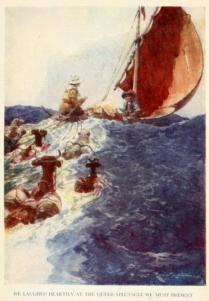
The Swiss Family Robinson was one of my favourite books growing up. I received an abridged version of this book for my 10th birthday and it was love at first read. For a 10- year-old girl with a rather active imagination, the story of a shipwrecked family living on a deserted island with nobody but each other for company was extremely thrilling and romantic. The family comprises Father Robinson (who is never named in the book), Mother Robinson (Elizabeth), and their four sons—Fritz, Ernest, Jack and Franz.

I read the book (which was first published in 1812) many times over the years and never failed to marvel at the resourcefulness of the hard- working Swiss Family Robinson who lived off the land, sea and air, or delight in their discoveries, inventions and adventures. In a way, it was one of my comfort books !

So when I recently found an unabridged, second-hand version of the book, I was delighted. It was a much-anticipated read and I was looking forward to reading all the details that an abridged version always leaves out. And the unabridged version of The Swiss Family Robinson did not disappoint on that score—the characters were fleshed out, the various adventures, discoveries and inventions were described in more detail, etc.

Continue reading “The Swiss Family Robinson: A favourite no more”

A weekend with a purpose

This weekend was a weekend with a purpose. A single-minded purpose to do some much-needed pruning. No, not pruning of trees or bushes or shrubs, but of my book collection, which had grown, multiplied and reached unmanageable levels at home.

Yes, I am talking about space constraints which was threatening domestic peace. A week ago, my mother nearly had a fit when she found 3 of my books inside the pressure cooker she uses when we have more than 10 people over for a meal. When I told her that she had not used that cooker for more than 6 months and would probably not use them for another 6, she was not amused. When I persisted by saying that I was only making good use of available space like a true Mumbaikar, she mumbled something about encroachment and territorial rights. Mothers !

But I knew that she was right. A pressure cooker is nearly always meant for cooking (though I do remember the pressure cooker in question being used for storing water, when we faced severe water shortage a few years back) and is certainly not the place for keeping books. And my books were all over the place at home (in addition to being in book shelves meant for them)—they shared space with sheets and the pillow covers, my dupattas and shalwars, my CDs and my tanpura, and of course my mother’s pots and pans.

Image Source: MS Office Cliparts 

The easiest thing for me would have been to get additional shelves made, but I knew that this was not the solution. The solution lay in pruning my book collection—not an easy decision at all as I am attached to all my books and it would be difficult to decide which books to keep and which ones to discard/give away/sell.

After thinking about it for some time, I came up with a 5 point criteria that I hoped would help me separate the books I wanted to keep and the books I could to say goodbye to.

Shakespeare in doubt !

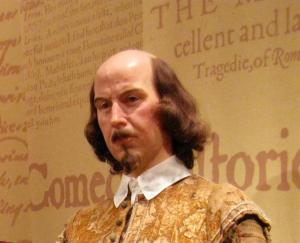
William Shakespeare at Madam Tussaud’s

Willm Shaksp. William Shakespe. Wm Shakspe. Willm Shakspere. William Shakspeare.

These are the different ways in which the world’s (arguably) best known dramatist’s name has been spelt in documents dating from the 16th and 17th centuries. Funnily, the one spelling that has not been used is the one currently used today — William Shakespeare (1564–1616). One can also not be reasonably sure as to how the name was pronounced either. In fact, one cannot be reasonably sure about many things about William Shakespeare — what he looked like, what was the order in which his plays were written, did he ever travel outside England, his sexuality, his likes or dislikes… or even when he was born. It is quite ironical that while most of Shakespeare’s own works have survived, nothing about Shakespeare himself survives. It is almost as if he did not exist !

Although he left nearly a million words of text, we have just 14 words in his own hand… Not a single note or letter or page of manuscript survives… We can only know what came out of his work, not what went into it… It is because we have so much of Shakespeare’s work that we can appreciate how little we know of him as a person.

All this information and more form the basis of a biography on William Shakespeare by Bill Bryson. Simply titled Shakespeare, this book is based on information gathered from many sources, as well as previously published work and is presented in trademark Bill Bryson style. The book is not just about Shakespeare, his life and works, but is also about Elizabethan England, Protestantism, 16th century London and more.

Continue reading “Shakespeare in doubt !”

Puranic tales for cynical people and humour for all

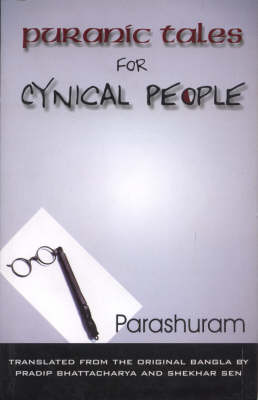
How often do you pick up a book on the basis of its title? I do that sometimes, often to be disappointed. But Puranic Tales for Cynical People (Indialog, 2005), written by Parashuram and translated from the original Bangla by Pradip Bhattacharya and Shekhar Sen, was an exception. I purchased this book in 2005, read it from start to finish, and loved it so much that I was all set to read it a second time. That never happened, and after a while it got shelved with my other books, hidden but not fully forgotten.

Until recently, that is. My brother unearthed it recently during a raid on my bookshelves in search of some reading material. Thanks to him, I was able to once again delight in the book’s sometimes light, sometimes acerbic, and sometimes irreverent humour.

Parashuram was the pen name of Rajsekhar Bose (or Basu, if you please) (1880-1960). Under this nom de plume, he wrote a 100 short stories, which were published in 9 collections. Twenty of these stories have been put together in this collection of Puranic Tales for Cynical People by the translators.

The basic premise of most of these stories revolves around the intriguing possibility of placing “well-known characters from the Puranas in situations that might have been”. In other words, they cater to the question of what happened next or a behind the scene narration of a famous story or incident. For example: what happened to Surpanakha after the Ramayana? Did the celibate Hanuman ever consider matrimony? Did Vishwamitra and Menaka always have a lovey-dovey relationship? Do apsaras always stay young?
In the process, Parashuram pokes fun at everybody—from the Creators (Hindu, Christian and Muslim) themselves, to venerable sages and other characters that any reader who is even reasonably acquainted with Hindu mythology will be able to identify and relate to.

Some of the lesser known characters that Parashuram breathes life into are Yayati (‘Yayati’s Senility’), Revati (‘Revati Gets a Husband’) and Maharishi Jabali (‘Jabali’). Two of the stories actually make caricatures of two of the crankiest,  hot-tempered and feared sages—Durvasa (‘Bharat’s Rattle’), and Vishwamitra (‘The Clay Girdle’).

Two stories explore the possibility of what happens when (i) the creators of the world’s 3 main religions meet (‘Three Creators’); and (ii) the 7 immortal men from the Puranas meet—Ashwatthama, Vyasa, Hanuman, Vibhishana, Kripacharya, Parashuram (the sage that is, not the author), and the Daitya king, Bali—at ‘The Gandhamadan Conclave’. Both these stories are absolutely delightful. While the former hits out at the claim of comparative superiority of one religion over others, the latter story emphasises the fact that all wars are essentially unfair.

Continue reading “Puranic tales for cynical people and humour for all”

84 Charing Cross Road: A second-hand love affair

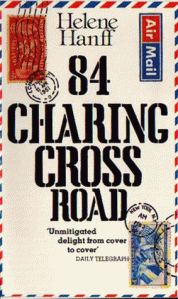
It was at a cousin’s wedding that an uncle gave me his copy of 84 Charing Cross Road with a crisp, “Read it. It’s good”. Now, I don’t know about you but long drawn-out weddings are not my cup of tea, and I always look for avenues to keep sane at such events. This book provided me with that perfect opportunity to escape from cope with the wedding festivities.

So, I read the book while getting my mehendi done, while helping my cousin’s trousseau to be packed, in the middle of the night under torchlight, when I couldn’t bear the collective grunts and snores of so many aunts in the hall we were sleeping in, between the many wedding ceremonies, etc. By reading a few pages at a time, I managed to finish the 100-odd pages of the book over 3 days and return it to my uncle. I was just in time to congratulate the newlyweds after the wedding ceremony, and then run out to try to obtain my very own copy of the book.
So what is 84 Charing Cross Road (by Helene Hanff) all about? I found the book’s blurb—an extract from its review in the Daily Telegraph—tantalising.

This book is the very simple story of the love affair between Miss Helene Hanff of New York and Messrs Marks and Co, sellers of rare and second-hand books at 84 Charing Cross Road, London. It is unmitigated delight from cover to cover.

Continue reading “84 Charing Cross Road: A second-hand love affair”

The Emerald Route: One book, many narratives

What would you call a book that

(a) is primarily a travelogue,
(b) is also a concise literary, spiritual, religious, mythological, and political history of the region,
(c) is part autobiographical, and
(d) includes a description of taming wild elephants, a folk tale and a one-act play.

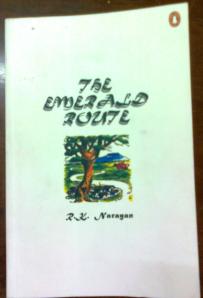
The cover illustration is by R.K. Laxman

The book that I am talking about here is R.K. Narayan’s (RKN) The Emerald Route, which is the outcome of the author’s travels along with R.K. Laxman, his brother and the famous cartoonist, through the length and breadth of Karnataka.

First published in 1977 by the Director of Information and Publicity, Government of Karnataka, and then by Penguin India in 1999, I recently bought the latter edition on the recommendation of Smeedha, a friend.

RKN chose to title his book “The Emerald Route” for one important reason—he did not encounter even a single dry patch during the first phase of his tour from Mysore through Hunsur and Hassan and back. He says:

Continue reading “The Emerald Route: One book, many narratives”