A book lover’s Narnia

The Guest Post Series on “My Favourite Thingshas contributions by those sharing my interests in travel, books, photography, music, and on issues that I am passionate about. Though the guest posts are not always by fellow bloggers, the guest authors are always those who have interesting experiences to share.

Today’s guest author is Deepa of Deepa’s Kaleidoscope. An engineer by training, but a writer at heart, Deepa writes fiction and on social issues with equal parts passion and reflection, which results in a unique perspective on a particular topic. Currently based in Melbourne, this guest post is a result of her exploration into the bewitching world of the many bookstores in the city. An exploration that has just begun and one, I suspect, is a never-ending one. 🙂

The way to a man’s heart is through his stomach, so they say. This morning, I found a sweet little image that said, ‘The way to a woman’s heart is through a bookstore’. And if you’re here reading this blog post in the middle of your workday, night or while on the road, regardless of whether you’re a man or a woman, the saying probably applies to you too!

Melbourne, where I am currently based, is well-known for its Arts Precinct, a part of which also includes the Literary Arts. And when we think of literary festivals and fundraisers, how can books be far behind? Walking through the streets of Melbourne, you would be pleasantly surprised at how you encounter a bookstore every 2–3 blocks. Some of them are the typical run-of-the-mill kinds boasting of sales and specials, some are steeped in history and every one of them has a story behind it!
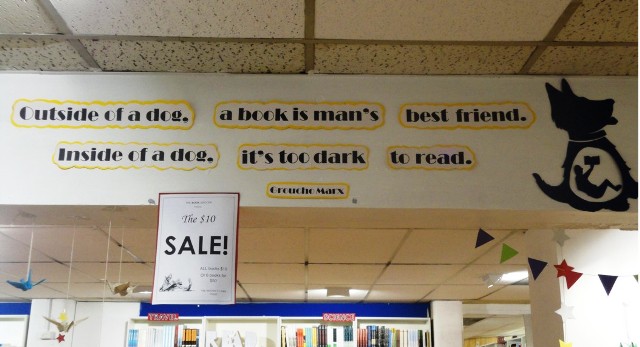
Melbourne Bookstores 1 Continue reading “A book lover’s Narnia”

Serendipity and a second-hand book

Serendipity. I can sum up my day today with this one word.

It was a day that began very simply with my camera and I setting out to do a bit of exploration of my city. We first went to Sion, clicked some impressions and recorded some memories. And then to Matunga to have some hot filter kaapi. Happy and satisfied with the morning’s efforts and eager to see the results of my  photography, I turned homeward.

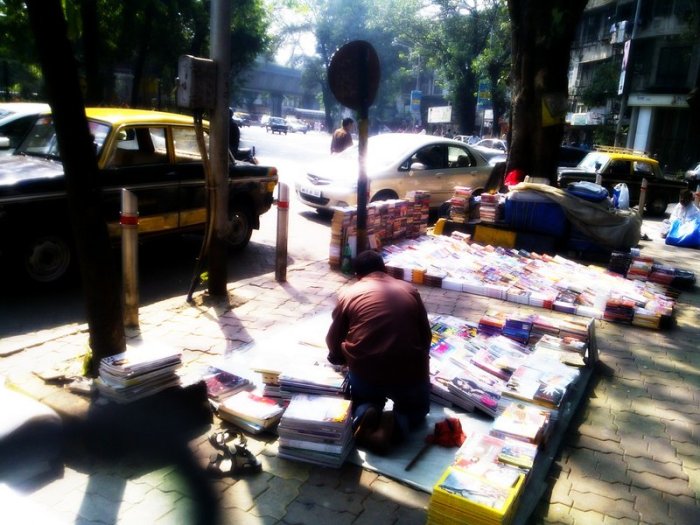
As I walked towards my bus stop, I came across this sight of booksellers setting up their stalls on the pavement at King’s Circle.

Pavement Bookstalls
Booksellers setting up their stalls on the pavement at King’s Circle in Mumbai

The late morning winter sunlight created beautiful patterns of light and shadows amongst the piles of National Geographic, Home & Garden, travel magazines, self-help books, classics, Mills & Boon, pirated copies of best sellers… It was delightful to see the books being dusted and lovingly laid out. Since, I had already packed my camera away, it was my cell phone camera that had the honour of capturing this sight.

As my eyes skimmed the book piles, the magazine stacks, and the neatly laid out rows of books, there came that little heart-stopping moment of the beautiful kind. The one where you see an unexpected treasure in the form of a book. One that lights up your eyes in anticipation, and quickens your breath just that little bit. And as you savour that moment, the world slows down just for you.

Continue reading “Serendipity and a second-hand book”

The House of Fear by Ibn-e-Safi

The place: Allahabad. The year: 1948. Twenty-year old Abrar Narvi was a fairly well-known Urdu poet, a sometimes writer of short stories and satires, and with a wish to write in other genres as well. One day, someone told him that Urdu novels “would not sell without an element of sex in them”. When Narvi said that no one had ever tried, the same someone retorted that until this was tried no one would know, would they?

Narvi took this remark very seriously, changing the course of his life and that of a whole legion of his readers. In 1952, under the pseudonym of Ibn-e-Safi, he produced his first novel in Urdu without an element of sex and with an emphasis on originality and newness. This novel, in the crime fiction genre, was the first of a series that came to be known as “Jasoosi Duniya”. And in 1953, when Narvi migrated to Karachi in Pakistan, another series was created in the same genre that came to be known as the Imran Series.

Ibn-e-Safi was a prolific writer and wrote 3–4 novels a month at the peak of his productive period. When he passed away in 1980, he had written about 245 novels across both the series. Published simultaneously in India and Pakistan, his novels were hugely popular as they were the type that everyone in a family could read. In fact, Ibn-e-Safi’s publishers (on both sides of the border) claim that no writer of Urdu crime fiction has broken his sales record till date!

It is this popularity which prompted an attempt at translating Ibn-e-Safi’s novels into English to enable a larger number of readers to become acquainted with his works.

Continue reading “The House of Fear by Ibn-e-Safi”

The Red House

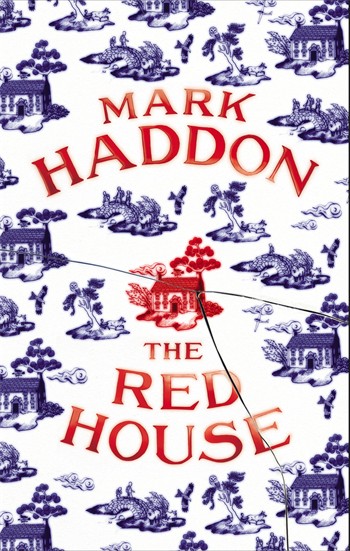
Take two families, related families actually, and have them holiday together. They spend a week together in a neutral place, a holiday home, and interact and relate to each other, and attempt to be one big happy family. This is the plot, in brief, of The Red House by Mark Haddon (Jonathan Cape, 2012, pp. 264). But families are never simple are they, and the families here are no exception. And therein lies the extraordinariness of this book.

Richard and Angela are brother and sister, siblings who have buried their mother recently. Estranged for many years now, they don’t really feel like “brother and sister, just two people who spoke briefly on the phone every few weeks or so to manage the stages of their mother’s decline” (p. 6-7). A week after their mother’s funeral, Richard invites Angela and her family to holiday with him and his family. A surprised Angela accepts.

For Richard and Angela, this week gives them a chance to try to put their estrangement behind them and forge a new relationship. It is a week where 4 adults and 4 children try to “bond” with one another. So who are these 8 “family” members?

Continue reading “The Red House”

The Sunday Book Club


Do you like Sundays? I do. In fact, I love Sundays as I can laze around, have a traditional South Indian lunch, chat with friends and family over the phone, read books or surf for books to beg, borrow or steal buy. It is generally a day for relaxing and recharging for the week to come.

Starting 30th September 2012, my Sundays are going to change, and I am very excited and happy and nervous about this. You see, I have agreed to be part of a new venture, and that too as a co-founder, no less ! Co-founder of The Sunday Book Club. Raghav (@raghavmodi), the founder of the very successful Movie Talk on Sunday (#MTOS), contacted Rahul (@meetneo) and me about 10 days back. And after a flurry of emails, DMs, and tweets, we found ourselves co-founders of The Sunday Book Club (#TSBC). 🙂

The Sunday Book Club on Twitter (#TSBC) is an initiative to get the Twitter Community together at a particular time and day each week to discuss various book-related topics. The aim of the whole exercise, besides having fun, is to find like-minded individuals who share the same passion for books as you do and in the process discover different books, authors, and genres that the bookworm in you might fancy.

In other words, it is the perfect opportunity for you to know about new books, interesting facts, and even participate in competitions and interact with special guests. The #TSBC events will take place from 15:00-16:00 Indian Standard Time every Sunday beginning 30th September. For more details on #TSBC, please visit my page on The Sunday Book Club. 

Continue reading “The Sunday Book Club”

Colour: A natural history of the palette

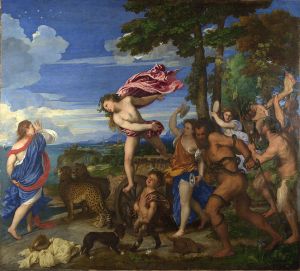
Sometimes, we miss the forest for the trees. And sometimes, we miss the trees for the forest. Let me give you an illustration. Take a look at the painting below (click on the picture to see a larger view).

Source: The National Gallery, London

The painting is called “Bacchus and Ariadne”. It was painted by Titian sometime between 1520 and 1523. It depicts a tale from Roman  mythology where Bacchus (the God of Wine) sees the mortal Ariadne and falls in love with her at first sight. He is so smitten that he jumps out of his cheetah-drawn chariot towards her. The painting has captured Bacchus in mid-leap as Ariadne shies away from him in alarm.

I saw this painting at London’s National Gallery in 2009. I duly noted the story that the painting conveyed, the various characters in it, the lovingly painted animals, Titian’s trademark use of bright colours… and moved on to the next artwork. It was a nice painting, but not particularly impressive. Or so I thought. Today, I bitterly regret at only looking at the painting, but not seeing it closely enough. In only looking at the painting, I had completely failed to see the colours themselves, particularly the brilliant blue of the sky — a blue which came from the ultramarine paint made from the semi-precious lapis lazuli mined hundreds of miles away in the Sar-e-Sang valley (in present day Afghanistan).

The lapis lazuli from these mines would have travelled through ancient trade routes to the colour maker in Italy, who then transformed it into the very expensive ultramarine paint through a laborious process. First, the lapis lazuli would have been finely powdered and kneaded into a dough along with resin, wax, gum and linseed oil for 3 days, after which it would have been put in a mixture of lye and water. This mixture would have been kneaded again, this time with sticks, to draw out the blue of the lapis lazuli into the liquid. The blue-coloured liquid would have been be collected in bowls and allowed to dry, leaving behind a powdery blue pigment, the ultramarine blue. The process would have been repeated with the “dough” to get different qualities and shades of blue (pg.290-291). These days making the ultramarine paint is not so laborious as it is made synthetically.

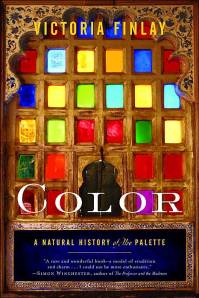
I read about all this and much more in Colour: A Natural History of the Palette (2004, Random House, pp.448) by Victoria Finlay. The book can be considered as a travelogue; it can also be considered as a book on art history. But for me, it is a book on the micro-history of colour as explored through an artist’s paintbox holding the colours of the rainbow and then some more — violet (or purple), indigo, blue, green, yellow, orange, red, ochre, white, black and brown.

In her attempt to trace and draw out the stories of how natural dyes, paints and colours were made for a European artist’s paintbox, Finlay travelled to Australia, England, China, Chile, Italy, India, Iran, Spain, Afghanistan and Lebanon. As each story, myth, legend of the colours come into life, we realise that:

Continue reading “Colour: A natural history of the palette”