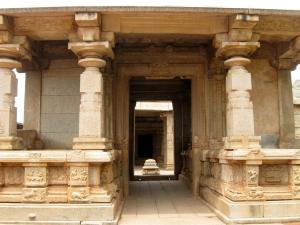
The temple ruins of Hampi – 1: Hazara Rama Temple

The simple and elegant entrance to the Hazara Rama Temple

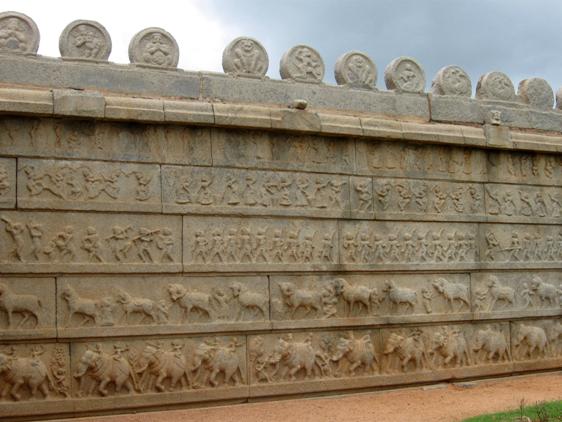
For me, the Hazara Rama Temple is right on top of the list of temples I liked in Hampi. This is not one of the biggest or the grandest of temples in Hampi, but it is certainly the most intimate temple, a temple which felt like my own personal space. It is also the temple with the most intricate carvings, which begin with the outer walls of the temple complex itself.

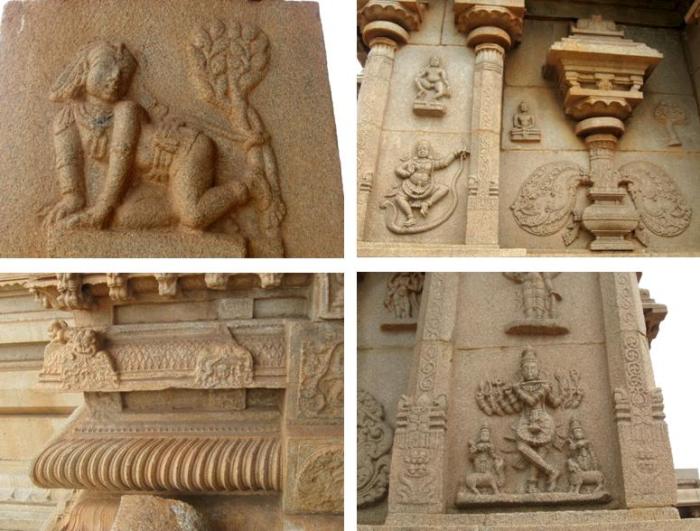
Inside, the temple is no less ornamental. It is full of bas reliefs from the life of Rama or Krishna, both avatars of Vishnu. I was very proud of myself for being able to recognise the various characters in the panels and reliefs and the stories that were trying to convey. All thanks to the stories that my grandmothers and my mother narrated to me in my childhood. And of course, Amar Chitra Katha!
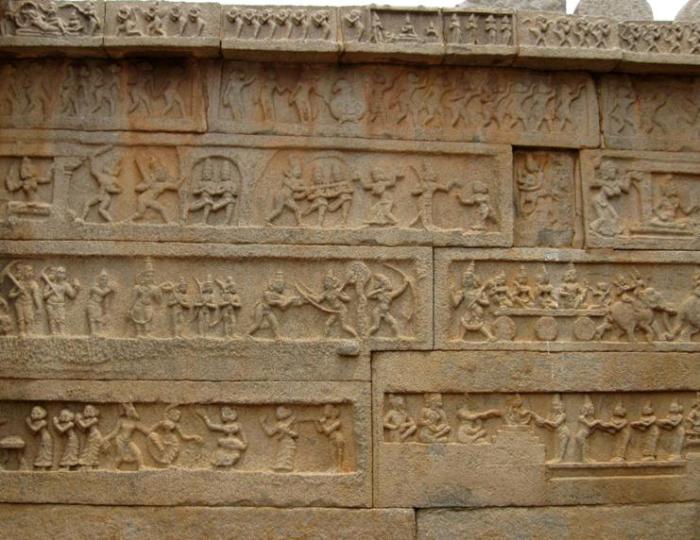
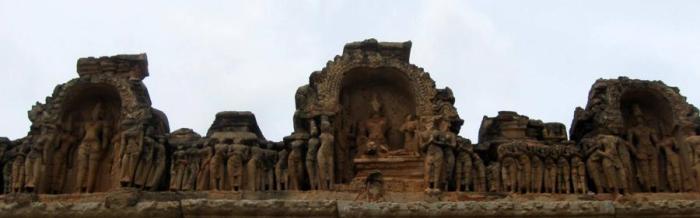
Carving above the entrance to the Hazara Rama Temple
This wall panel at the Hazara Rama Temple depicts hunting scenes, foreign traders, and dancing women
Sculpted friezes on the walls of the main shrine at the Hazara Rama Temple

All monuments in Hampi have been built out of granite, the local stone. Only in two places have other stones been used and that too for decorative purposes, rather than as a building stone per se. The first instance is at the Mahanavami Dibba where a green schist has been used as a cladding stone. The second instance is at the Mahamandapa of the Hazara Rama Temple, where 4 pillars made from black Cuddapah stone—brought all the way from present day Andhra Pradesh—have been installed. The carvings on these pillars are also from the lives of Rama and Krishna and are simply awesome. The gleam of the black pillars in the cool, dim light of the Mahamandapa is indescribable.
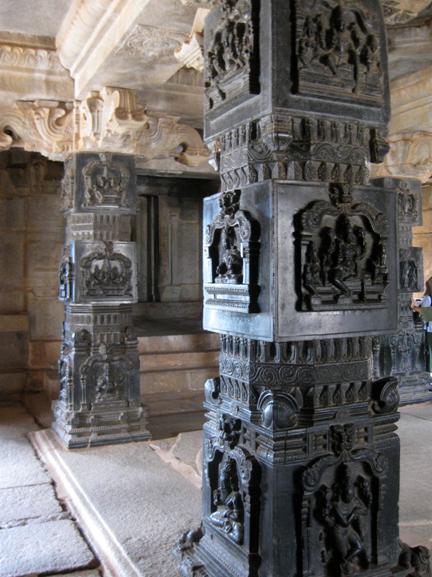
Intricately carved pillars made of the black Cuddapah Stone in the Mahamandapa of the Hazara Rama Temple

The Hazara Rama Temple is located somewhere between the Royal Enclosure and the Zenana Enclosure, and historians consider that this temple was built for the exclusive use of the royal family.

I do not buy this theory simply because of the nature of the bazaar outside the Temple. Like all the main temples in Hampi, the Hazara Rama Temple too had a bazaar outside its premises—the Paan-Supaari Bazaar. Now tell me, why would a bazaar outside the so-called Royal Temple, be selling paan (betel leaf) and supaari (betel nut)? If the bazaar had been selling precious stones and gold and silver items, I might have been willing to consider the fact that the Hazara Temple was exclusively meant for the Vijayanagara Royal Family.
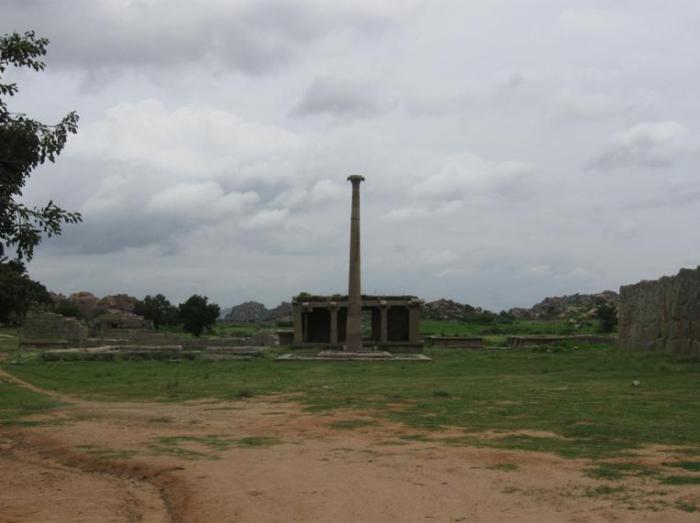
The Paan-Supaari Bazaar outside the Hazara Rama Temple

What do you think?

P.S.: This visit was part of a tour organised by Doreen D’Sa of Doe’s Ecotours. She can be contacted at does_ecotours@yahoo.co.in.

♦ ♦ ♦ ♦ ♦ ♦

Read more about my trip to Hampi through the following posts:

Royal Hampi

Royal Hampi is almost synonymous with Krishna Deva RayaVijayanagara Empire‘s best known king, who ruled from 1509–1529. Though there were many kings before him and a few after, most people associate everything with the Empire to Krishna Deva Raya. Lokesh, our local tour guide, was no exception—after a general introduction to Hampi and the Vijayanagara Empire, all his stories began and ended with Krishna Deva Raya!

Royal Hampi is instantly distinguishable from the other ruins at Hampi, largely due the different design elements used (for example, the Indo-Islamic architectural style of the Queen’s Bath), the delicate embellishment (for example, the Lotus Mahal), and of course, the royal size (for example, the Mahanavami Dibba).

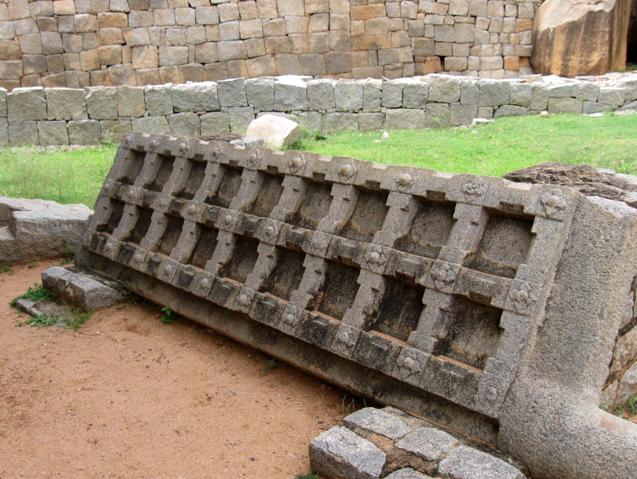
When our group disembarked at the Royal Enclosure from our vehicles, I don’t think many of us were sure as to what we were going to see beyond a high wall in front of us and some large blocks of stones lying here and there. As our group gathered around Lokesh for his orientation talk to the Royal Enclosure, none of us paid much attention to those blocks of stones. I was too busy looking around here, there, everywhere—except at my feet, which were just inches away from the massive “block of stone” shown in the picture below.

Stone Door outside the Royal Enclosure at Hampi

Continue reading “Royal Hampi”

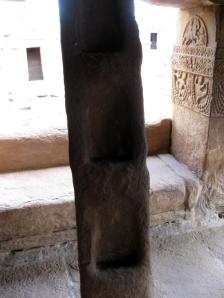
Aihole: A UNESCO world heritage site-in-waiting

A stone ladder leading to the roof and inside the Ladkhan Temple

A drive through sleepy hamlets, lush green fields and the village of Aihole (pronounced I-ho-lay), brought us to another heritage temple site dating from around the 5th century.

Known as Aryapura in ancient times, Aihole occupies a unique place in the history of temple architecture in India. It was the site for experimenting with different temple-building styles by the early Chalukyan kings from AD 450 to 750. This experimentation began in Aihole, continued at Badami and finally culminated at Pattadakal. Our guide told us that the ruins of a temple, probably dating back to pre-Chalukyan times, had been recently excavated in Aihole. The present-day village settlement and agricultural lands were coming in the way of a full-scale excavation.

There are around 120 temples of varying styles and sizes in Aihole (all built from the same local red sandstone). I tried to imagine 120 temples, each with a unique architecture and failed. But I could imagine the whole area being turned into an architectural laboratory or a workshop, with architects and sculptors being invited over and given a site for constructing a temple. Just imagining the creative buzz in the area was enough to give me a high! Unfortunately, our group had the time to visit only one site, which had about 4 temples of such varying styles that it was astonishing and gave a glimpse into the kind of experimenting that was promoted and encouraged.

Continue reading “Aihole: A UNESCO world heritage site-in-waiting”

The Pattadakal Temples: Where kings were crowned and villagers dwelled

The Ganges or the River Ganga is considered to be holy to Hindus. And in Varanasi or Benares, the Ganga is considered to be at its holiest. Do you know why? It is because the Ganga’s flow is uttarabhimukhi or from South to North there, as against the usual West to East, or the less common East to West. I learnt about this piece of trivia when I visited Pattadakal.

Pattadakal is a small village in North Karnataka, situated on the banks of the river Malaprabha. It is a rather unremarkable looking, dusty village, made remarkable for one thing—the Malaprabha is also uttarabhimukhi here. This unique feature was considered an auspicious sign by the rulers of the Chalukya dynasty, thereby singling it out for royal attention.

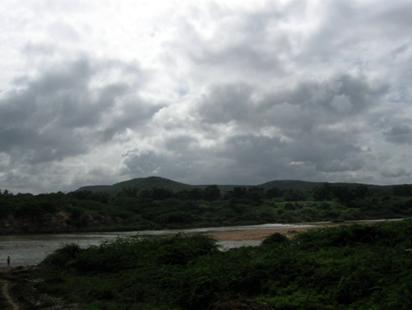
The North-flowing Malaprabha River at Pattadakal

And what an attention Pattadakal got ! The Chalukya Kings chose Pattadakal as the site for their coronation ceremonies. Being lovers of art and culture, they also chose Pattadakal as the site for building a unique temple complex that would blend the architectural and artistic traits of the northern and southern styles of temple-building that was in vogue in the 8th century. Eight temples were built on one site as a group, while two other temples were built some distance away in Pattadakal. This group of monuments at Pattadakal are designated as a UNESCO World Heritage Site.

Continue reading “The Pattadakal Temples: Where kings were crowned and villagers dwelled”

An enchanted evening at the Agastya Teertha & Bhootnatha Temple

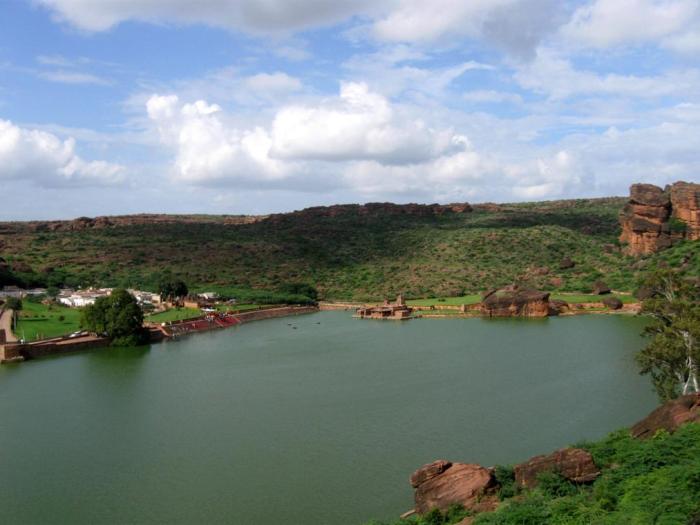
The two Bhootnatha Temples of Badami are located in one of the most picturesque settings that I have seen in my travels. In the photograph below, the Agastya Teertha or lake is spread out with the Bhootnatha Temple on the eastern bank visible somewhere near the centre of the photograph. Though I had seen pictures of the Agastya Teertha and the Bhootnatha Temple in a similar setting, the feeling of “Wow” is quite different when you see it yourself, than the “Wow” you feel when you see a photograph.

The Agsatya Teertha and the Bhootnatha Temple on its eastern bank

The Bhootnatha Temples are dedicated to Lord Shiva—Shiva in the form of the God of souls, spirits and ghosts. Built out of red sandstone probably sourced from the surrounding hills, the two temples are placed opposite one another at the eastern and western banks of the Agastya Teertha. The approach to the Agastya Teertha and the Bhootnatha Temples from Badami Caves is via a narrow and winding path that passes through a village.

It was around 5 pm when we arrived at the banks of the Agastya Teertha. From there we could see both the Bhootnatha Temples. The sun, which had been playing hide and seek with the clouds and us the whole afternoon, came out for a brief while. Almost on cue, the strains of a shehnai began, probably played from western Bhootnatha temple. The strains soon grew louder and discernible as Raga Sarang.

Continue reading “An enchanted evening at the Agastya Teertha & Bhootnatha Temple”

Badami rocks !

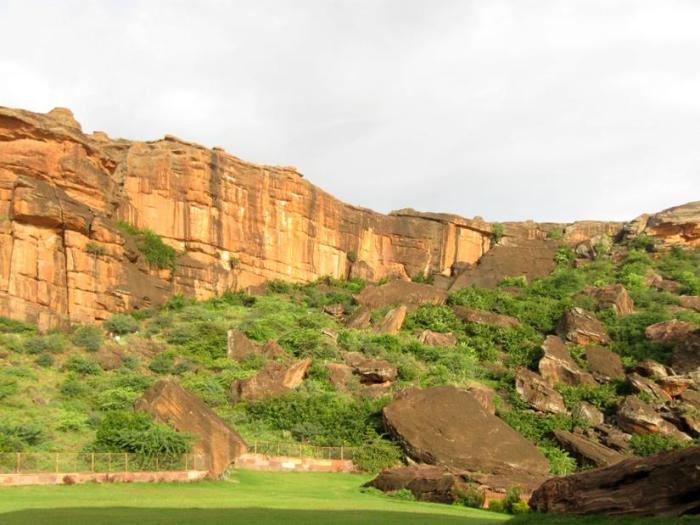
The first time I heard about Badami was in my undergraduate Geology class nearly 20 years back. It was a class on the Geological Time Scale and we were being shown slides from various parts of India and the world as examples of different geological time periods. I still remember the Badami slide from that class—the sheer red sandstone cliffs, silhouetted against a deep blue sky. It was love at first sight.

Red Sandstone Cliffs of Badami

At that time I had absolutely no idea that Badami was also the location of rock-cut cave-temples dating from the 6th century. I got to know about this only a couple of years back, when one of my brothers visited the cave-temples of Badami and shared his photographs. Now, it was love at second sight!

When the opportunity to visit Badami, along with other heritage places in North Karnataka, as part of an organised tour group came up, I grabbed it with both hands. I applied for leave from work a full month in advance, juggled deadlines, prayed hard, etc., etc.

Bijapur was our first halt and after an overnight stay in that town, we left early next morning for Badami, with a short halt at the Almatti Dam Gardens. By noon, the red sandstone cliffs of Badami appeared in the horizon. There is an interesting reason as to how Badami got its name. Someone in the historical or mythological past, and I don’t know who, felt that the red stones were the colour of  badam or almonds. And hence, the name!

Continue reading “Badami rocks !”