Remembering Satyendra Dubey

Today is 27/11. A day that is almost over at the time of publishing this post. For many, it may have been a day like any other. For some, it may have been a day marking a personal or professional milestone. But 27/11 is no ordinary day. It is a day that no Indian should forget for it was on this day, 8 years ago, that the issue of entrenched corruption in India was brought to the forefront like never before. It was the day that Satyendra Dubey was killed for exposing corruption.

Source: http://www.rediff.com/news/dubey.htm

Satyendra Dubey was a bright young engineer and project manager of the Golden Quadrilateral, one of India’s most ambitious road-building projects undertaken by the National Highway Authorities of India (NHAI). In a letter to the Prime Minister’s Office in May 2003, he exposed  the corruption and irregularities in the road building contracts issued by the NHAI for this project. In the same letter, he also requested for his identity to be kept a secret. The contents of the letter and his identity were ‘leaked’ by the Prime Minister’s Office and on 27 November 2003, he was shot dead in Gaya, Bihar. His murder sparked off an unprecedented public outrage in a country that is quite thick-skinned and immune to such callousness. It would not be incorrect to say that Satyendra Dubey’s was probably the first martyr against corruption in recent times

Continue reading “Remembering Satyendra Dubey”

Papakudi Meena

It was a little over noon when the train from Madras pulled into Dadar station in Bombay. It had been a long journey for the weary and grimy travellers, who disembarked with a sense of relief. Some were being received by family and friends, while many more were just making their way out of the station on their own.

Ram looked fearfully out of the train window. This was his first time in Bombay and he had never seen so many people or heard so many languages spoken at one time. He had also never smelt anything like this before—the smell of so many people, sweat, the salty air and his own fear of the unknown. His first instinct was to take the next train back to Madras and then another to his native village in southern Tamil Nadu. That’s when he thought of his family back home and the reason he had come to Bombay—to make a living like countless others before him, and countless others after him.

He took a deep breath, gathered his belongings and resolve, said a prayer to his favourite god Shiva and stepped off the train. He now had to make his way to his cousin Meena’s house in Matunga; Meena’s husband, Raman had promised to help him find a job. But first he needed to get to Meena’s house, which he had been told was not too far from Dadar station.

Continue reading “Papakudi Meena”

Appa

The mood was quite festive in the shop. It was the first day of the 10-day Ganpati festival and customers were lining up to collect their pre-booked idols to take home. They would give their names and man at the counter would check against the labels attached to the various idols and hand over the correct one with some flowers and coconut, and a loud “Ganpati Bappa Morya”.

Soon it was our turn to collect the Ganpati idol we had booked.

“Namaskar,” said the man at the counter, “What is your name?”

“Ganapathi”, said Appa (my father).

“Uncle, I asked for your name,” said the man at the counter.

“Ganapathi,” repeated Appa.

“Uncle, I know you have come to collect your Ganpati idol. I want to know the name you have booked it under,” said the man at the counter, a little impatiently now.

“That is what I have been telling you. My name is Ganapathi,” said Appa patiently.

The man at the counter looked a little stunned and then burst out laughing. “Sorry, Uncle. I have never had a Ganapathi come to collect a Ganpati idol.” He handed over our pre-booked idol with the flowers and coconut, and then came out of the counter to touch Appa’s feet and ask for his blessings.

Whenever Appa shares this incident, which happened about 10 years back, with family and friends it always brings forth lots of laughter. And during the Ganpati season, it is a much repeated story. The 2011 Ganpati season is underway now and this year too, the story will be narrated, not by Appa, but by us with a bittersweet tinge. For Appa is no longer here to narrate this incident. He passed away a month ago.

Continue reading “Appa”

Conversations and encounters in a hospital

It is almost 7.00 pm when I enter the hospital. Appa (father) is in hospital once again (the third time in as many months) and I am hurrying to relieve my eldest brother who has done the “day shift”; I will be doing the “night shift”. The huge lobby is packed with people and the place actually looks and sounds like a railway station sans luggage. There is a group of about 30-40 people waiting to meet a patient and from their looks and body language, I presume that this is a happy occassion—probably the birth of a baby. The  harassed security guards are having a tough time turning away the rush of visitors as visiting hours are long over.

One of the security guards, who by now recognises me from my numerous visits to the hospital, mutters to me in an exasperated undertone, “Visitors!” I smile sympathetically at him, while recalling a conversation I had many years ago about hospitals and visitors.

“Madam, I want to leave early today.”

I look up from my work to see my department peon, Purushottam, standing at my desk.

“I have to go to the hospital, madam, ” he continues.

“Is everything all right?” I ask.

“I am fine. My cousin’s father-in-law’s sister’s husband has been admitted to the hospital and I have to go there.”

“Purushottam, the patient is not even related to you. Why do you want to go to the hospital? If it is that important, you could visit him once he has been discharged.”

Purushottam is shocked. “It doesn’t matter that the patient is not a close relative. He is from our biradari (clan), and everybody from our biradari will visit the hospital. If I don’t go, it will not be taken well. And anyway, I will also visit him after he is discharged.”

I change my tactic. “Won’t the patient need rest? He is hospitalised, after all, and with your entire biradari visiting, he’ll end up getting tired.”

“Oh I may not actually see him per se; I don’t even need to. I will meet his son or wife and give my best wishes for a speedy recovery. What is important is to show solidarity and support at this time.”

Continue reading “Conversations and encounters in a hospital”

‘Meeting’ MF Husain in London

Christmas Eve 2008. London. At around 7.30 pm that evening, you could have found me at Hyde Park with two friends, Bharath and Krithika. Three Indians with varying degrees of homesickness. Hyde Park was more crowded than usual that day—apart from the casual visitors and walkers and joggers, it was full of revelers at the Christmas Fair being held at the Park. We, too, joined the revelers, but after some time found it unbearably noisy and decided to leave.

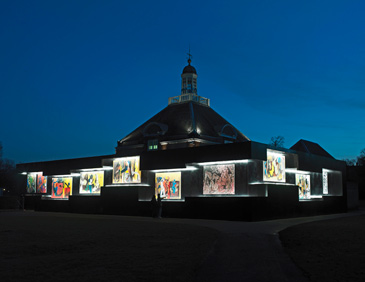
We took a path that appeared to have fewer people and after some time found ourselves in the Kensington Gardens. As we were walking along and chatting about that and this, I suddenly noticed a building in the distance all lit up and covered by what appeared to be extremely colourful graffiti—at least from where we were standing.

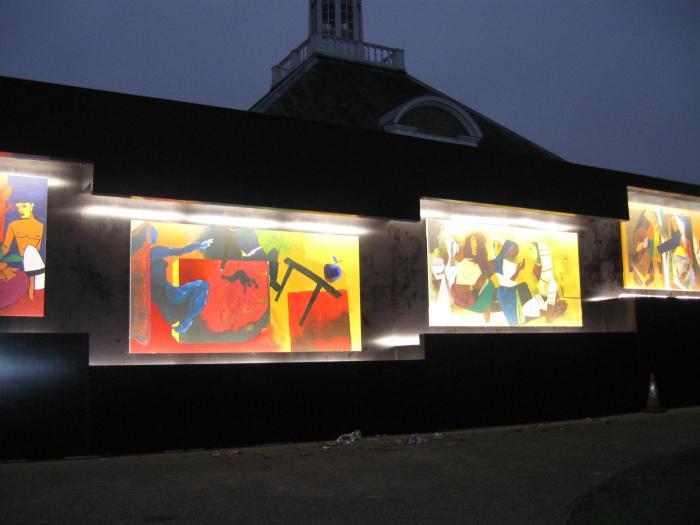
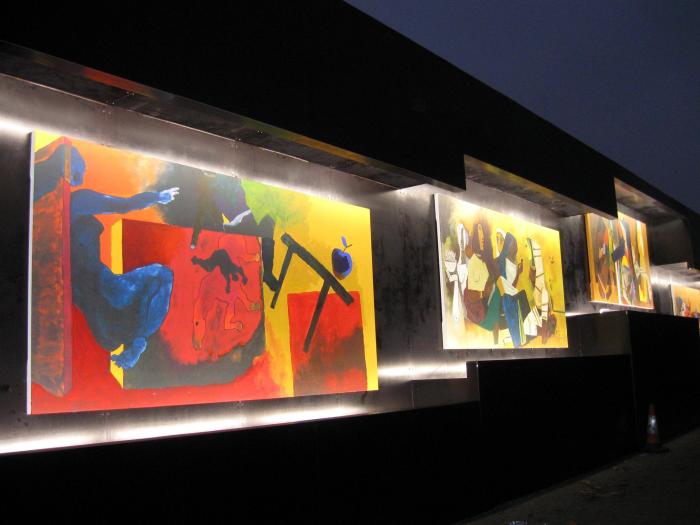
Curious, we decided to investigate. As we walked closer, we discovered that it was not colourful graffiti, but paintings that were hung on the exterior walls of the building. They were glowing in the dark and against the silhouette of the building, it was a sight to behold.

Photograph: Sylvain Deleu. Photo Courtesy: http://www.serpentinegallery.org

The exterior walls of the Serpentine Gallery showcase MF Husain’s works

And what an architectural frame! They could not have described it more aptly. It was amazing to see these works of art displayed the way they were, outside the confines of a sterile, gallery interior. Once I got over the unexpected shock of seeing Husain’s works displayed as such, I was able to just stand back and enjoy them. Even though it was quite cold that evening, just looking at the pictures warmed me up.

Reds, yellows, oranges and blues. All my favourite colours in one frame

Allowing Husain’s vibrant and colourful paintings to surround me with their warmth, I felt some of my homesickness dissipate, and suddenly cold, grey, sunless London was bearable. I sent a heartfelt, but silent thank you to MF Husain for making me feel happier than I had felt in days.

Yesterday, when I read of MF Husain’s death, I immediately remembered that evening when he, or rather his paintings, helped me tide over homesickness. For someone who was hounded in the country of his birth, forced to give up his citizenship, publicly declared his homesickness and yearn to come back to India—I wonder what comforted him and kept him going.

R.I.P. Maqbool Fida Husain.

Retirement blues and a thank you!

Akkinimuthu Krishnan, the 8th child of his parents, was born in 1952 into a well-to-do, landed family in Panchalingapuram village of Kanyakumari district in Tamil Nadu. From a very young age, he had a burning desire to study and nothing came in his way in fulfilling that desire—not the various back-breaking chores he had to do on his family farm, not the indifference to education his family showed, not the disheartening sight of his older siblings dropping out of school, one by one. Krishnan persevered in his goal to attain a college education.

The first graduate in his family, Krishnan studied in the Tamil medium in the village school, and then moved to study in the English medium in college where he read Economics at the Aringar Anna College in Kanyakumari. In fact, his was the first batch to pass out from that college. While studying in college, he also enrolled for shorthand and typing lessons as any good, self-respecting South Indian at that time did.

Krishnan wasn’t very sure as to where he wanted to work or what he wanted to do—all he was sure about was that he wanted to put his education to use and not be dependent on his family. He also did not want to manage his share of the family’s farmlands until he had a chance to work elsewhere. During this time, a friend of his asked him to come to Bombay (it was still Bombay then) and try his luck in the city of dreams.

Continue reading “Retirement blues and a thank you!”