Travel Shot: The broken chair

No visit to Geneva is complete without a visit to the United Nations. I mean not everyone can go in, but one can stand outside the building and have a photograph taken. That’s what most people think they are going to do, until they reach there. Then they find themselves distracted by a big broken chair. Don’t believe me? See the picture below. 
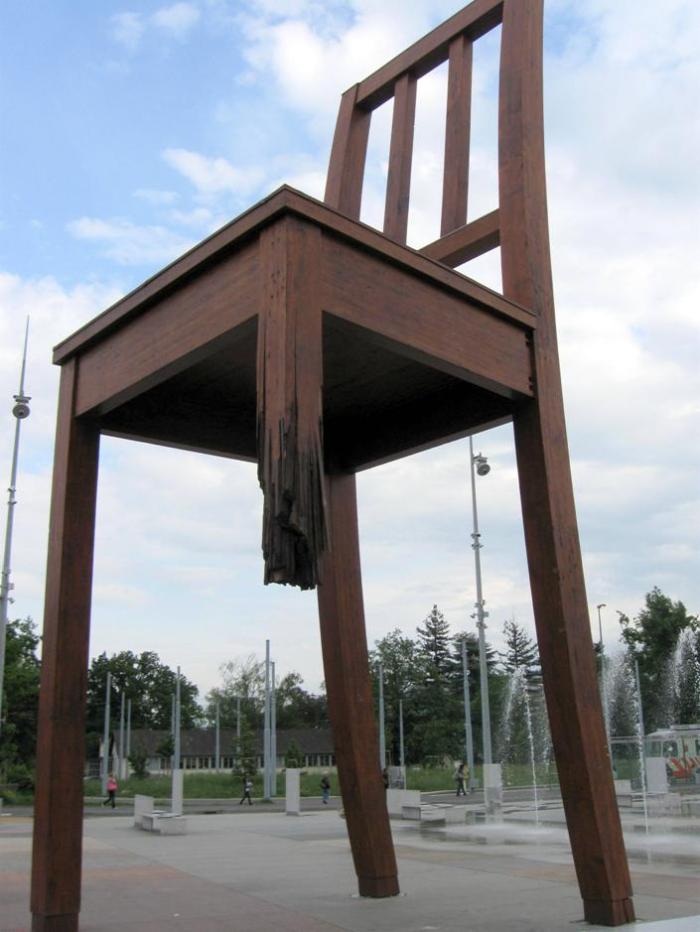
The Broken Chair

The Broken Chair is a wooden sculpture by the Swiss artist Daniel Berset, and constructed by the carpenter Louis Genève. Made out of 5.5 tons of wood, the 12 m high chair with a broken leg symbolises opposition to land mines and cluster bombs. It acts as a reminder to those visiting the place about the horrors of land mines. Many protests and demonstrations are held at this site.

The above photograph taken by me looks relatively benign like a piece of sculpture, while the one of the Broken Chair, taken by my niece’s friend on a cold December evening looks positively menacing and threatening, much like the danger posed by landmines and cluster bombs themselves.
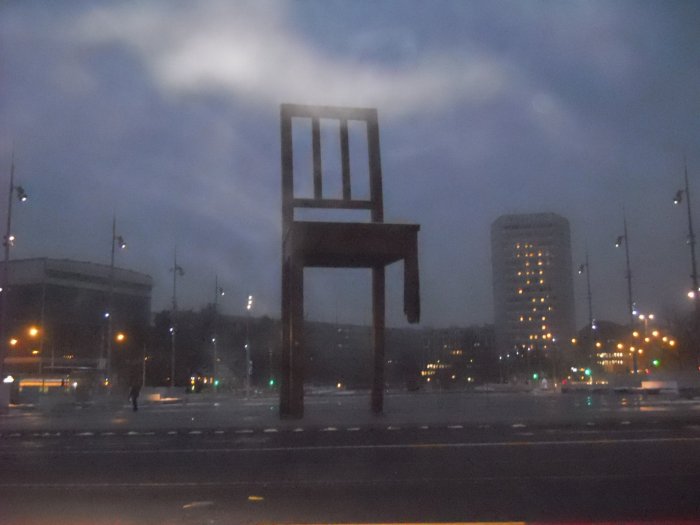
30th December 2010: The Broken Chair

According to the International Campaign to Ban Landmines, “landmines claim victims in every corner of the globe each day”.  The Campaign is working towards a world-wide ban on landmines and as of date, 39 countries including India have not signed the Treaty.

The UNICEF has declared April 4 as the International Day for Mine Awareness and Assistance in Mine Action. And you will do your bit by reading this blog and passing on information about the dangers from landmines and cluster bombs, won’t you?

Travel Shot: A wedding in Wales

1 August 2009: Newly weds at a photo shoot at Chepstow Castle, Wales

One rainy and damp day in August 2009, I was at Chepstow Castle, Wales, walking around and delighting in its various nooks and crannies, when I came across a newly married couple having their photographs taken. During my year-long stay in London and my forays to other places in England and Wales, it never happened that I visited some historical place or park and came away without seeing a newly wed couple having a photo shoot there. When I first saw such a shoot, I thought it was a professional shoot for some bridal paraphernalia ! It was only later that I figured out that it was a tradition for newly married couples to have a photo shoot at a nearby historical site or park.

This couple at Chepstow Castle was oblivious to the rain and the muddy trails on the bride’s gown, as they laughed and giggled and posed for the camera. I waited for them to finish, so that I could pass through the door to the other side. While waiting, I couldn’t help noticing the different textures of stone, wood, metal and fabric , not to mention the fresh green of the grass in an otherwise almost monochromatic frame. Even though I felt like I was trespassing on the couple’s privacy, I could not resist taking a photograph.

As they finished, and the photographer beckoned me to come through, I heard the bride asking the photographer,

“Rhys, you’re sure the mud on my gown won’t show in the photos?”

“100% sure, darling. What’s Photoshop for?” replied the photographer.

Travel Shot: The Bored Woman of Gloucester Cathedral

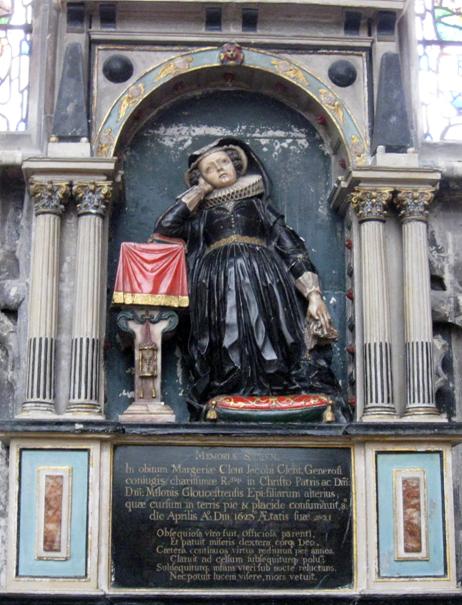
August 1, 2009: The Bored Woman of Gloucester Cathedral

The trip to Gloucester Cathedral happened by chance. Our tour group was on its way to Wales from London and Gloucester was a pit stop for the bus driver to have a smoke and stretch his legs. Since we had made good time, our tour guide generously allowed us an hour in Gloucester and suggested either exploring the Gloucester docks, or visiting the Cathedral. I opted for the latter.

A 15 minute walk and a fast trot later I was at the beautiful Gloucester Cathedral admiring its beautiful architecture, graceful columns and stunning stained glass windows, Then suddenly the above relief caught my eye. I had a tough time controlling my laughter. In a place where one comes across expressions of piety, even severity, this bored “whatever” expression was a real eye-catcher ! The inscription for this rather quirky relief was in Latin, a language I do not know. All I could figure out was that it was a memorial for a person named “Margerie” who died in April 1623.

I tried to find out more about the “bored woman” on the Cathedral website, but not find anything there. In case you do come across any information on her, you will let me know, won’t you?

Travel Shot: The red line

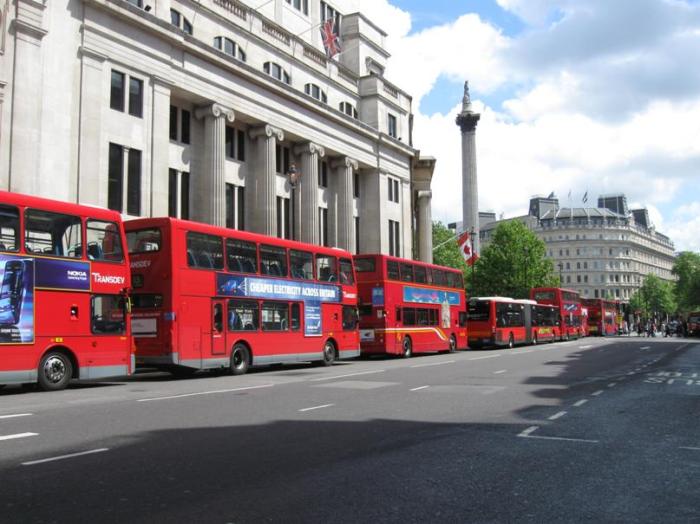
May 19, 2009: Buses line up before a signal at Trafalgar Square, London. You can see Nelson's Column standing high in the background

I saw this row of red buses all lined up at a signal at Trafalgar Square, while I was waiting for a bus on the opposite side to take me to Baker’s Street. The buses contrasted beautifully with the grey of the buildings, Nelson’s column and the road, as well as the cloudy blue sky.

And before I knew it, I was digging into my backpack for the camera. 🙂

Travel Shot: Brihadeeshwara Temple

Brihadeeshwara Temple

My parents and I visited the Brihadeeswara Temple in Thanjavur, in December 2005. We couldn’t have chosen a worse time as it was raining heavily and there a flood alert as well. The upside was this had deterred a lot of tourists and we arrived to a practically deserted temple at around 8.30 in the morning. Needless to say, I was delighted at the lack of people around.

A UNESCO World Heritage Site, the Brihadeeshwara Temple Complex is very well maintained and remains, to this day, one of the most beautiful and cleanest temples that I have seen. The temple, which celebrated in 1000th anniversary earlier this year, is huge and yet, very compact and intimate.

I took many photographs of the Temple, but the one featured here is my favourite as the wet temple ground as well as the perspective add a mysterious depth to this magnificent temple. Don’t you think so?

Travel Shot: Cross Bones Graveyard

All cities have a past that they would rather forget about and not acknowledge or  showcase it to adoring tourists. The Cross Bones Graveyard in London is one such place.

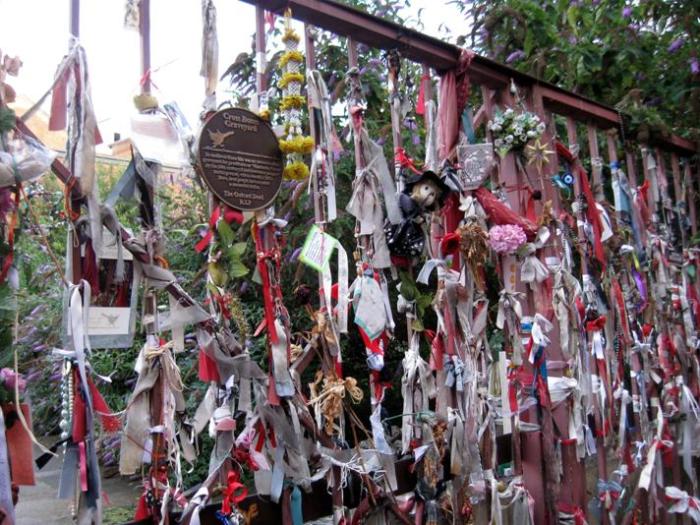
July 25, 2009: The "festooned" entrance to the Cross Bones Graveyard

Located in the Southwark borough of London, near London Bridge, the Graveyard was an unconsecrated site for burying over 15,000 prostitutes and paupers of medieval London. Though the site was never a secret, it came into prominence in the early 1990s when it was dug up for construction of the Jubilee Line of the London Underground. Excavators found an unusually “crowded graveyard with bodies being piled on top of one another”. Forensic tests showed that most of the buried had suffered from some disease or the other.

I visited the Cross Bones Graveyard one July evening as part of “The Other London Walk”, a guided walk conducted by a homeless woman. She led our group to the sites of London’s other history, a history not showcased to tourists—a London of the deprived, the homeless, the sick, and the disadvantaged.

The simple memorial plaque affixed to the gates only says what the site is, but the gates which are “festooned” with ribbons, and messages and prayers convey a far more powerful and poignant message.