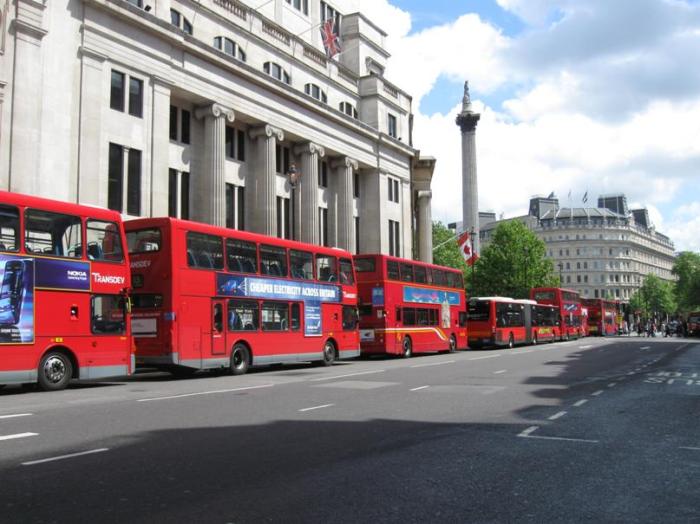
May 19, 2009: Buses line up before a signal at Trafalgar Square, London. You can see Nelson's Column standing high in the background
I saw this row of red buses all lined up at a signal at Trafalgar Square, while I was waiting for a bus on the opposite side to take me to Baker’s Street. The buses contrasted beautifully with the grey of the buildings, Nelson’s column and the road, as well as the cloudy blue sky.
And before I knew it, I was digging into my backpack for the camera. 🙂
When I told a friend about my plans to visit Coventry, this is what he had to say:
Coventry is a rather nondescript little city in the West Midlands region of the UK. It has two universities (University of Warwick and Coventry University), two museums and a humongous Ikea. And, yes, it also has 2 cathedrals.
I didn’t really pay attention to the rest of his description as only the “two cathedrals” part intrigued me—a city has only one cathedral, and Coventry had two? This I had to see.
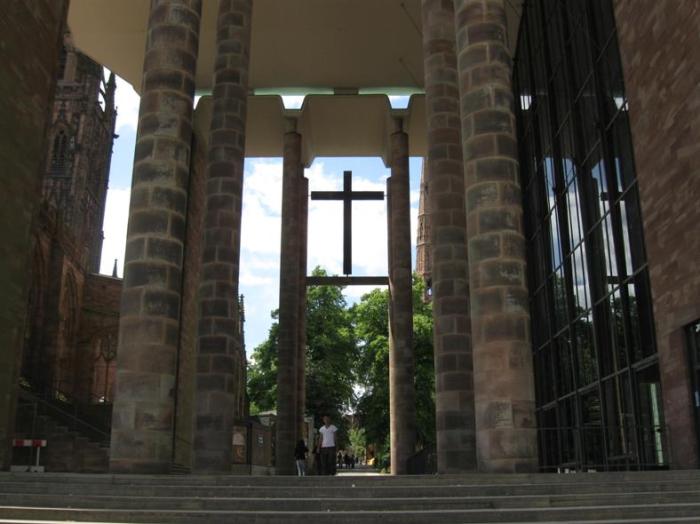
So are there two cathedrals in Coventry? Well, yes and no. There are two cathedrals in Coventry—the first is the ruins of the Old Medieval Cathedral, and the second is the modern, New Cathedral. But only the latter Cathedral is a place of worship today, so in that sense there is only one cathedral in Coventry. Both the cathedrals exist side by side, with the St. Michael’s porch connecting the two.
St. Michael's Porch. The glass-fronted entrance to the new Cathedral is to the right, while the steps on the left lead to the ruins of the Old Cathedral
My parents and I visited the Brihadeeswara Temple in Thanjavur, in December 2005. We couldn’t have chosen a worse time as it was raining heavily and there a flood alert as well. The upside was this had deterred a lot of tourists and we arrived to a practically deserted temple at around 8.30 in the morning. Needless to say, I was delighted at the lack of people around.
A UNESCO World Heritage Site, the Brihadeeshwara Temple Complex is very well maintained and remains, to this day, one of the most beautiful and cleanest temples that I have seen. The temple, which celebrated in 1000th anniversary earlier this year, is huge and yet, very compact and intimate.
I took many photographs of the Temple, but the one featured here is my favourite as the wet temple ground as well as the perspective add a mysterious depth to this magnificent temple. Don’t you think so?
All cities have a past that they would rather forget about and not acknowledge or showcase it to adoring tourists. The Cross Bones Graveyard in London is one such place.
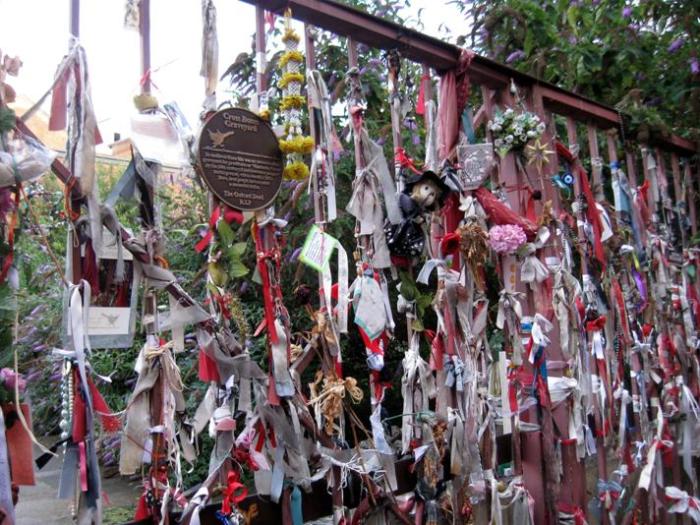
July 25, 2009: The "festooned" entrance to the Cross Bones Graveyard
Located in the Southwark borough of London, near London Bridge, the Graveyard was an unconsecrated site for burying over 15,000 prostitutes and paupers of medieval London. Though the site was never a secret, it came into prominence in the early 1990s when it was dug up for construction of the Jubilee Line of the London Underground. Excavators found an unusually “crowded graveyard with bodies being piled on top of one another”. Forensic tests showed that most of the buried had suffered from some disease or the other.
I visited the Cross Bones Graveyard one July evening as part of “The Other London Walk”, a guided walk conducted by a homeless woman. She led our group to the sites of London’s other history, a history not showcased to tourists—a London of the deprived, the homeless, the sick, and the disadvantaged.
The simple memorial plaque affixed to the gates only says what the site is, but the gates which are “festooned” with ribbons, and messages and prayers convey a far more powerful and poignant message.
“Hurry up ! The bears are already there. We need to get to the observation site quickly,” urged Doreen, our tour organiser. We scrambled out of the vehicle and followed Doreen to climb some rather steep steps that seemed to go on forever.
Our tour group had just driven to the Daroji Sloth Bear Sanctuary from Hampi (about 15 km) over some rather bad roads, through beautiful scenery, and imminent rain. We were at the Sanctuary to see the Indian sloth bear or karadis, who came out of their caves every evening to have a special paste of rice and honey (or was it jaggery?) that was smeared on the rocks near their caves by the Sanctuary guards. For me karadi brought forth images of Baloo, the Jungle Book bear, resplendent in his Disney avatar or Jambavan, the wise bear king from the Ramayana. I was rather keen on what the karadi really looked like!
Created in 1994, the Daroji Sloth Bear Sanctuary covers an area of about 5.58 sq.km. In addition to the bears, the Sanctuary is also home to wild boar, leopards, porcupines, striped hyenas, monkeys, hare, and peafowl, along with many bird species. Though we had come here to see the sloth bears, I secretly hoped to spot a leopard or two as well.
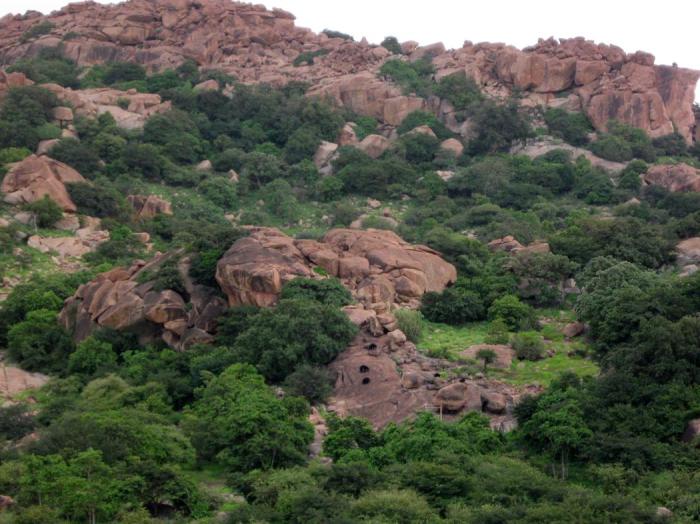
After about five minutes of huffing and puffing, we reached the observation site which is at the top of a hillock with fencing all around. Quite a few people had gathered there to watch the bears and they all seemed to be looking across the fencing and pointing at some black dots on the opposite hillock quite some distance away. It took me a while to realise that those black dots were actually the karadis.
A view of the black dots, sorry sloth bears, from the observation point
My recent trip to some heritage sites in North Karnataka (Aihole, Badami, Bijapur, Hampi and Pattadakal) was an eye-opener in more ways than one. While I was amazed to see the excellent work done by the Archaeological Survey of India (ASI) in restoring and maintaining the sites, as well as the efforts taken by the Karnataka Tourism Board, I was appalled to see condition of heritage sites not maintained by the ASI. My visits to the Banashankari Temple and the Mahakuta Temple Complex, both near Badami, are perfect examples of this.
The Banashankari Temple site has been a place of worship for about 14 centuries or so, though the current temple building is only about 200 years old. The temple’s name is derived from its location in the Tilakaranya forest. The main deity, Banashankari is also known as Shakambari or the vegetable goddess. Banashankari was the kuldevata or the tutelary deity for the Chalukya kings of the 7th century.
Our tour group arrived at the Banashankari Temple after spending a magical and enchanted evening at the Bhoothnatha Temples and the Agastya Teertha, near the Badami Cave-Temples. And came back to earth rather rudely with a ride through narrow, dusty, potholed and dirty access road to the temple. It was an inkling to the state of the temple itself.
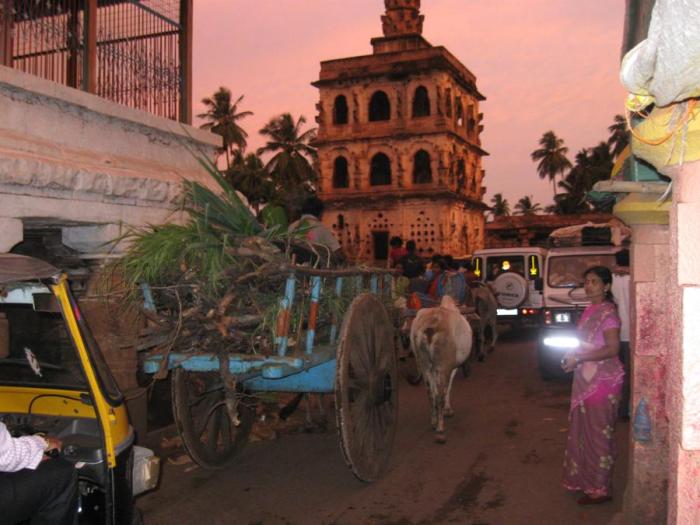
Outside the Banashankari Temple. The guard-cum-lamp tower at the entrance to the Harida Teertha in the centre of the photograph







 My Favourite Things