The guide was sulking, the mid-day sun was relentlessly hot and I could feel my skin burn. But I was oblivious to all but the shimmering marble structure in front of me—the tomb of I’timad-ud-Daulah, with the local sobriquet of Baby Taj or Mini Taj.

Located on the western bank of the Yamuna river, the tomb complex was built by Noor Jehan (queen of Emperor Jehangir, the fourth Mughal Emperor) for her father, Mirza Ghiyas Beg and mother. Mirza Beg started off as an accountant in the Mughal court and rose to the rank of Lord High Treasurer or I’timad-ud-Daulah. And therein lies the name of the tomb, which was built between 1622 and 1628.
The tomb is rather squat and broad in appearance with hexagonal towers in each corner. Built on a low sandstone platform with marble inlay work on all four sides, like all Islamic structures, this one too is symmetrical. It is the presence of the two very different-sized and shaped trees on either side of the tomb that lessens the severity of the symmetry and actually gives it a slightly quirky look.
Continue reading “Agra’s other Taj: The tomb of I’timad-ud-Daulah”


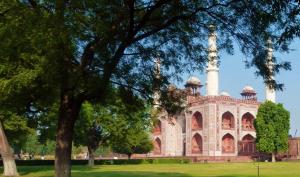 Akbar’s Mausoleum is in Sikandra, a suburb of Agra. Today, it has become so synonymous with the town’s name, that it is called Sikandra.
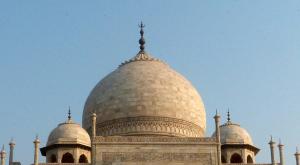
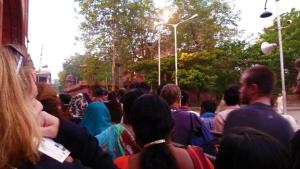 I recall all this as I stand in a queue with countless others waiting to enter this modern “wonder of the world”. Though I tell myself that I should regard this visit to the Taj with an open mind, it is difficult not to be affected by my own prejudices plus the influence of all that I have read about or heard about the Taj.



 “What do you know about Sarnath?” Premkumar, the guide, asked me.
 My Favourite Things