There’s something about Bukhara !

I fell in love in Bukhara. I wasn’t expecting to, but then love is always unexpected, isn’t it?

In fact, I wasn’t expecting anything from Bukhara when I visited Uzbekistan in September 2015. I was too busy dreaming about the Savitsky Museum at Nukus, the blue domes of Samarqand, and the minarets of Khiva. Bukhara was part of my itinerary, but it was more like a pit stop in the 700+ km road distance between Khiva and Samarkand — a place to rest and relax before moving on to the city that had inspired my Uzbekistan trip in the first place — Samarqand. Therefore, my online research for Bukhara only comprised a cursory reading of its history and finalising a B&B to stay.

I arrived in Bukhara after a 7-hour drive through the gorgeous Kyzyl Kum Desert from Khiva. The journey wasn’t particularly tiring as the roads were good for most of the distance, but after seven hours in the car, I just wanted to reach Bukhara. My first impressions of Bukhara were of a clean city with wide tree-lined avenues, multi-storied and traditional buildings existing side by side, and a very different vibe from the cities I had visited in Uzbekistan thus far.
#MyDreamTripUzbekistan, Bukhara, Uzbekistan, Travel, Central Asia, Heritage, UNESCO World Heritage Site
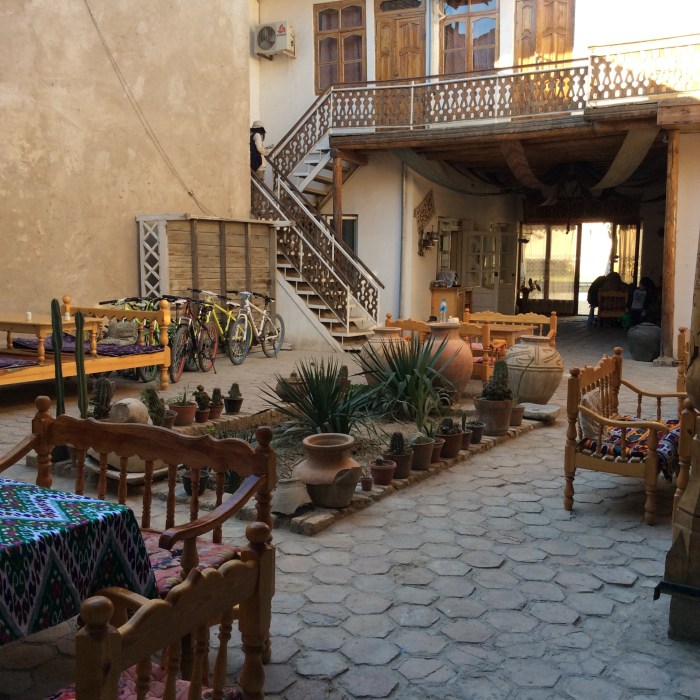
The main courtyard at Rustam & Zukhra

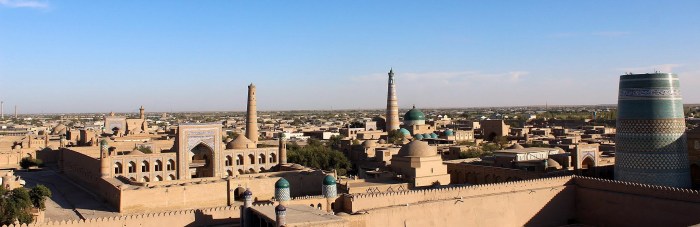
The B&B I was staying in, Rustam & Zukhra, was a charming little place and though I was tempted to rest after the long journey, I thought it best to walk and stretch my legs a bit. Within minutes, I was at the historic Lyabi Hauz Complex and was transfixed by the sight before me. Continue reading “There’s something about Bukhara !”

Itchan Kala: The inner fortress of Khiva

There are places that leave an impression on you after you have visited it. And then there are places which leave an impression on you even before you have visited it. Like Itchan Kala, the inner, fortified town of Khiva, an ancient city on the Silk Route in Central Asia. A UNESCO World Heritage Site, the Itchan Kala was the first of the sites to be inscribed in the list from Uzbekistan in 1990.

I came across Khiva and Itchan Kala, while researching on places to visit in UzbekistanWhile the photographs of Itchan Kala were uniformly breathtaking, not to mention tempting enough make me want to pack my bags and head there immediately, the descriptions were varied and the reactions mixed — a living fortress, a perfectly preserved medieval fortress, a fort museum, a museum city, former hub of slave trade, lifeless and artificial, a film set, a somewhere else place, over renovated and restored, lifeless, touristy… I found the multitude of opinions and impressions about Itchan Kala even more enticing than the pictures, and couldn’t wait to visit it for myself.

The sun was setting when I arrived on a September day in 2015 in the rather nondescript city of Khiva. It had been a long day of travel from Nukus, exploring the scattered ruins of Khorezem along the way. As my car wove in and out of twisting roads, I kept a lookout for the walled town, already familiar from the numerous pictures I had seen online.

Khiva, Xiva, Travel, Uzbekistan, #MyDreamTripUzbekistan, Ichon Kala

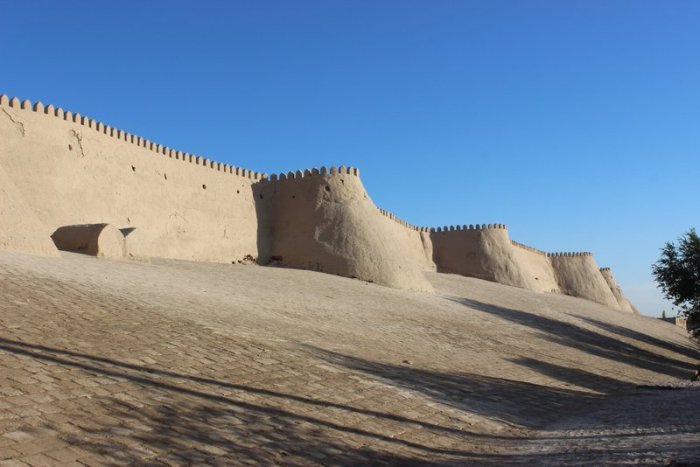
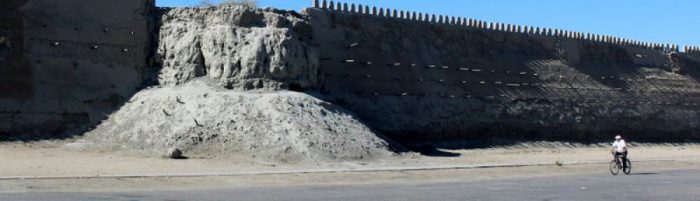
And then, as we drove through a market, the mud walls of a fortress suddenly loomed up. It was the Itchan Kala. I barely had time to recover from that first sight before the car entered the fortress through a gate and stopped outside my hotel. As soon as the registration formalities were completed, I set out to explore the place.

Continue reading “Itchan Kala: The inner fortress of Khiva”

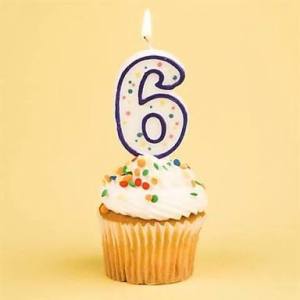
6 years, 458 posts, 3,87,765 words…

image
Click on the photo for the image source

later, it’s that time of the year again. That time when I review the blogging year(s) gone by, where I reflect a bit, whine a bit, make a confession or two… All because its my 6th blog anniversary or blogversary today. 🙂

When I published my first post on this day 6 years ago on the Bandra Fort in Mumbai, it was with the hope that I would be blogging for a long time to come. And yet, each time a blogversary comes around, I’m surprised, and secretly proud, that I have lasted for so long!

For those who came in late or have not followed my blogging journey, let me summarise the first five years of my blogging journey. While the first year was an exciting time of exploring and finding my feet in the blogging world, the second year was a heady period of peer appreciation and recognition. The third year was when I got a reality check in the form of severe writer’s block and negativity and bullying in the blogging world. In year four, I faced extreme blogging fatigue, and took time to slowly reclaim the pleasure of blogging. In contrast, year five was my most relaxed year of blogging where I did exactly what I wanted to do blog-wise.

We now come to Year Six and the question — what was it like? Continue reading “6 years, 458 posts, 3,87,765 words…”

My “now” song: Ambwa talay

Do you ever have a song, an idea, a story line, or an image stuck in your head? And it just refuses to go away? For some time at least? I have this with music — it could be a song, an instrumental piece, a jingle, a background score, etc. That particular piece of music becomes my “now’” song, and the “nowness”  (pardon my English here) could be for any length of time.

My current “now” song is Ambwa Talayan Amir Khusro composition, sung here by Javed Bashir and Humera Channa as part of a Coke Studio Pakistan performance.

Ambwa Taley is a traditional bidaai or farewell song, which is sung when the bride leaves her parents’ home for her marital home. The bidaai songs are usually weepy songs, but Ambwa Talay is different. It is a sublime song with just the right tinge of the bittersweet. The bride can’t wait to begin a new phase of her life with her beloved, and yet there is sadness at leaving her childhood behind — her dolls, carefree days of playing on the swing, the rains… The bride requests her palanquin bearers to halt under the shade of the mango tree to look back and reminisce.

A friend recommended this song to me about 2 months back and I was instantly drawn to it. It began with the melody and then the beautiful lyrics and each time I listened to it I fell more in love with it. Javed Bashir’s earthy vocals and Humera Channa’s melodious voice with just the right tinge of longing — for both the future and the past — were spot on and I can’t imagine anyone else singing this song. I also felt that the use of the clarinet as a substitute for the shehnai was masterstroke for mirroring the sentiments of Ambwa Talay. As a ‘modern’ instrument, it hinted at the future, and yet its reedy notes conveyed the sacredness and solemnity of the traditional shehnai, which usually accompanies a bidaai song. Ambwa Talay is based on Raga Desh, one of my favourite ragas, and one more reason for it to be my “now” song.

It has been a very busy time lately and I have been away from the blog for more than 2 months. Glad to be back here with this song that has literally captured my heart and my emotions too. Hope you enjoy listening to it as well.

PS: What have you been listening to these days and what is your “now” song? Tell me.


For more of my “now” songs and my other writings on music, do click here.

Join me on Twitter, Facebook and Instagram as I explore the world around me and share “My Favourite Things” with you.


Chamba Rumals: Painted Embroideries or Embroidered Paintings?

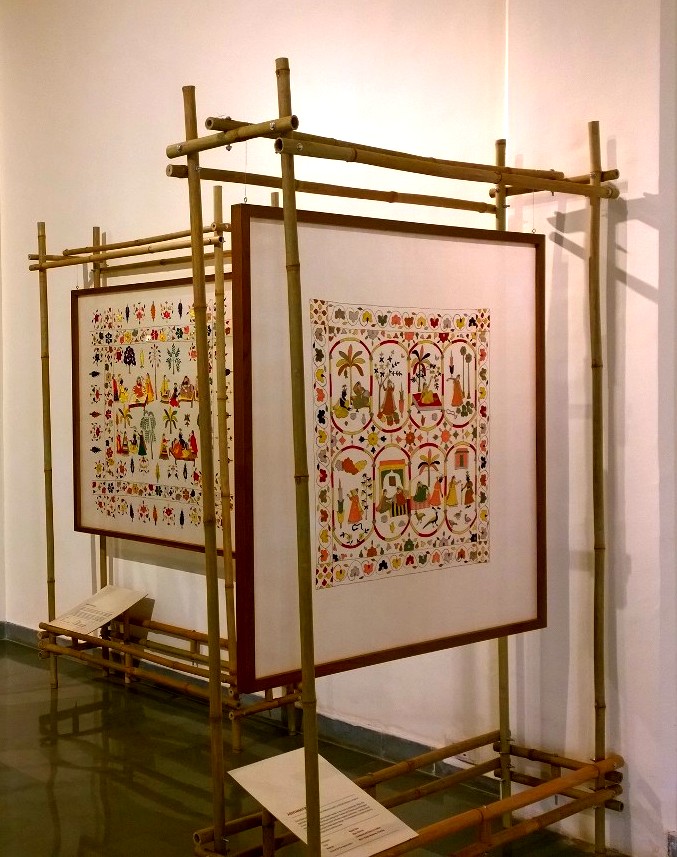
It was serendipity that led me to the exhibition on ‘Chamba Rumal: Life to a Dying Art’ at the Bhau Daji Lad Mumbai City Museum (BDL Museum) one Saturday evening earlier this month! I call it serendipity for till that afternoon, I had neither aware of the existence of something like the Chamba Rumal nor of the exhibition.

It all started in my Indian Aesthetics class on Krishna Shringara by Prof. Harsha Dehejia. While giving examples of the depiction of Krishna Shringara in art, the embroidered Chamba Rumal was one of the things he mentioned and showed in his presentation. Ruta, one of my coursemates (and who was probably aware of my love for museums), told me about the exhibition on Chamba Rumal during the break. And of course, this meant that I had to go see the exhibition that very evening after class. 🙂

When I walked into the Special Projects Area of the BDL Museum and where the exhibition on Chamba Rumal was being held, the first thing I noticed was the display — large framed pieces hung on bamboo stands. The cool whitewashed walls, and the gleaming kota flooring was just perfect for the vibrant exhibits, which looked like paintings from a distance, but were actually exquisitely embroidered pieces, the Chamba Rumals.

Chamba Rumal, Crafts of India, Art, Indian Aesthetics, Bhau Daji Lad Museum, Delhi Crafts Council, Exhibition

Continue reading “Chamba Rumals: Painted Embroideries or Embroidered Paintings?”

Kala Ghoda Arts Festival 2016, #HTKGAF, KGAF 2016, Rampart Row

The Kala Ghoda Arts Festival 2016

Déjà vu. That’s the feeling I was left with after attending the 2016 edition of the Kala Ghoda Arts Festival (KGAF), which was held from February 6th-14th this year.

Over 500 events were organised during this iconic annual festival in the following categories: Children, Children’s Literature, Cinema, Dance, Food, Heritage Walks, Literature, Music, Stand-Up Comedy, Street and Stalls, Theatre, Urban Design and Architecture, and Visual Arts. While I wanted to attend some of the events in the Workshops and Heritage Walk sections, I couldn’t. I could only manage to view the installations at different venues — Rampart Row, CSMVS Museum Grounds and Cross Maidan.

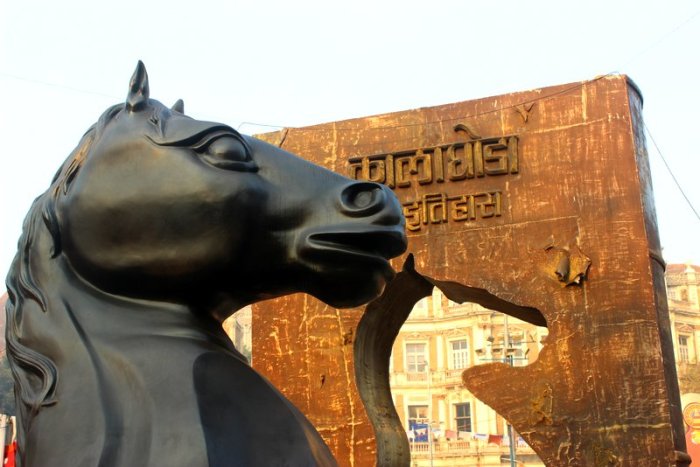
I visited the KGAF 2016 on three separate days. The first was on the evening of the opening day itself. When I arrived at Rampart Row, it was to the familiar sight of college goers with selfie sticks, ‘serious’ photographers with even more ‘serious’ camera gear, families looking forward to an evening together, wailing toddlers… all queuing up impatiently for the security check. Once in, my eyes automatically sought out the installation of the “Kala Ghoda” or the black horse that the festival derives its name from. This installation changes every year and the 2016 version was a visual stunner. Fashioned like a giant chess piece, it was strategically placed in front of a horse-shaped cut out.

Kala Ghoda Arts Festival 2016, #HTKGAF, KGAF 2016

Continue reading “The Kala Ghoda Arts Festival 2016”