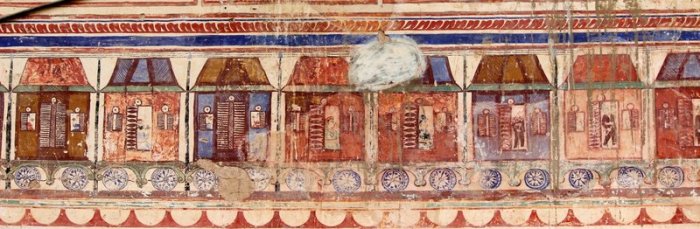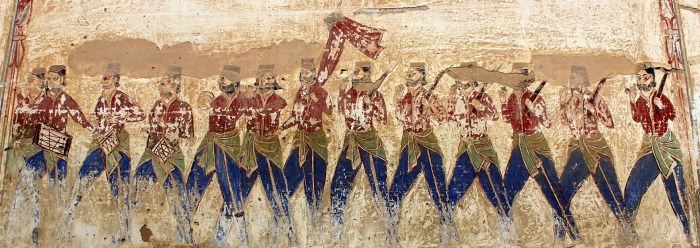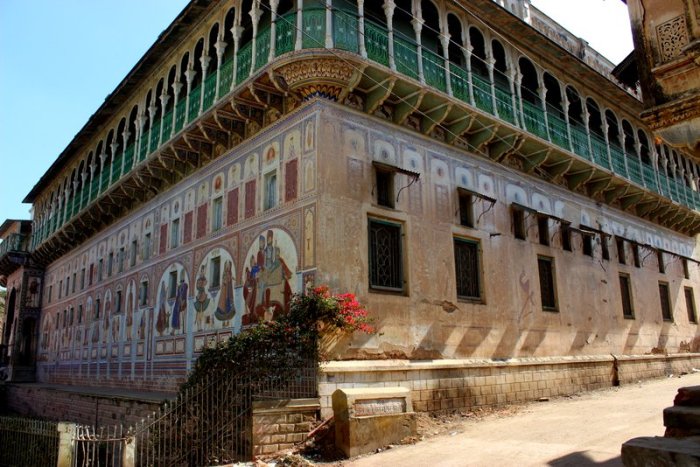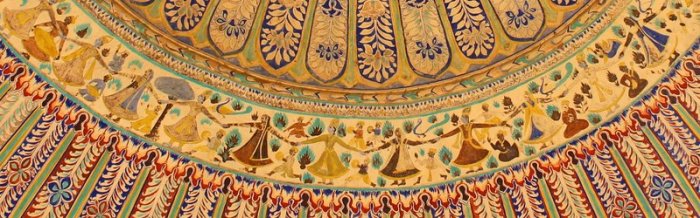
The painted towns of Shekhawati-2: Dundlod

Ilay Cooper’s book on Shekhawati set me off on an extraordinary trip to an extraordinary place, and I had to wait for nearly six months before I felt ready to write about it — so overwhelming were my thoughts and emotions. This post on Dundlod is the third of eight posts in the series on “The Painted Towns of Shekhawati”. If you haven’t read this introduction to Shekhawati’s history (and the series), I recommend that you do so now, before proceeding further.


The gates to the Dundlod Fort are locked when I arrive at 2.30 in the afternoon from Nawalgarh.

“How can a Fort be locked at this time of the day?” I grumble, looking around for some information on the Fort timings. I don’t find any and instead start looking around for someone who can help me, but there is no one around and all the shops are shut — Dundlod appears to be practically deserted.
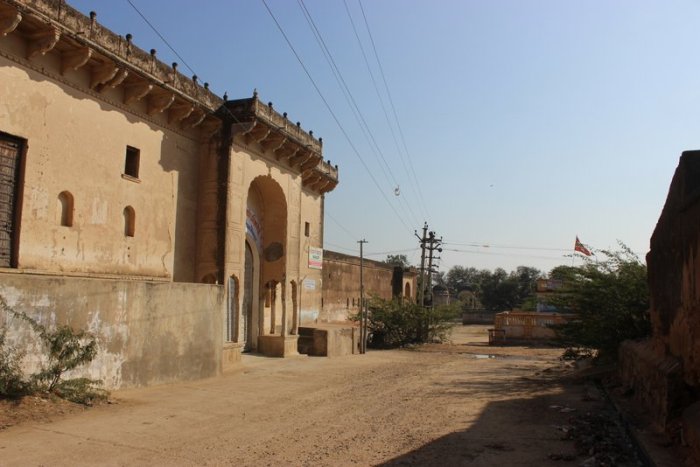
Dundlod, Painted Towns of Shekhawati, Fresco, Art Gallery, Painting, Heritage, Travel, Rajasthan, Goenka

I see a tea stall that is open and walk towards it. The tea stall owner guesses what I’m going to ask him and says: “The Fort is shut. They have gone horse riding.”

“Who are ‘they’?” I ask.

“The owners of the Fort and their foreign guests. You come after some time,” is the reply.

I decide to explore the town instead and as I’m wondering which direction to head towards, the tea stall owner points me towards a haveli (mansion) and says that the caretaker-cum-watchman will open it for me to see.

That’s how I end up at the Shubhnarayan Anandram Goenka Haveli. Continue reading “The painted towns of Shekhawati-2: Dundlod”

The painted towns of Shekhawati-1: Nawalgarh

Ilay Cooper’s book on Shekhawati set me off on an extraordinary trip to an extraordinary place, and I had to wait for nearly six months before I felt ready to write about it — so overwhelming were my thoughts and emotions. This post on Nawalgarh is the second of eight posts in the series on “The Painted Towns of Shekhawati”. If you haven’t read this introduction to Shekhawati’s history (and the series), I recommend that you do so now, before proceeding further.


Nawalgarh was my base for exploring the Shekhawati region and also the first of the towns I visited. Named after Nawal Singh, its founder, Nawalgarh was built in 1737 on the site of an earlier settlement.

Nawal Singh followed an active policy of encouraging traders and merchants from Jaipur to settle down in Nawalgarh. The Patodia and Murarka families were the first to arrive on his invitation and seeing them grow and prosper, other merchants soon followed. By the mid-1800s, Nawalgarh had become a large and prosperous town with three forts, city walls, bastions and four gates to protect it.

I arrived in Nawalgarh on a cold and rainy winter’s day in January, in time for a late lunch at my hotel before heading off to explore the town. It was a leisurely stroll through the town’s markets, lanes and bylanes with the purpose to get a feel of what had brought me to Nawalgarh (and for that matter the Shekhawati region) in the first place — the painted havelis or mansions.

Nawalgarh, Painted Towns of Shekhawati, Fresco, Art Gallery, Painting, Heritage, Travel, Rajasthan
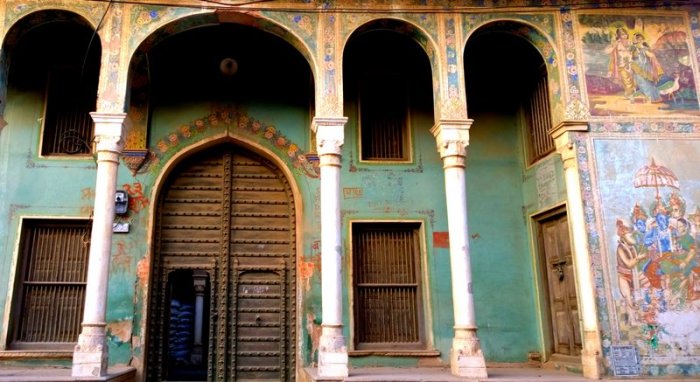
Entrance to the Sheth Anandram Jaipuria Haveli. Unlike other havelis where the background colour is beige, the walls of this haveli are green

Continue reading “The painted towns of Shekhawati-1: Nawalgarh”

The painted towns of Shekhawati: Past and present

Ilay Cooper’s book on Shekhawati set me off on an extraordinary trip to an extraordinary place, and I had to wait for nearly six months before I felt ready to write about it — so overwhelming were my thoughts and emotions.

Presenting the first of eight posts on the painted towns of Shekhawati. It is a brief account of the region’s history (an introduction to the series really), in order to understand the region’s past and present, in the context of the Shekhawati Series.


Shekhawati is one of the four regions of Rajasthan, the others being Mewar, Marwar and Hadoti). Spread over Sikar, Jhunjhunu and Churu districts of Rajasthan, it is best known for its grand and palatial havelis (mansions). It is also known for being home to many of India’s well-known business families — Birla, Poddar, Bajaj, Jhunjhunwala, Khaitan, Oswal, Piramal, Ruia, Singhania, and Goenka, among others are from this region.

One would think that this would automatically mean a lot of visibility and tourist footfall in the region, but this is not the case — compared to the other regions of Rajasthan, Shekhawati is less visible. Which, in my opinion, is really surprising as the history of the region is quite unique and distinct from the rest of the State (at least in the context of the series that I’m writing).

Take the famous painted havelis of Shekhawati, for example, and how they came to be built. Painted Towns of Shekhawati, Nawalgarh, Poddar Haveli, Continue reading “The painted towns of Shekhawati: Past and present”

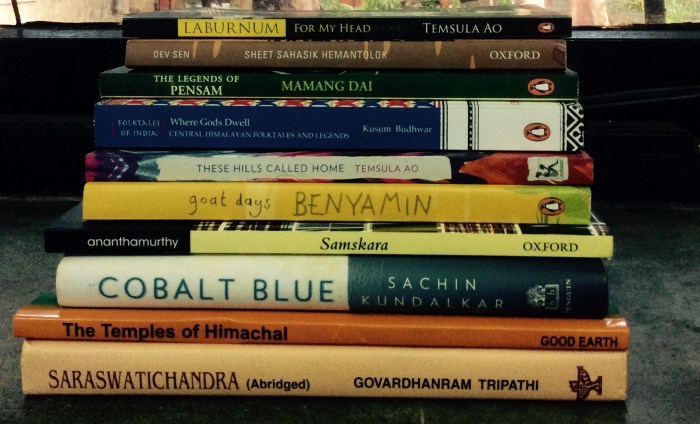
#TSBCReads India, Book pile, Books from India and on India, To be Read Books

Reading India with #TSBC

About a year back, I stumbled across Ann Morgan’s fabulous blog, A Year of Reading the World. I was completely blown away by what she had written there and with good reason too !

In 2012, Ann Morgan had embarked on a year-long journey of the literary kind. She read a book from every independent country in the world, which meant that she read a total of 196 books that year. Ann then went on to write Reading the World: Confessions of a Literary Explorer, a book which talks about this literary journey of hers — the stories, the research, the people involved — and how it changed her thinking and her perception of the world.

Reading Ann’s literary journey first on her blog and then in her book, got me thinking about reading my immediate world that is, India. Reading India’s diversity and sub-cultures through her 29 States and 7 Union Territories. Reading India one book at a time would be a literary journey with a difference, a reading challenge with a difference.

I was so inspired and excited that I discussed this idea with my co-founders at The Sunday Book Club (TSBC). The result of that discussion was the introduction of this unique India-centred reading challenge on TSBC. And that’s how the hashtag #TSBCReadsIndia was born in February 2015.

So, how does #TSBCReadsIndia work? Continue reading “Reading India with #TSBC”

5 years, 413 posts, 3,33,785 words…

5th birthday
Click on the picture for the source

… later, it is time for that annual blog anniversary post. The fifth to be precise, and about a blogging year that has been quite different from the previous years.

If the first year of blogging was an exciting time of finding my feet in the blogging world, then the second year was a heady and wonderful year of peer recognition. The third year of blogging was the year of reality check in the form of severe writer’s block and coming face to face with negativity and bullying in the blogging world. Year four was all about facing extreme blogging fatigue, wondering what to do, and slowly reclaiming the pleasure of blogging.

As for the fifth year of blogging, it has probably been the most relaxed year of blogging ever — barring a couple of mini rants here and there. I blogged when I wanted to, what I wanted to, how I wanted to, and even where I wanted to. Basically, I did what I wanted to. Blog-wise, that is. 🙂

But before I go into a little bit of details of that, I must share with you an incident that turned out to be the highlight of Year 5 of blogging. It’s not about the blog directly and yet it is. It  happened on the morning of 19th October 2014.

It was a Sunday and I was woken up by the doorbell at around 7.30 am. Though I like to sleep in a little on Sundays, that rarely happens. Our housing society’s garbage collector, Suraj, has a rather perverse streak — on weekdays he collects the garbage around 9.30 am; on weekends he’s there before 8.00 am.

I stumbled out of bed, grumbling under my breath, picked up the garbage bag and opened the door to hand it to Suraj. But it wasn’t Suraj who was standing on the other side of the door. It was someone else. Continue reading “5 years, 413 posts, 3,33,785 words…”

Travel, travellers and travel blogging… Some thoughts

We live in a super-specialised world and the world of travel and travellers is no different. It’s not enough to just say that “I like to travel” or that “I am a traveller”. One has to qualify what kind of travel you like or what kind of traveller you are. You’d be considered boring otherwise !

Don’t believe me? Well then, just see some of the words I picked up from the Twitter and Facebook bios of travel bloggers on my TL, which describes the kind of travel they do or the type of travellers they are.

Solo. Couple. Family. LGBT. Gay. Luxury. Heritage. Road. Backpacker (you can add variations in spelling here like backpakker, bacpacker, bakpakker). Nomadic. Wandering. Itinerant. International. Different. Newly wed (I kid you not!). Budget. Flashback. Mountain. Himalayan. Beach. Food. Frugal. Happy-Go-Lucky. Culture. Nature. Environmental. Rural. Eco. Weekend. Slow. Lazy. Grumpy. Happy. Lost. Spiritual. Religious. Ethical. Independent (really wonder what this means). Immersive. Adventure. Long-term…

One would think that the “variety” in travel / travellers would have automatically translated into variety in travel writing or blogging as well. Surprisingly, I have found that this is not the case. Sure, a lot of destinations get written about, but they are usually in the form of listicles, guides, travel tips, sponsored articles or articles espousing the cause of a particular type of travel (read the above para for examples). First-person accounts of travel experiences — which in my opinion is what any travel writing/blogging should be about — are comparatively few.

And therein lies my problem with travel blogging. As someone who blogs about travel (among other things), I know how important it is to read well in order to write well. The operative word here is ‘to read well’. Unfortunately, more often that not, whenever I read a travel blog post, I’m left with a feeling of “this is not about travel / this is not what I want to read in a post on travel”.

Let me elaborate with some examples the reason I’m peeved with the state of travel writing / blogging today.

Continue reading “Travel, travellers and travel blogging… Some thoughts”