Being a “Banu” in Bombay

Here’s introducing the Guest Post Series on “My Favourite Things”, which will have contributions by those sharing my interests, and writing about issues that I am passionate about. These guest posts will not necessarily be by fellow bloggers; they could be by anyone who has interesting experiences to share.

The first guest post on here is by Ashabanu, who writes about the prejudice and bias she has faced because of her name. Prejudice and bias in the supposedly liberal city of Bombay (or Mumbai, if you please).

“B…a…n…u”. This is the second part of my name, Ashabanu.

I never thought that part of my name will seek so much of attention in the city of Bombay (or Mumbai if you please), when I stepped into the city about 8 years back. This name of mine has never intrigued anyone in the small town I hail from, near Chennai, or in any of the places I have worked or studied in Tamil Nadu. However, it has puzzled almost everyone in Bombay. From the day I landed in Bombay, I have had to keep explaining the “Banu” part to people.

On my very first day at work in Bombay, a colleague asked me, “Oh…You are the Banu? Sorry I did not realise that, as we were expecting someone with a burkha.

Continue reading “Being a “Banu” in Bombay”

Ladies compartment, 8.47 local: Book release function and review

Sometime early last month, Mumbai experienced a few days of gloomy, cloudy, rather funny weather.Though this type of weather was quite uncharacteristic for Mumbai, it was  typically London weather. And suddenly I was remembering and missing my days in London. On a whim, I put a status update on my Facebook wall about missing London, which elicited some responses. One of the responses I got was this:

You really miss England, don’t you? Go back, Sudha. Steep yourself in the legends and the history, touch the old walls and let them flow up your finger-tips into your heart, let the lakes and the streams and the little sudden springs soak into your soul, let the 40 shades of green fill your eyes and mind, let the cathedrals and the quaint corners whisper forgotten secrets and fervent prayers to you. Then come back home again.

As I read these beautiful lines, I did “travel” back to England, experience all that it said I should and came back “home” rejuvenated. And excited. Excited, because these lines had been written and posted by Suma Narayan, whose first book I had agreed to review. If these lines were a preview of what Suma’s writing would be like, I knew that the book would be a good read.

Continue reading “Ladies compartment, 8.47 local: Book release function and review”

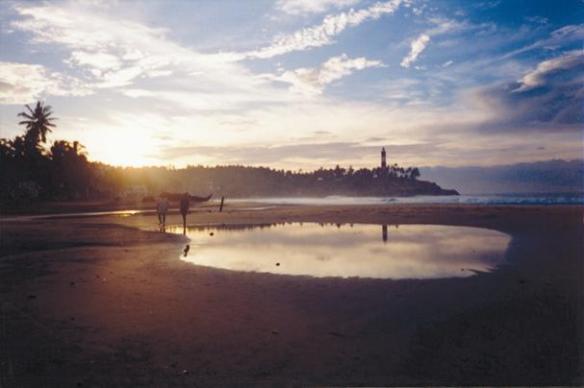
Travel Shot: Sunrise at Kovalam Beach

In the winter of 1998, a friend and I embarked on a trip along the West Coast of India beginning at Honnavar (Karnataka) and ending at Thiruvananthapuram (Kerala) 10 days later. It was a hop on, hop off trip, one of the best trips I have ever undertaken, and a trip that I remember for various reasons.

While in Thiruvananthapuram, we took a spur of the moment decision to spend the night at one of the hotels on Kovalam Beach. That turned into quite an experience—being the only Indians staying back, being the subject of countless stares and comments, and dealing with plate-sized spiders in our room. After a sleepless night (you didn’t really expect us to sleep with the spiders around, did you?), we stumbled out of our room at daybreak—all red-eyed and cranky—to see a glorious sunrise.

Sunrise at Kovalam Beach, Thiruvananthapuram

Continue reading “Travel Shot: Sunrise at Kovalam Beach”

My “now” song: Apni toh har aah ik toofan hai

Do you ever have a song, an idea, a storyline, or an image stuck in your head? And it just refuses to go away? For some time at least? I have this with music—it could be a song, an instrumental piece, a jingle, etc. This becomes my ‘now’ song, and the “nowness”  (pardon my English here) could be for any length of time.

My now song is “Apni toh har aah ik toofan hai” sung by Mohammad Rafi to music set by S.D. Burman for the 1960 film Kala Bazaar featuring Dev Anand and Waheeda Rehman.

About two nights back, Amma and I were watching a “retro Hindi film music” show on a music channel on TV. The songs being played were from the B&W films of the 1950s and 1960s, with many of the songs featuring Dev Anand. The song selection was so good that we kept postponing going to bed, and it was midnight when we finally switched off the TV.

But then, as it usually happens after a good music session, we stayed up for quite some time talking about old Hindi film music, in general, and songs featuring Dev Anand, in particular. We hummed and sang our favourite Dev Anand songs for a bit (Amma’s is “Tere mere sapne” from Guide and mine is “Apni toh har aah ik toofan hai” from Kala Bazaar). By the time we went to bed, it was nearly 1.30 am, and when we woke up at 7.00 am, it was to the news of Dev Anand’s demise. I can’t tell how strange we felt about our musical night; it was almost as if we knew what was going to happen.

And now, I have all Dev Anand’s songs playing like a non-stop record in my mind, with this particular song playing more than the others. It’s mellow, romantic melody is simply unmatchable and to me it is like Dev Anand himself—timeless and eternal.

R.I.P. Dev Anand.

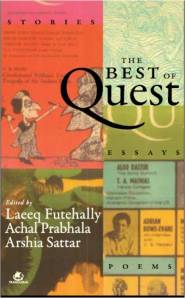
The Best of Quest: A review

The book

Once upon a time there existed a magazine which was a “quarterly of inquiry, criticism and ideas” and fittingly enough called Quest. It had very clear-cut guidelines for the content it carried: everything and anything published in the Quest had to have “some relevance to India. It was to be written by Indians for Indians” (p.xix).

It was because of these guidelines that Quest was able to publish highly original writing in English in the form of essays, opinions, book reviews, film reviews, critiques, stories, poems, memoirs, etc. The writers were a mix of the new and the established, academicians and journalists, politicians and poets — Rajni Kothari, Nirad Chaudhuri, Kiran Nagarkar, Ashis Nandy, Khushwant Singh, and Neela D’Souza, to name a few.

Published from Bombay, Quest was born in 1954 with Nissim Ezekiel as its first editor. After Ezekiel, A.S. Ayub and Dilip Chitre took on the role of editors of Quest, and both of them stayed true to the founding vision of publishing works relevant to India. In spite of this, or perhaps because of it, Quest died an untimely death with the imposition of the Emergency about 20 years later. In the decades that followed, Quest got relegated to the realm of nostalgic memories of people who were associated with it, or in wooden boxes stored in lofts and attics. Some forgot about it and some like me did not even know about the existence of Quest. Till recently, that is.

Continue reading “The Best of Quest: A review”

Mumbai Lens: The Asiatic Library

This blog post was featured in the “Around the Blog” section of the DNA newspaper published on December 7, 2011 (pg.7). 🙂

The iconic building of the Asiatic Library of Mumbai, also called Town Hall, was recently in the news for a rather sad reason. Renovation work, which had begun in 2008–2009, had been stalled due to unpaid bills amounting to nearly 2 crores ! (You can read more about this here). When I had last walked by this beautiful building one August morning earlier this year, there was scaffolding on the sides, scraped and chipped paint on the ground, and blue protective sheets covering the exposed parts. Sounds of repair work could be heard even over the traffic.

The entrance to the Asiatic Society Library

Continue reading “Mumbai Lens: The Asiatic Library”