My car collection

I do not own a car (or a two-wheeler or any other type of four-wheeler) and neither do I see myself owning one. For one, I am a great fan of public transport, and living in a city like Mumbai, I have never had to worry about transport. Second, I do not want to contribute to the existing traffic chaos and pollution by adding my vehicle to it. And third, I can’t drive. Yes, I have been told it is shocking that I can’t drive, but hey, that’s one skill I’m quite comfortable not having. But all this has not stopped me from liking cars. In fact, I consider vintage cars as works of art, and seeing a Volkswagen Beetle on the road gives me a high.

I realised only lately that I didn’t just like cars. I loved them. I discovered 94 photos of cars (I counted, honest!) during yet another attempt to bring some order to my ever-growing, unmanageable, digital photos. Surprisingly, there were no photographs of Volkswagen Beetles—though there were lots of photos of vintage cars as well as photographs of strange-looking and quirky cars.

Presenting some of them the cars from “my car collection” 😀

Hampstead Village, London: A pretty strange looking car, called Cube !

Continue reading “My car collection”

My ‘now’ song: Raske bhare tore nain

Do you ever have a song, an idea, a storyline, or an image stuck in your head? And it just refuses to go away? For some time at least. I have this with music—it could be a song, an instrumental piece, a jingle, etc. This becomes my ‘now’ song, and the ‘nowness’ (pardon my English here) could be for any length of time.

My now song is “Raske Bhare Tore Nain”, a thumri in Raga Bhairavi.

I first heard Heera Devi Mishra’s version of the song from the film Gaman, as an 8- or 9-year-old, when my brother got home an audio recording of Gaman’s songs. I didn’t think much of this song then, as the other songs (Seene main Jalan by Suresh Wadkar and Ajeeb sa Neha by Hariharan) were more appealing. As I grew older, it was “Raske bhare tore nain’s” sensuous music and lyrics and Heera Devi’s earthy voice that captured my imagination like no other. So much so, that I learnt this song from the audio tape and it remains in my repertoire of songs that I dare to sing in public ! Needless to say, it remains one of my all time favourite songs.

For a long time, I thought that only Heera Devi Mishra had sung this song, till quite recently I discovered versions of this song sung by Girija Devi and Bhimsen Joshi. In my opinion, both Girija Devi’s and Bhimsen Joshi’s renditions of this thumri is not as nice as Heera Devi’s.

Yesterday, I stumbled across Barkat Ali Khan’s sublime rendition of this song and I knew then that “Raske bhare tore nain” was my new “now” song. Though Khan’s mellifluous voice and Heera Devi’s earthy tones are in sharp contrast to one another, both their renditions delight in different ways — the former playful and soothing, and the latter sensuous and raw. Barkat Ali’s Khan’s version is given below.

You could take your pick as to which version you liked, or you could enjoy both of them like I did. Do let me know which one you liked. 🙂

Mumbai Lens: The Blue Retro Bus

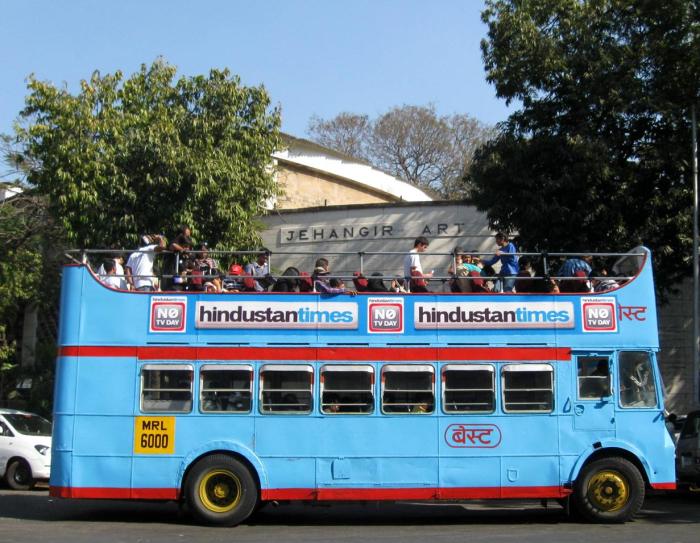
Mumbai’s BEST buses are known for their trademark red coloured buses, But only when they are not covered with advertisements, or have their AC buses painted a hideous purple. But one day, about two months back, I saw a new colour on the BEST bus. A lovely new, fresh, colour.

29 January 2011: An open deck, double-decker, BEST tourist bus outside Jehangir Art Gallery

Continue reading “Mumbai Lens: The Blue Retro Bus”

Puranic tales for cynical people and humour for all

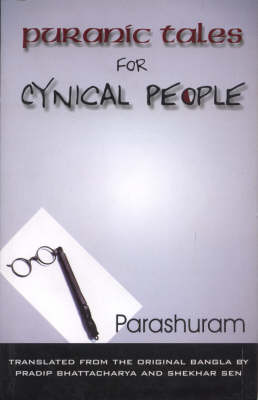
How often do you pick up a book on the basis of its title? I do that sometimes, often to be disappointed. But Puranic Tales for Cynical People (Indialog, 2005), written by Parashuram and translated from the original Bangla by Pradip Bhattacharya and Shekhar Sen, was an exception. I purchased this book in 2005, read it from start to finish, and loved it so much that I was all set to read it a second time. That never happened, and after a while it got shelved with my other books, hidden but not fully forgotten.

Until recently, that is. My brother unearthed it recently during a raid on my bookshelves in search of some reading material. Thanks to him, I was able to once again delight in the book’s sometimes light, sometimes acerbic, and sometimes irreverent humour.

Parashuram was the pen name of Rajsekhar Bose (or Basu, if you please) (1880-1960). Under this nom de plume, he wrote a 100 short stories, which were published in 9 collections. Twenty of these stories have been put together in this collection of Puranic Tales for Cynical People by the translators.

The basic premise of most of these stories revolves around the intriguing possibility of placing “well-known characters from the Puranas in situations that might have been”. In other words, they cater to the question of what happened next or a behind the scene narration of a famous story or incident. For example: what happened to Surpanakha after the Ramayana? Did the celibate Hanuman ever consider matrimony? Did Vishwamitra and Menaka always have a lovey-dovey relationship? Do apsaras always stay young?
In the process, Parashuram pokes fun at everybody—from the Creators (Hindu, Christian and Muslim) themselves, to venerable sages and other characters that any reader who is even reasonably acquainted with Hindu mythology will be able to identify and relate to.

Some of the lesser known characters that Parashuram breathes life into are Yayati (‘Yayati’s Senility’), Revati (‘Revati Gets a Husband’) and Maharishi Jabali (‘Jabali’). Two of the stories actually make caricatures of two of the crankiest,  hot-tempered and feared sages—Durvasa (‘Bharat’s Rattle’), and Vishwamitra (‘The Clay Girdle’).

Two stories explore the possibility of what happens when (i) the creators of the world’s 3 main religions meet (‘Three Creators’); and (ii) the 7 immortal men from the Puranas meet—Ashwatthama, Vyasa, Hanuman, Vibhishana, Kripacharya, Parashuram (the sage that is, not the author), and the Daitya king, Bali—at ‘The Gandhamadan Conclave’. Both these stories are absolutely delightful. While the former hits out at the claim of comparative superiority of one religion over others, the latter story emphasises the fact that all wars are essentially unfair.

Continue reading “Puranic tales for cynical people and humour for all”

Travel Shot: The broken chair

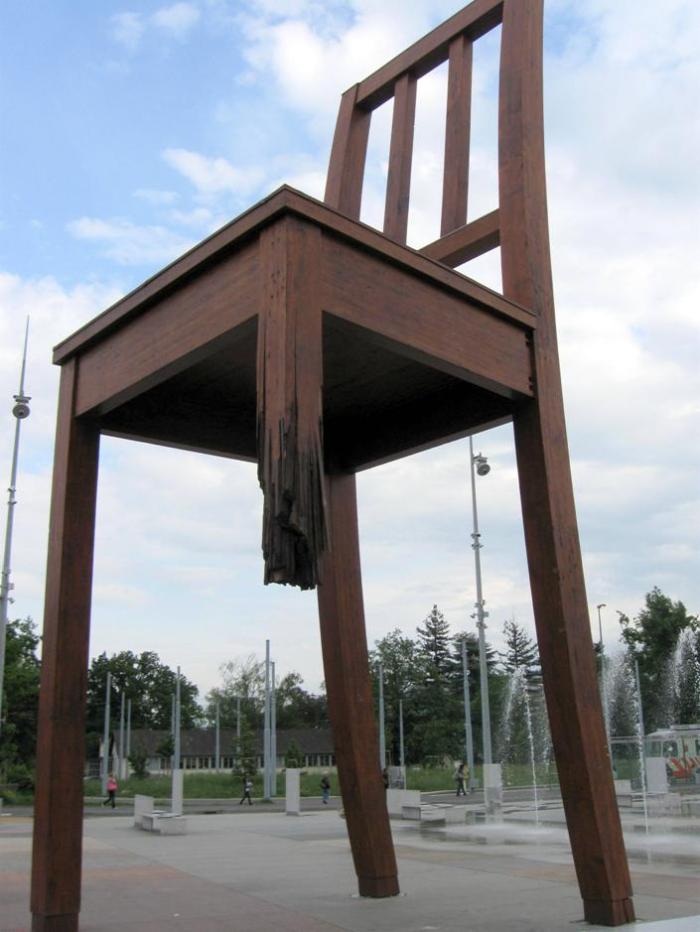
No visit to Geneva is complete without a visit to the United Nations. I mean not everyone can go in, but one can stand outside the building and have a photograph taken. That’s what most people think they are going to do, until they reach there. Then they find themselves distracted by a big broken chair. Don’t believe me? See the picture below. 

The Broken Chair

The Broken Chair is a wooden sculpture by the Swiss artist Daniel Berset, and constructed by the carpenter Louis Genève. Made out of 5.5 tons of wood, the 12 m high chair with a broken leg symbolises opposition to land mines and cluster bombs. It acts as a reminder to those visiting the place about the horrors of land mines. Many protests and demonstrations are held at this site.

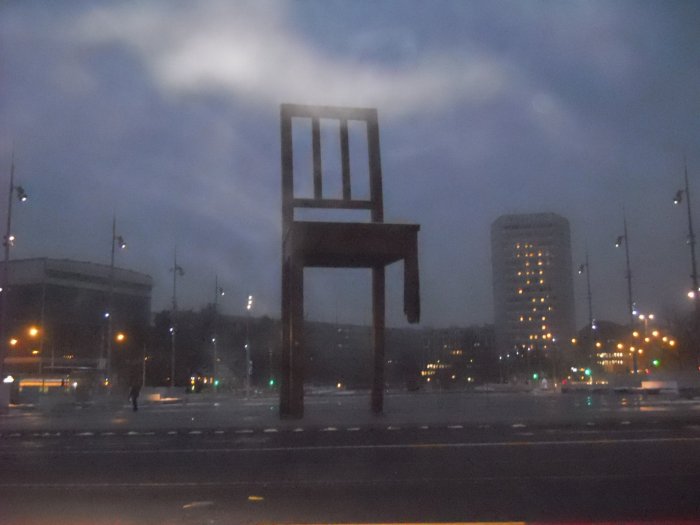
The above photograph taken by me looks relatively benign like a piece of sculpture, while the one of the Broken Chair, taken by my niece’s friend on a cold December evening looks positively menacing and threatening, much like the danger posed by landmines and cluster bombs themselves.

30th December 2010: The Broken Chair

According to the International Campaign to Ban Landmines, “landmines claim victims in every corner of the globe each day”.  The Campaign is working towards a world-wide ban on landmines and as of date, 39 countries including India have not signed the Treaty.

The UNICEF has declared April 4 as the International Day for Mine Awareness and Assistance in Mine Action. And you will do your bit by reading this blog and passing on information about the dangers from landmines and cluster bombs, won’t you?

Two incidents and a lesson

I was 16 and in my last year of school when the first incident happened. School had finished for the day and I was waiting for a rickshaw outside my school to take me to the railway station, from where I would take a train home. Hearing a rickshaw approach behind me, I turned hoping that it would be empty. It wasn’t and as it sped by me, I saw a horrific sight. A man and a woman were struggling in the rickshaw and the man had a knife in his hand.

Photo Courtesy: Istock photos

I saw all this in a flash and for a moment I thought that I had imagined the whole thing. But then I reasoned that I couldn’t have imagined the glint of the knife, could I? Just then an empty rickshaw came and I saw to my relief that the driver was someone I knew, in the sense that I had travelled in his rickshaw many times.

I told the driver about what I had just seen and asked if we should give chase. The driver said that I must have imagined the knife and what I must have witnessed was some friendly “wrestling” between a couple. Besides, wouldn’t the rickshaw driver have done something if he sensed that there was something wrong going on? No, no, I must have had a stressful day, and it would not do for a girl like me to have such an active imagination. I should concentrate on my studies and try to get home as quickly as possible. With these words of advice, he dropped me off at the railway station.

Continue reading “Two incidents and a lesson”