Ilay Cooper’s book on Shekhawati set me off on an extraordinary trip to an extraordinary place, and I had to wait for nearly six months before I felt ready to write about it — so overwhelming were my thoughts and emotions.
Presenting the first of eight posts on the painted towns of Shekhawati. It is a brief account of the region’s history (an introduction to the series really), in order to understand the region’s past and present, in the context of the Shekhawati Series.
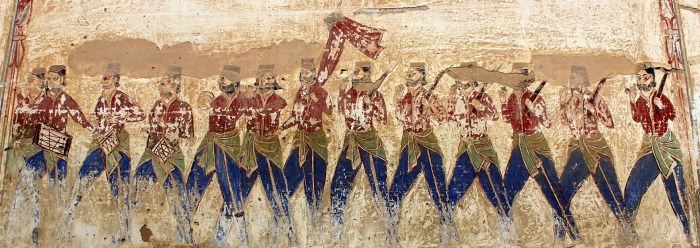
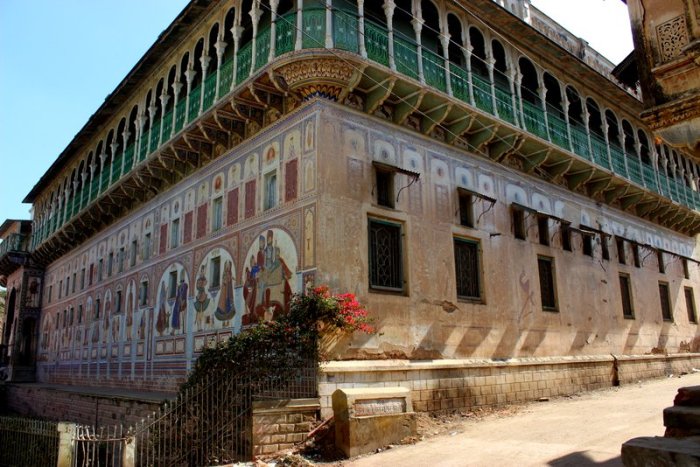
Shekhawati is one of the four regions of Rajasthan, the others being Mewar, Marwar and Hadoti). Spread over Sikar, Jhunjhunu and Churu districts of Rajasthan, it is best known for its grand and palatial havelis (mansions). It is also known for being home to many of India’s well-known business families — Birla, Poddar, Bajaj, Jhunjhunwala, Khaitan, Oswal, Piramal, Ruia, Singhania, and Goenka, among others are from this region.
One would think that this would automatically mean a lot of visibility and tourist footfall in the region, but this is not the case — compared to the other regions of Rajasthan, Shekhawati is less visible. Which, in my opinion, is really surprising as the history of the region is quite unique and distinct from the rest of the State (at least in the context of the series that I’m writing).
Have you ever seen a painting, a picture, a poster, a photograph… or any work of art and instantly felt a connection to it? Not the janam janam ka rishta type, but a connection where that piece of art is communicating with you? Talking only to you? And everything around just fades into the background and it’s just you and that work of art. This happens to me sometimes and it’s quite inexplicable, really, as to why I feel a connection that particular piece of art only !
This post is about one such connection. A connection forged while viewing it on a computer screen. It happened something like this…
It was a dull day at work. One of those days when everything moved sluggishly — papers, people, the internet connection, thoughts …. The humid weather didn’t help and by the time tea break came around I was ready to go to sleep. Of course, I couldn’t being at work and all that. So I did the next best thing — armed with nice cup of Assam tea, some biscuits, and piano music in the background, I decided to do some blog surfing. And, serendipitiously, stumbled across this painting by Monishikha:
“Roses” by Monishika Roy-Choudhury. Watercolour on art paper
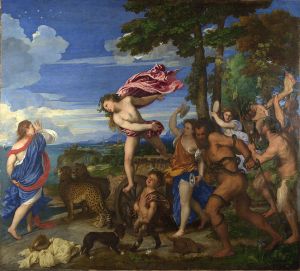
Sometimes, we miss the forest for the trees. And sometimes, we miss the trees for the forest. Let me give you an illustration. Take a look at the painting below (click on the picture to see a larger view).
Source: The National Gallery, London
The painting is called “Bacchus and Ariadne”. It was painted by Titian sometime between 1520 and 1523. It depicts a tale from Roman mythology where Bacchus (the God of Wine) sees the mortal Ariadne and falls in love with her at first sight. He is so smitten that he jumps out of his cheetah-drawn chariot towards her. The painting has captured Bacchus in mid-leap as Ariadne shies away from him in alarm.
I saw this painting at London’s National Gallery in 2009. I duly noted the story that the painting conveyed, the various characters in it, the lovingly painted animals, Titian’s trademark use of bright colours… and moved on to the next artwork. It was a nice painting, but not particularly impressive. Or so I thought. Today, I bitterly regret at only looking at the painting, but not seeing it closely enough. In only looking at the painting, I had completely failed to see the colours themselves, particularly the brilliant blue of the sky — a blue which came from the ultramarine paint made from the semi-precious lapis lazuli mined hundreds of miles away in the Sar-e-Sang valley (in present day Afghanistan).
The lapis lazuli from these mines would have travelled through ancient trade routes to the colour maker in Italy, who then transformed it into the very expensive ultramarine paint through a laborious process. First, the lapis lazuli would have been finely powdered and kneaded into a dough along with resin, wax, gum and linseed oil for 3 days, after which it would have been put in a mixture of lye and water. This mixture would have been kneaded again, this time with sticks, to draw out the blue of the lapis lazuli into the liquid. The blue-coloured liquid would have been be collected in bowls and allowed to dry, leaving behind a powdery blue pigment, the ultramarine blue. The process would have been repeated with the “dough” to get different qualities and shades of blue (pg.290-291). These days making the ultramarine paint is not so laborious as it is made synthetically.
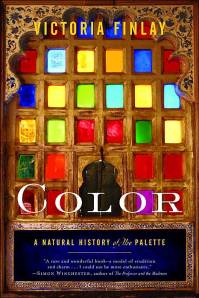
I read about all this and much more in Colour: A Natural History of the Palette (2004, Random House, pp.448) by Victoria Finlay. The book can be considered as a travelogue; it can also be considered as a book on art history. But for me, it is a book on the micro-history of colour as explored through an artist’s paintbox holding the colours of the rainbow and then some more — violet (or purple), indigo, blue, green, yellow, orange, red, ochre, white, black and brown.
In her attempt to trace and draw out the stories of how natural dyes, paints and colours were made for a European artist’s paintbox, Finlay travelled to Australia, England, China, Chile, Italy, India, Iran, Spain, Afghanistan and Lebanon. As each story, myth, legend of the colours come into life, we realise that:
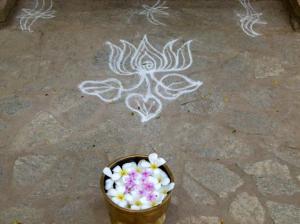
A welcoming Kolam and flowers greets visitorsThe glass of chilled mosambi juice was a life-saver. The blinding white heat and the humid haze that had assaulted my senses from the time I had landed in Chennai dissipated a wee bit.
I became aware of the quiet and calm of Dakshinachitra, “a living museum of art, architecture, crafts, and performing arts of South India”.
Located on the East Coast Road in Muthukadu, Dakshinachitra is about 21 km south of Chennai. The sprawling, 10-acre complex houses carefully recreated heritage structures, traditions and culture from the four southern Indian states of Andhra Pradesh, Karnataka, Kerala and Tamil Nadu. It is also a hub for performing arts, a retreat for artists, a learning centre for students, an exhibition space, a place to visit for the culturally inclined tourist… And a place that I had been wanting to visit for a long time, particularly to see the heritage structures.
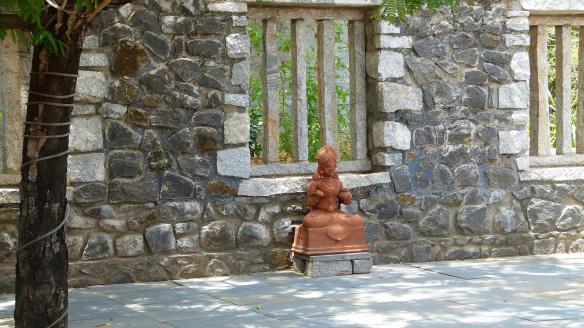
So when the opportunity to visit Chennai came up about 10 days back, I planned my itinerary in such a way that I would go straight to Dakshinachitra from the airport itself. So far so good. What I had not accounted for, or rather ignored what everyone told me, was the severity of the infamous Chennai heat. I mean, how much more different could Chennai humidity be from Mumbai’s? By the time I reached Dakshinachitra, I was almost dehydrated and was having fond thoughts about Mumbai weather !A shady courtyard at Dakshinachitra
Though the mosambi juice and lots of water revived me enough to brave the heat and take a walk through the heritage houses, the relentless heat made it difficult for me to really enjoy my visit there. I did manage to walk through the entire section of heritage structures, but my mind and camera did not register or record everything I saw.
But do allow me to share with you what they camera recorded. 🙂
 Continue reading “The painted towns of Shekhawati: Past and present”


 I read about all this and much more in Colour: A Natural History of the Palette (2004, Random House, pp.448) by

 My Favourite Things