Colour: A natural history of the palette

Sometimes, we miss the forest for the trees. And sometimes, we miss the trees for the forest. Let me give you an illustration. Take a look at the painting below (click on the picture to see a larger view).
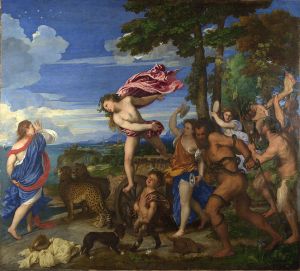
Source: The National Gallery, London

The painting is called “Bacchus and Ariadne”. It was painted by Titian sometime between 1520 and 1523. It depicts a tale from Roman  mythology where Bacchus (the God of Wine) sees the mortal Ariadne and falls in love with her at first sight. He is so smitten that he jumps out of his cheetah-drawn chariot towards her. The painting has captured Bacchus in mid-leap as Ariadne shies away from him in alarm.

I saw this painting at London’s National Gallery in 2009. I duly noted the story that the painting conveyed, the various characters in it, the lovingly painted animals, Titian’s trademark use of bright colours… and moved on to the next artwork. It was a nice painting, but not particularly impressive. Or so I thought. Today, I bitterly regret at only looking at the painting, but not seeing it closely enough. In only looking at the painting, I had completely failed to see the colours themselves, particularly the brilliant blue of the sky — a blue which came from the ultramarine paint made from the semi-precious lapis lazuli mined hundreds of miles away in the Sar-e-Sang valley (in present day Afghanistan).

The lapis lazuli from these mines would have travelled through ancient trade routes to the colour maker in Italy, who then transformed it into the very expensive ultramarine paint through a laborious process. First, the lapis lazuli would have been finely powdered and kneaded into a dough along with resin, wax, gum and linseed oil for 3 days, after which it would have been put in a mixture of lye and water. This mixture would have been kneaded again, this time with sticks, to draw out the blue of the lapis lazuli into the liquid. The blue-coloured liquid would have been be collected in bowls and allowed to dry, leaving behind a powdery blue pigment, the ultramarine blue. The process would have been repeated with the “dough” to get different qualities and shades of blue (pg.290-291). These days making the ultramarine paint is not so laborious as it is made synthetically.
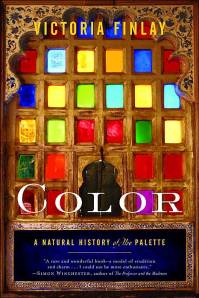
I read about all this and much more in Colour: A Natural History of the Palette (2004, Random House, pp.448) by Victoria Finlay. The book can be considered as a travelogue; it can also be considered as a book on art history. But for me, it is a book on the micro-history of colour as explored through an artist’s paintbox holding the colours of the rainbow and then some more — violet (or purple), indigo, blue, green, yellow, orange, red, ochre, white, black and brown.

In her attempt to trace and draw out the stories of how natural dyes, paints and colours were made for a European artist’s paintbox, Finlay travelled to Australia, England, China, Chile, Italy, India, Iran, Spain, Afghanistan and Lebanon. As each story, myth, legend of the colours come into life, we realise that:

Continue reading “Colour: A natural history of the palette”

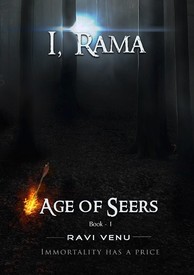
I, Rama or Ayyo, Rama !

I, Rama: Age of Seers by Ravi Venu (Cratus Media, pp. 264, Rs.225) is the first book in the “I, Rama Series”. The series is a retelling of the Ramayana from Rama’s point of view.

This is His tale… let Him share His story with you…His account of the Legend. This is the story of that mighty king through His eyes, but my hand. (p.17)

I, Rama is narrated as a flashback to Rama’s twin sons Lava and Kusa, his brothers Lakshman, Bharat and Shatrughan, and his foremost devotee, Hanuman. It is not a simple straightforward flashback as there are tales within tales and flashbacks within flashbacks. So, even if it is Rama, who is narrating the tale, he narrates it through another’s voice. This volume takes the readers through the origins of the Ishvaku clan, the reign of Dashrath, the birth of Rama and his brothers, Rama and Lakshman’s sojourn to the Dandaka forest with Vishwamitra, Sita’s swayamvar and her ensuing marriage with Rama, and his encounter with Parasurama. The book ends with Rama, Sita and Lakshman being exiled from Ayodhya.

This is what I, Rama narrates, a story that anyone who has read the Ramayana will be familiar with, including me.

Now, how do I write a review of a book that is yet another retelling of the beloved Hindu legend, the Ramayana?
How do I write a review of a book that is part science fiction, part fantasy, part mythology and ends up being an uncooked khichdi of genres?

How do I write a review of a book with that is woven around a unique premise, but is written very badly?

How do I write a review of a book that was much-anticipated, but which failed to deliver?

How do I write a review of a book whose language is so archaic that it made me cringe?

How do I write a review of a book called I, Rama, but one that made me go “Ayyo, Rama”?

How do I write a review of a book that I struggled to complete and then did not want to review it?

I, therefore, decided not to write a usual review. What I have written is this…

Continue reading “I, Rama or Ayyo, Rama !”

The forest of stories: A review

The background

It can be safely stated and assumed with confidence that no other story captures the imagination of Indians across caste, class, region, religion and borders like the Mahabharata. The sheer range of books, films, television serials, critiques, essays, poems, theatre adaptations, folk dances and performances based on this epic are a mind-boggling testimony to this. Each version brings with it the claim that it is a fresh re-telling or re-interpretation of the Mahabharata, a claim that is true to a certain extent. Each author/poet/director/singer/dancer brings a perspective to the story that is uniquely his/her own in their narration. And yet, each re-telling retains the essence of the story that is the Mahabharata.

Ashok Banker, the latest writer to come out a re-telling of the Mahabharata, is very clear that his version is not a “religious polemic”, or a “historical document” or “itihasa”. It is just a great story told in his voice, a story that he wanted to narrate all his life.

This is simply the Mahabharata of Krishna Dweipayana Vyasa retold by one man.

That man is me, of course. (p.xix)

The book review

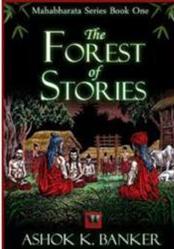
The Forest of Stories (Westland, 2012, pp. 352 + xxii, Rs.295/-) is the first of 18 books in the Mahabharata series of Ashok Banker, who prefers to call it the MBA series ! The book is divided into 9 sections or pakshas, and each paksha is further sub-divided. In addition, there is an introduction to the series/book as well as acknowledgements and some information on the forthcoming two books in the series.

The book begins with the arrival of Ugrasrava Lomarsana (also known as Sauti) at Naimisha-sharanya, a school of learning and meditation for young brahmins, which is located deep within the bowels of the hostile and dense forest, Naimisha-van. Sauti is a renowned kusalavya or wandering bard whose renditions of poems and stories and epics have made him famous all over the land. His arrival sends the ashram residents, students and teachers alike, into a tizzy of hope: that they will be fortunate to hear Sauti narrate the epic poem Jaya.

Continue reading “The forest of stories: A review”

Twitter + Literature = Twitterature?

Classics and bestsellers are rarely left to ..er.. rest on their popularity. The moment they become popular, an entire line of copycat books (which also hope to become a classic one day, or at least the next bestseller) are published. Then come the attempts to make a film or a TV serial (or both) based on the classic/bestseller. Parodies of the classics are not too far behind in getting published or filmed. Then you have the critiques and the re-interpretations of these popular books. And with the social media boom, it is not surprising that some of these books are being tailored or re-written to fit that criteria (for example, click here to read a Facebook version of the Mahabharata, and here to read a  Facebook version of the Ramayana).

With the Twitter boom, can its influence on literature be far behind? Not at all, and this is where two teenagers, Alexander Aciman and Emmet  Rensin, rewrote over 80 classics and some recent bestsellers as a series of tweets. And thus was Twitterature: The World’s Greatest Books Retold Through Twitter born.

Twitterature (Penguin Books, 2009, pp. xiv + 146) is an attempt at “facing and understanding … the greatest art of all arts: Literature” through Twitter. The authors, both 19-year-old students at the University of Chicago at the time of publication of the book, wrote it with the intention of mastering “the literature of the civilized world, while relieving [the reader of] the burdensome task of reading it” in its original form. In other words, Twitterature is a retelling of literature in the form of tweet stories in Twitter language.

Continue reading “Twitter + Literature = Twitterature?”

Balasaraswati: Her art and life

Photo Source: http://www.firstpost.com

The background

I did not know what I was getting into when I decided to review Balasaraswati: Her Art & Life by Douglas M. Knight Jr. (Tranquebar Press, 2011). All I was aware of at that time was the fact that I would be reading about a person I “knew”. Let me elaborate here.

Amma (my mother) grew up on a diet of classical music and dance. A student of Carnatic classical music, she was fortunate to watch many musicians and dancers perform, one of whom was Balasaraswati herself. Amma worshipped and idolised her as only a true rasika can. I started attending kacheris (music performances) and dance performances with Amma when I was 5. After each performance there would be a discussion on what we liked or did not like, and we would try sing the pieces we liked. If it was a dance performance that we had attended, the discussion would begin with the dance, then move on to the music, and finally to the inevitable mention of how Balasaraswati would have performed a particular dance item. By the time I was 6 or 7, I knew who Balasaraswati was, what her dance was like, and how she danced—all this without ever having seen her dance. But thanks to Amma’s vivid descriptions, and whenever Amma herself sang, I could and would imagine Balasaraswati dancing to them ! Such was her impact on me.

Continue reading “Balasaraswati: Her art and life”

Ladies compartment, 8.47 local: Book release function and review

Sometime early last month, Mumbai experienced a few days of gloomy, cloudy, rather funny weather.Though this type of weather was quite uncharacteristic for Mumbai, it was  typically London weather. And suddenly I was remembering and missing my days in London. On a whim, I put a status update on my Facebook wall about missing London, which elicited some responses. One of the responses I got was this:

You really miss England, don’t you? Go back, Sudha. Steep yourself in the legends and the history, touch the old walls and let them flow up your finger-tips into your heart, let the lakes and the streams and the little sudden springs soak into your soul, let the 40 shades of green fill your eyes and mind, let the cathedrals and the quaint corners whisper forgotten secrets and fervent prayers to you. Then come back home again.

As I read these beautiful lines, I did “travel” back to England, experience all that it said I should and came back “home” rejuvenated. And excited. Excited, because these lines had been written and posted by Suma Narayan, whose first book I had agreed to review. If these lines were a preview of what Suma’s writing would be like, I knew that the book would be a good read.

Continue reading “Ladies compartment, 8.47 local: Book release function and review”