The Elephanta Caves

“I couldn’t tear myself away from the image of the Maheshmurti. It was so beautiful. So mesmerising. Elephanta was so nice,” gushed Iskra, an exchange student from Bulgaria.

I listened to Iskra’s description of her visit to Elephanta Caves with part fascination and part envy. The reason? In spite of having lived in Mumbai for nearly 23 years, I had never been to the Elephanta Caves. Listening to Iskra, and that too a foreigner, rave about them needled me into resolving to visit the caves at the earliest opportunity.

And would you believe it? The opportunity presented itself to me the very next day, almost as if it was just waiting for me to make up my mind. My Facebook wall announced that Girls on the Go (GOTG), a women’s only travel club, was conducting a guided day trip to the Elephanta Caves on 13 March 2011. Would I be interested? Not one to let go of an opportunity like this, I signed up for the trip within seconds of seeing the intimation. 😀
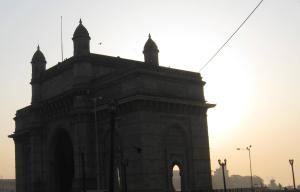
Gateway of India

So, on D-Day, I was at the Gateway of India much before the reporting time of  7.45 am. While waiting for Piya Bose, the founder of GOTG, and the rest of the group to assemble, I tried to recall what I knew about the Caves. They were … um… really old rock-cut caves, were located in Elephanta Island some distance away from Mumbai, could be accessed only by boat, and was a UNESCO World Heritage Site. In short, I knew nothing about the Caves. Of course, by the time the tour got over I was a little wiser thanks to Lakshmi Kishore, our guide, and a booklet on the Elephanta Caves that I purchased from the ticket office.

Elephanta Island has traces of habitation from 2nd century BC in the form of remains of a Buddhist stupa, reportedly built by Emperor Ashoka himself. But what the Island is really famous for are 7 rock-cut caves, whose age is not well established due to absence of written records. Various theories exist as to the age of the caves as well as to who built them, and according to the Archaeological Society of India’s (ASI) booklet, the caves were excavated during the middle of the 6th century, during the rule of the Konkan Mauryas.

Locally, Elephanta Island is known as Gharpuri and is located about 11 km from Mumbai. It was called Elephanta by the Portuguese, who found a stone statue of an elephant at one of the entry points to the Island. Though they tried their best to destroy the statue, they only succeeded in severely damaging it and today the restored elephant is installed at the Bhau Daji Lad Museum in Mumbai.
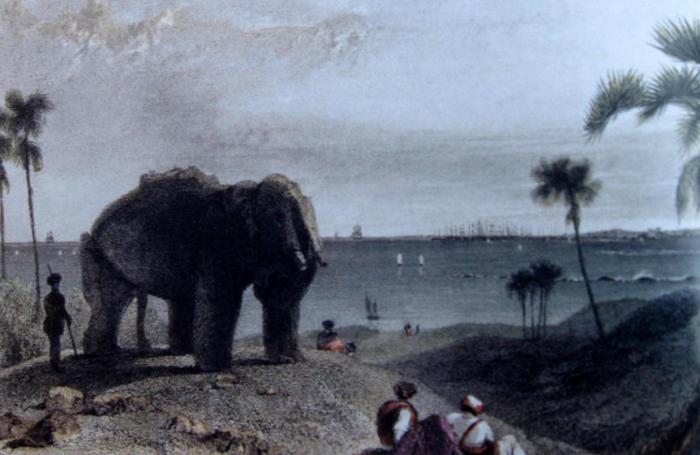
Aquatint of the Stone Elephant by Thomas Daniell and William Daniell, 1786. Photo Courtesy: Elephanta by George Michell

Continue reading “The Elephanta Caves”

India’s Republic Day celebrations: Time for a change

Another Republic Day has come and gone. India’s 62nd, to be precise. This one has been no different from its previous ones, at least the ones I have been observing for the last 25 years or so. For example,

  • The run-up to the Republic Day saw the print and electronic media competing with each other in reporting the achievements of the country.
  • There were interviews with key armed forces personnel, academicians, ministers, investors, NRIs, and other stakeholders for a “holistic” view of India.
  • There were interviews with the kin of freedom fighters (there aren’t any freedom fighters left now, I guess) in the media. A couple of interviews with retired armed forces personnel were also thrown in for a little variety.
  • The President’s speech (yawnnn…) was boring as usual and had nothing inspiring in it.
  • The Republic Day parade was beamed live on Doordarshan, the national television.

I think that even for those who did not watch the parade (either in New Delhi or the live telecast), like me, could imagine what it would have been like. This is because the parade has been following a set pattern year after year and does not deviate from it for even an inch.

So I knew that there would be an impressive display of India’s military might through its arms and ammunition, various regiments and divisions of the armed forces, the BSF camels, the CRPF, the Coast Guard, etc. Then there would be tableaux from the states and union territories of India, as well as performances by school children and folk dancers.

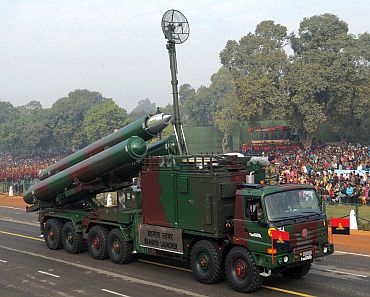
The evening news on TV and the Republic Day coverage on various news websites confirmed that my visualisation of India’s 62nd Republic Day celebrations was spot on. Some images from this year’s Republic Day parade at New Delhi are presented below (all images are courtesy of www.rediff.com).

Brahmos Missile Launcher

Continue reading “India’s Republic Day celebrations: Time for a change”

The Emerald Route: One book, many narratives

What would you call a book that

(a) is primarily a travelogue,
(b) is also a concise literary, spiritual, religious, mythological, and political history of the region,
(c) is part autobiographical, and
(d) includes a description of taming wild elephants, a folk tale and a one-act play.

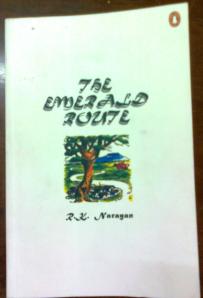
The cover illustration is by R.K. Laxman

The book that I am talking about here is R.K. Narayan’s (RKN) The Emerald Route, which is the outcome of the author’s travels along with R.K. Laxman, his brother and the famous cartoonist, through the length and breadth of Karnataka.

First published in 1977 by the Director of Information and Publicity, Government of Karnataka, and then by Penguin India in 1999, I recently bought the latter edition on the recommendation of Smeedha, a friend.

RKN chose to title his book “The Emerald Route” for one important reason—he did not encounter even a single dry patch during the first phase of his tour from Mysore through Hunsur and Hassan and back. He says:

Continue reading “The Emerald Route: One book, many narratives”

What’s in a name?

None of us have a say with what we are named as, do we?

It depends entirely on what our parents (or whoever else had a say in this matter) wanted to name us. But sometimes, even the parents (or whoever else had a say in this matter) do not have a choice in choosing their child(ren)’s name(s). For instance, the Tamil Brahmin (a.k.a. TamBrahm) Iyer community from Tirunelveli district of Tamil Nadu, follows certain pre-ordained rules. You wouldn’t find these rules in any book or magazine, as it is part of the oral traditions of the community passed down from generation to generation.

I make an attempt (albeit a tongue-in-cheek one) here to codify these “scientific”, and quirky, rules on naming children born to the TamBrahms of Tirunelveli district. My qualifications for doing so are due to my being (i) a TamBrahm from Tirunelveli District, and (ii) a recipient of this oral tradition. 🙂

Some common TamBrahm names. Designed with the help of Wordle

Continue reading “What’s in a name?”

A competition, two surprises and a Sunday

Last Sunday, instead of waking up late and pottering about the house the whole day doing that and this, I did something different. I co-judged the city-level Classmate Ideas for India 2010 competition held in Mumbai.

An initiative of the ITC as part of its centenary celebrations, the Classmate Ideas for India 2010 competition has youth in the 14–21 years category present their ideas for the “betterment of India”. These ideas are in the fields of Science and Technology; Environment Protection; Education for All; Encouraging Social and Religious Tolerance; Infrastructure for a Better Tomorrow; and Emerging India.

The first round of the competition saw the competition receiving over 60,000 ideas from all over India. These ideas were then evaluated on the basis of originality, feasibility, practicality, and impact factor and then whittled down to 500 ideas equally divided over 10 cities and their surrounding regions. For example, the Mumbai Idea Presentation had entries from Maharashtra and Goa. Each city’s Idea Presentation would pick out a winner for the National Finals to be held later this year in December. The entire event is being managed by KrayOn, an event management company for kids and youth events. They were the ones who contacted me to judge the Mumbai event.

Continue reading “A competition, two surprises and a Sunday”

Happy Diwali

It’s the night before Diwali (sorry for the completely unoriginal beginning). It is 10.30 pm and I am at home savouring the calm after a week of hectic house cleaning and shopping and helping my mother make some sweets and savouries.

The house is fragrant with the til (sesame) oil that my mother has just heated with some herbs and spices for the ritual oil bath tomorrow. The new clothes that my parents and I will be wearing tomorrow are stacked in a beautiful bronze tray for my father to hand out after the morning oil bath. The Diwali sweets (theratipal and okkarai) and the savouries (tenkozhal and cornflakes chivda) are also laid out with the leghiyam, a spicy ginger preparation, which is supposed to be a cure against the effects of gluttony that one normally indulges in during Diwali. The rice kolam has been drawn at the entrance to our house, and the clay diyas have been lit and all is well with the world. Well almost. This is the calm before the storm—the storm of firecrackers.

To most Indians, Deepavali or Diwali is not about new clothes, an endless orgy of eating, holidays, and gifts—it is about bursting firecrackers, and the louder they are the better it is. And this is the reason why I hate dislike Diwali so much. I am petrified of firecrackers.

I recall some Diwalis spent crying non-stop and other Diwalis trying to cope and manage with a brave face. As I grew older, the crying bouts gave way to sullen anger and sulking episodes during Diwali. I must admit here that this is something that I have not got over completely, even today.

Like every year, this year too, I have made a conscious effort to not let the firecrackers get to me. It hasn’t been smooth sailing though—a sudden burst of crackers at the market place, where I was buying vegetables yesterday, almost had me bursting into tears. The children in my building, who have been busy with their bagfuls of firecrackers throughout the day today have also severely tested my resolve.

Continue reading “Happy Diwali”