Chamba Rumals: Painted Embroideries or Embroidered Paintings?

It was serendipity that led me to the exhibition on ‘Chamba Rumal: Life to a Dying Art’ at the Bhau Daji Lad Mumbai City Museum (BDL Museum) one Saturday evening earlier this month! I call it serendipity for till that afternoon, I had neither aware of the existence of something like the Chamba Rumal nor of the exhibition.

It all started in my Indian Aesthetics class on Krishna Shringara by Prof. Harsha Dehejia. While giving examples of the depiction of Krishna Shringara in art, the embroidered Chamba Rumal was one of the things he mentioned and showed in his presentation. Ruta, one of my coursemates (and who was probably aware of my love for museums), told me about the exhibition on Chamba Rumal during the break. And of course, this meant that I had to go see the exhibition that very evening after class. 🙂

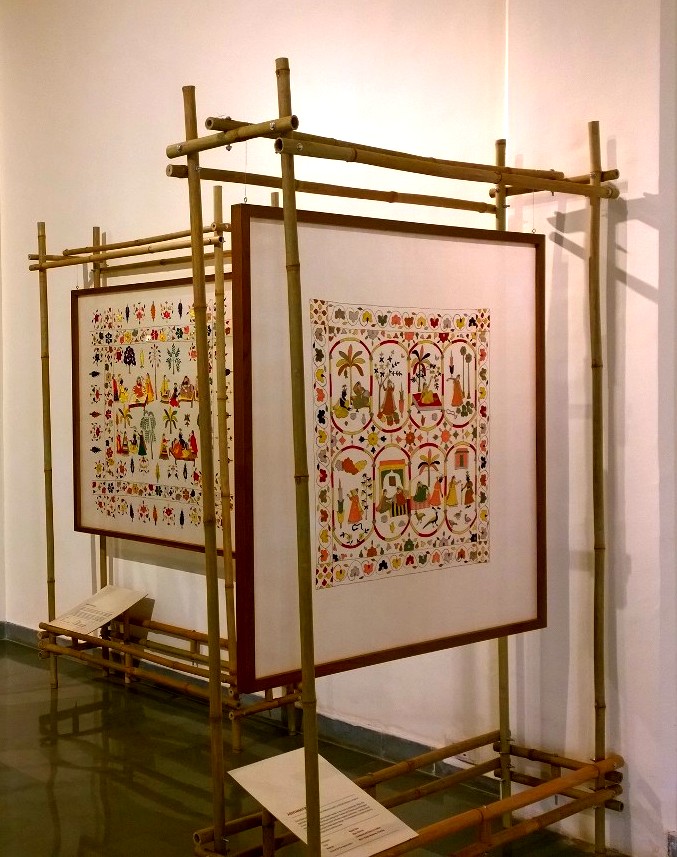
When I walked into the Special Projects Area of the BDL Museum and where the exhibition on Chamba Rumal was being held, the first thing I noticed was the display — large framed pieces hung on bamboo stands. The cool whitewashed walls, and the gleaming kota flooring was just perfect for the vibrant exhibits, which looked like paintings from a distance, but were actually exquisitely embroidered pieces, the Chamba Rumals.
Chamba Rumal, Crafts of India, Art, Indian Aesthetics, Bhau Daji Lad Museum, Delhi Crafts Council, Exhibition

Continue reading “Chamba Rumals: Painted Embroideries or Embroidered Paintings?”

Mahisasuramardini: The slayer of the buffalo demon

Today is Vijaya Dashami or Bijoya. Today is the day when the Goddess Durga defeated Mahisasura or the buffalo demon, after a fierce battle that lasted 9 days and 9 nights. After killing him on the 10th day, Durga came to known as Mahisasuramardini or “she who killed the buffalo demon”.

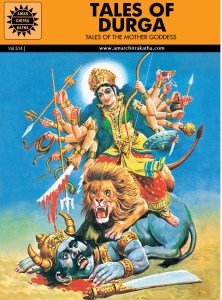
Durga, Mahisasuramardini, Hindu Mythology, Indian Art, Indian AestheticsThe story of Mahisasuramardini (which you can read here or here) is perhaps one of the best known in Hindu mythology, and its associated imagery is one of the most recognisable.

I was introduced to the story of Mahisasuramardini by my grandmothers, and also my mother’s recitation of the Mahisasuramardini Stotram. Like most children of the 1970s, I was introduced to the popular imagery of Mahisasuramardini through Amar Chitra Katha’s “Tales of Durga” (see picture on the left).

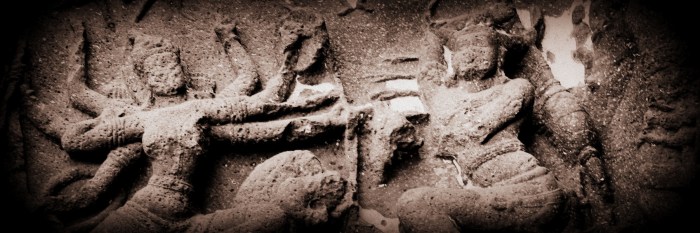
It was this image of Mahisasuramardini that stayed with me till 1997 when I visited Mahabalipuram. I saw Indian sculptural art in a ‘natural’ setting for the first time, including this depiction of Mahisasuramardini. That was when I realised the immensity, beauty and power of the narratives I had heard and read from the time I was a kid.

That visit also marked the beginning of my interest in Hindu mythology expanding to include its representation in classical Indian art. And Mahisasuramardini fascinated me like no other, which, thanks to my travels in India, I came across in Aihole, Ellora, Patan, Vadnagar and Nalla Sopara. Artiistically and stylistically, each one of the relief sculptures were very different, and yet unmistakably that of Mahisasuramardini.

Continue reading “Mahisasuramardini: The slayer of the buffalo demon”