The Jewish heritage of Mumbai

Somewhere in Basra, c. 1831

The room was dark and the only light, feeble as it was, came from a flickering oil lamp placed in a corner of the room. But it was enough for the fortune-teller to recognise the man being ushered in by his son.

“Salaam, Master,” the fortune-teller greeted the robed man.

You know who I am, ” the robed man said. It was a statement and not a question.

“Who doesn’t know you, Master?” said the fortune-teller. “Everyone knows you and about you.”

“Then you also know why I have come here.”

“I can guess, Master,” the fortune-teller bowed.

“I have no choice but to leave this region. Where should I go? London? China? Where does my future lie?”

The fortune-teller was silent for a long time. Just when the man was about to ask him again, the fortune-teller said.

“Your should leave immediately for Bombay in Al-Hind [Arabic for India]. A bright future and fortune lies awaits you there.”

The robed man was surprised with the response, but he knew better than to ignore the fortune teller’s advice. After paying him handsomely and thanking him, the robed man left. His mind was already planning for the move to Bombay.

And sometime later in 1832, the man arrived in Bombay and over the next 32 years made a phenomenal contribution to the city that Bombay was developing into. That man was David Sassoon

Continue reading “The Jewish heritage of Mumbai”

Mumbai Lens: The two bus stops

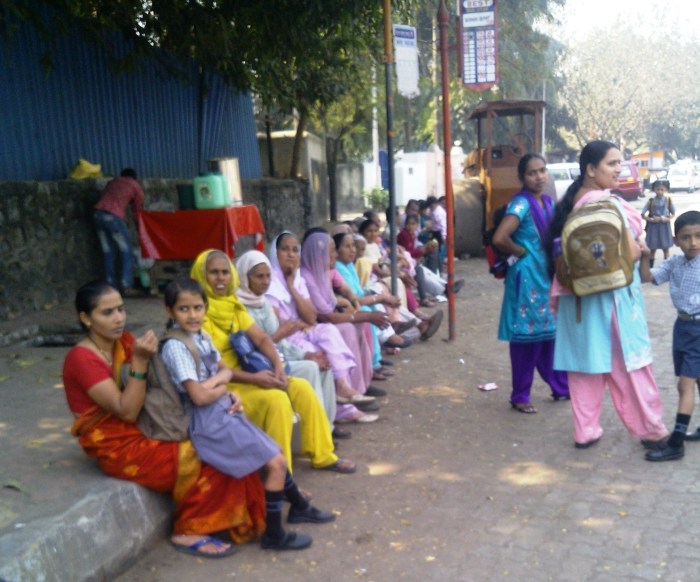
Deonar Bus Depot is a major bus stop in Mumbai on a route that links Navi Mumbai to Mumbai via Chembur. A few important bus routes originate from this stop and many other routes pass through the bus stop. At last count, 19 bus routes have this as a bus stop. And considering the number of bus routes that plying by Deonar Bus Stop, it is a fairly crowded one, especially during office hours. So, one would expect that being a major one, Deonar bus stop would have some seating space and shelter.

Wrong. This is what the bus stop looks like:

Mumbai, Bus Stop
The wait for a bus. Oh for a bus ! This photo was taken around noon

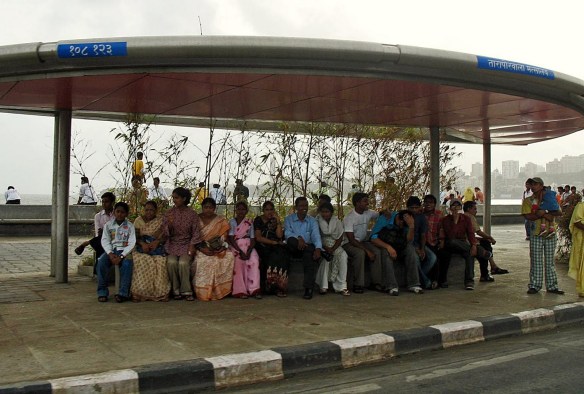
And then there is this bus stop on Marine Drive in South Mumbai. This bus stop services just two bus routes and I have rarely seen it crowded.

Photo: Nita Jatar Kulkarni. Please click on the photo to go to the original page.

Both the bus stops are constructed and maintained by the cash-strapped and corruption-ridden Transport Division of BEST. That still doesn’t explain why two bus stops in the same city maintained by the same organisation have to be so different and get such differential treatment.

Why? Oh why?

Mumbai Lens is a photographic series which, as the name suggests, is Mumbai-centric and is an attempt to capture the various moods of the city through my camera lens. You can read more posts from this series here.

Discovering Outsider Art

Outsider Art, Museum Dr. Guislain
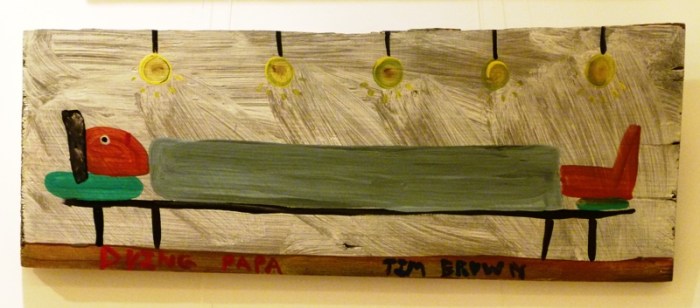
“Dying Papa”, by Tim Brown. Oil on Wood

The man lies rigid on a bed. Or is it a bench? There is no mattress on the bed/bench, but there’s a pillow under his head and another, flatter and smaller one, under his feet. The sheet covering him is too small and his feet stick out. The lights above the bed/bench cast sickly grey shadows on the walls, that appear to hover over the man. Are the shadows angels of death, I wonder?

I am drawn to this compelling artwork titled “Dying Papa” by Tim Brown, one of the many artworks on display at the exhibition on “Breaking the Chains of Stigma“, at the Institute for Contemporary Indian Art, Mumbai. This first-of-its-kind exhibition in India, which presents a global overview of mental health and a selection of “Outsider Art“, has been conceptualised by the Museum Dr. Guislain of Ghent in Belgium (and brought to India in collaboration with the Tata Institute of Social Sciences and Janssen Pharmaceuticals).

The information given along with the above artwork says that Brown (b.1923) is an African-American who grew up poor in the religious, rural and segregated South of the United States and worked in menial jobs. Brown started painting when he realised that he had no visuals from his childhood to share with his children. An untrained artist, Brown painted from his childhood memories on rough wooden boards or planks. After Brown’s wife died and his children left home, he withdrew from society at large and preferred to communicate with the outside world only through his paintings.

As I read this information, I realise that I have just been introduced an unknown and new genre of art (for me, that is) — “Outsider Art” — and one that sounds exciting ! But what  exactly is this Outsider Art? A walk through the exhibition acquaints me with this genre and how it has developed over the years.

Continue reading “Discovering Outsider Art”

Museum Treasure: Rama’s coronation

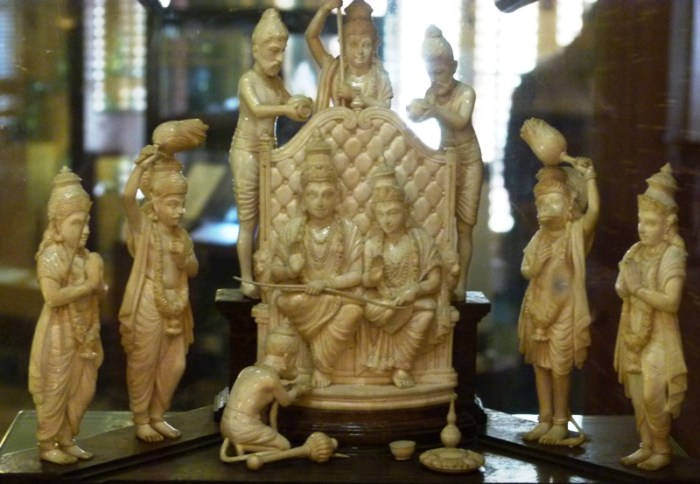
In India, popular perception in religious art largely spread through calendars, posters and periodicals. These colourful works of art were important in reinforcing images that we instantly recognise today. For instance, if we were to try to imagine Rama’s coronation in Ayodhya, it would be something like this — Rama and Sita seated on the royal throne with Hanuman bowing at their feet. Rama’s brothers, Lakshmana, Bharata and Shatrughna are in attendance, as is the Vanar king Sugreeva. The royal priest, Vashishta, is busy conducting the ceremony.

It is a gloriously celebratory image, but uni dimensional, and oh-so-safe-and-recognisable, if you know what I mean. And frankly, quite boring as the expressions on all the faces are fixed and beatific.

But then, sometimes, one comes across depictions that shakes you out of the boredom and makes you look at the same thing all over again, but with delight this time.

I came across two artifacts/tableaus on Rama’s coronation at at Mumbai’s Bhau Daji Lad Museum. Though both were instantly recognisable for what they depicted, they had more than an element of surprise on offer. Here is the first one:

Rama's coronation. Ivory, Mid-18th Century
Rama’s coronation. Ivory, Mid-18th Century

Continue reading “Museum Treasure: Rama’s coronation”

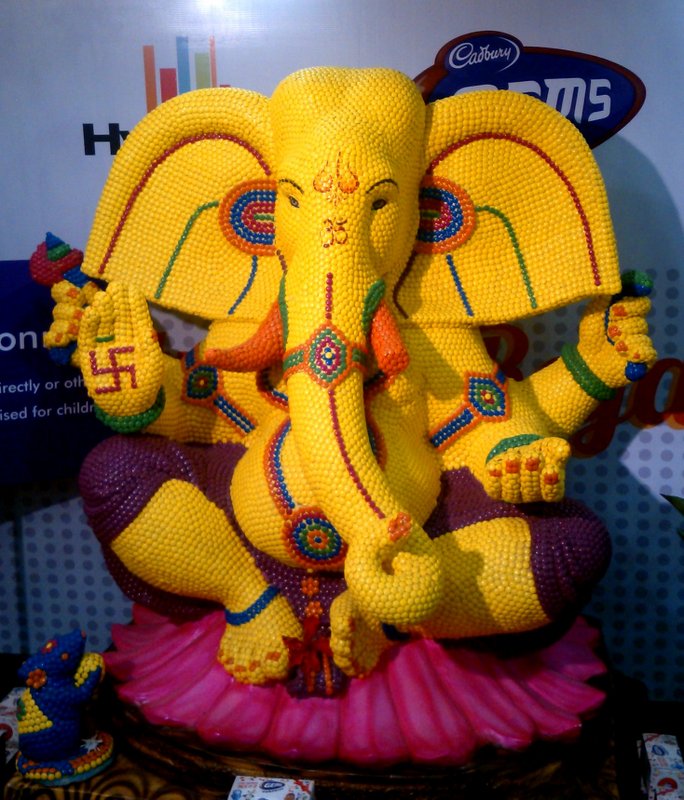
Mumbai Lens: Gem of a Ganpati

It is Ganeshotsav or Ganpati time in Mumbai and other parts of Maharashtra and . And depending on how one looks at it, this is a time for holidays, modaks, new beginnings, traffic jams, crowded market places, laddoos, discounts, devotion… For me, it is an explosion of creativity.

From the time Bal Gangadhar Tilak turned the annual family level Ganeshotsav to a community level event in 1893, Lord Ganesha became everyone’s favourite deity. This also meant that, over the decades, the Ganpati idols got more creative with each passing year and the Ganesh pandals became opportunities to highlight social issues, or creative talent in presenting Ganeshas made from ice, different types of grasses or cereals, vegetables, fruits, papier-mache, etc.

It is not just Ganpati Pandals that get creative; shopping malls and departmental stores get into the act too. It was at a well-known departmental store that I saw one of the most unusual and creative Ganpati idols last year.

Ganesha, Ganpati, Gems

Continue reading “Mumbai Lens: Gem of a Ganpati”

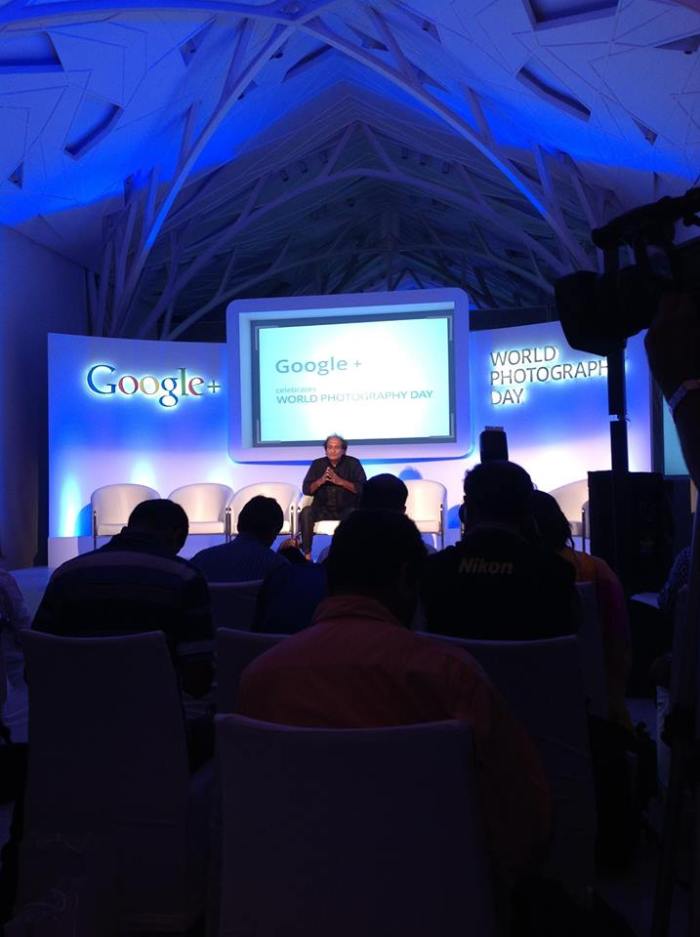
Celebrating World Photography Day with Google+

A photograph has picked up a fact of life and that fact will live forever.

With these words, distinguished photographer Raghu Rai drew the audience right into the heart of the magical world of photography.

World Photography Day, Google +, Raghy RaiNot that he really needed to considering that the select audience comprised professional and amateur photographers, and also photography enthusiasts like me who had been specially invited by Google+ to commemorate World Photography Day at the Tote on the Turf restaurant in Mumbai.

Raghu Rai delivered the Keynote Address at the event where he spoke of his own journey as a photographer and shared experiences and anecdotes on developments in the field of photography and transitions over the years; how he never touched a film camera after getting introduced to a digital camera; how he was introduced to Google and its various features by his daughter, and much more. He also engaged with the audience and answered their questions. I particularly liked his response to a question on how to choose a mentor. His answer: “Your conscience is the best mentor you can ever have.”

Continue reading “Celebrating World Photography Day with Google+”