The painted towns of Shekhawati-6: Bissau

Ilay Cooper’s book on Shekhawati set me off on an extraordinary trip to that extraordinary place in January this year. I had to wait for nearly 6 months, though, before I felt ready to write about it — so overwhelming were my thoughts and emotions. This post on Bissau is the seventh of 8 posts in the series on “The Painted Towns of Shekhawati”. If you haven’t read the introduction to Shekhawati’s history (and the series), I recommend that you do so now, before proceeding further. If you have already done so, then dive straight into the post.


When I set out for Bissau on my third day of exploring the painted towns of Shekhawati, I had no idea of the surprises awaiting me.

The first was the drive to Bissau from Nawalgarh. Gone was the flat landscape (with an occasional hillock breaking the monotony) that I had seen on my previous days in the region. Instead, there were stretches of gentle, undulating sand dunes.

The second was Bissau itself or rather the state the town was in — it was clean with recently swept roads, no rubbish heaps or plastic bags lying around. After having seen filthy towns like Nawalgarh, Bissau came a pleasant and welcome surprise.

The next surprise was the first painted monument I visited in Bissau — the Sarkari Chhatri. It turned out to be a school, an open air school in fact, with the chhatris serving as classrooms for different grades. A PT class was in progress when I arrived and though I wanted to explore the monument, I baulked at disturbing the students. But the school teachers assured me that it was fine and I went ahead to the accompaniment of curious stares and many giggles from the students.
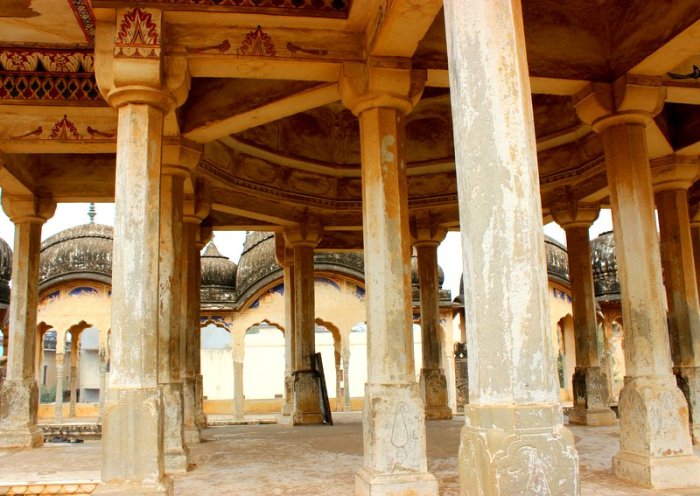
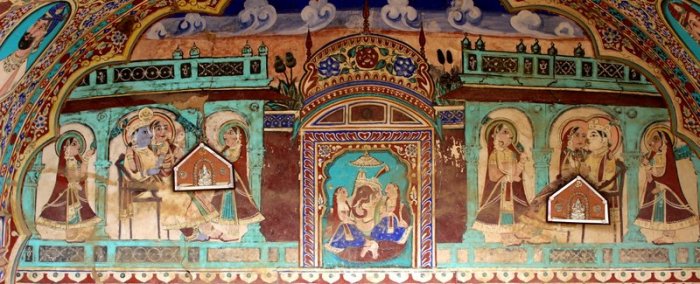
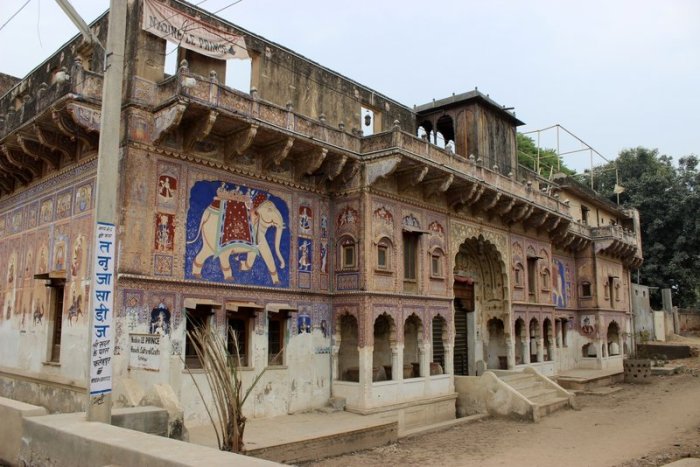
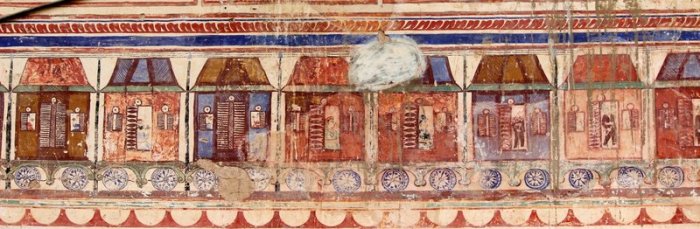
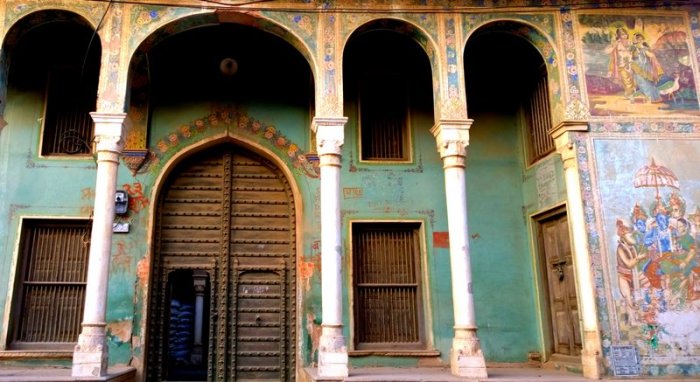
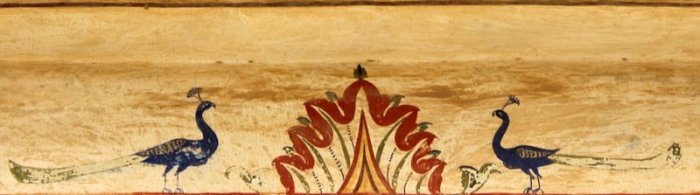
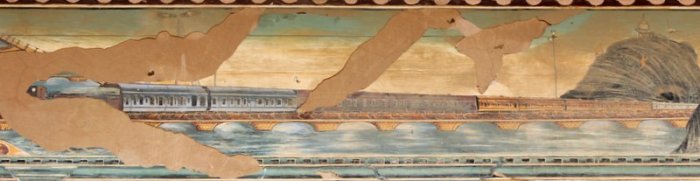
Bissau, Painted Towns of Shekhawati, Fresco, Art Gallery, Painting, Heritage, Travel, RajasthanAnd the last surprise were the frescoes themselves, at least some of them. But more about that later on in this post.

Continue reading “The painted towns of Shekhawati-6: Bissau”

Fatehpur, Painted Towns of Shekhawati, Fresco, Art Gallery, Painting, Heritage, Travel, Rajasthan

The painted towns of Shekhawati-5: Fatehpur

Ilay Cooper’s book on Shekhawati set me off on an extraordinary trip to that extraordinary place in January this year. I had to wait for nearly 6 months, though, before I felt ready to write about it — so overwhelming were my thoughts and emotions. This post on Fatehpur is the sixth of 8 posts in the series on “The Painted Towns of Shekhawati”. If you haven’t read the introduction to Shekhawati’s history (and the series), I recommend that you do so now, before proceeding further. If you have already done so, then dive straight into the post.


Fatehpur, Painted Towns of Shekhawati, Fresco, Art Gallery, Painting, Heritage, Travel, RajasthanThe door to the haveli was shut. A signboard (in Hindi, English and French) requesting visitors to ring the bell if they wished to tour the haveli greeted me instead. I rang the bell and waited. And I waited and waited some more… Just as I was getting ready to ring the doorbell again, I heard footsteps approaching the door.
The door opened and I found myself face to face with a young man, a Westerner, who said in a distinctly French accent, “Hello ! Sorry I took so long to open the door. I was in another part of the haveli. Are you here to see it?

“Yes, please, ” I said.

“Great ! My name is Jonathan and I’m an art history student. I’ll take you around the haveli. Would you like the tour to be in Hindi, English or French?”

I gaped at Jonathan and said, “Umm… English please.”

“Wonderful,” beamed Jonathan. “Welcome to the Nadine Le Prince Haveli.”

And that’s how an art history student from France took me on a guided tour of a haveli in Fatehpur in the Shekhawati region of Rajasthan, India.

But more about that later, as I have to introduce you to Fatehpur and take you around some of the other havelis there first. 🙂 Continue reading “The painted towns of Shekhawati-5: Fatehpur”

Mandawa, Painted Towns of Shekhawati, Fresco, Art Gallery, Painting, Heritage, Travel, Rajasthan

The painted towns of Shekhawati-4: Laxmangarh

Ilay Cooper’s book on Shekhawati set me off on an extraordinary trip to an extraordinary place in January this year. I had to wait for nearly 6 months, though, before I felt ready to write about it — so overwhelming were my thoughts and emotions. This post on Laxmangarh is the fifth of 8 posts in the series on “The Painted Towns of Shekhawati”. If you haven’t read the introduction to Shekhawati’s history (and the series), I recommend that you do so now, before proceeding further. If you have already done so, then dive straight into the post. 🙂


When I arrived at Laxmangarh on that bitterly cold January morning, it had just stopped raining and the sun was playing hide-and-seek with the clouds. Thankful that the rains would not play spoilsport, I headed straight for the Fort, which is built on a hillock overlooking the town.

Laxmangarh Fort dates back to the early 1800s when the town was founded by Laxman Singh, the Raja of Sikar, to take advantage of the rise in caravan trade at that time. He built the Fort and a walled fortification with nine gates to protect the town. Today, only the Fort remains.

Laxmangarh, Painted Towns of Shekhawati, Fresco, Art Gallery, Painting, Heritage, Travel, Rajasthan
The entrance to the Lakshmangarh Fort and the sign warning people not to enter it.

To my surprise, I found that the Fort was now private property having been bought by a trader in Delhi, who had, in turn, leased it to a telecommunications company to construct cell towers. There is a temple inside the Fort and visitors are allowed only till that point in the Fort. I tried to look inside the door leading up to the top of the Fort and almost got told off by the priest of the temple for daring to do so !

Disappointed with not being able to see a Fort the second time around in Shekhawati, I  set off to explore the town instead.

Continue reading “The painted towns of Shekhawati-4: Laxmangarh”

The painted towns of Shekhawati-1: Nawalgarh

Ilay Cooper’s book on Shekhawati set me off on an extraordinary trip to an extraordinary place, and I had to wait for nearly six months before I felt ready to write about it — so overwhelming were my thoughts and emotions. This post on Nawalgarh is the second of eight posts in the series on “The Painted Towns of Shekhawati”. If you haven’t read this introduction to Shekhawati’s history (and the series), I recommend that you do so now, before proceeding further.


Nawalgarh was my base for exploring the Shekhawati region and also the first of the towns I visited. Named after Nawal Singh, its founder, Nawalgarh was built in 1737 on the site of an earlier settlement.

Nawal Singh followed an active policy of encouraging traders and merchants from Jaipur to settle down in Nawalgarh. The Patodia and Murarka families were the first to arrive on his invitation and seeing them grow and prosper, other merchants soon followed. By the mid-1800s, Nawalgarh had become a large and prosperous town with three forts, city walls, bastions and four gates to protect it.

I arrived in Nawalgarh on a cold and rainy winter’s day in January, in time for a late lunch at my hotel before heading off to explore the town. It was a leisurely stroll through the town’s markets, lanes and bylanes with the purpose to get a feel of what had brought me to Nawalgarh (and for that matter the Shekhawati region) in the first place — the painted havelis or mansions.

Nawalgarh, Painted Towns of Shekhawati, Fresco, Art Gallery, Painting, Heritage, Travel, Rajasthan
Entrance to the Sheth Anandram Jaipuria Haveli. Unlike other havelis where the background colour is beige, the walls of this haveli are green

Continue reading “The painted towns of Shekhawati-1: Nawalgarh”

Travel Shot: Cow in the box

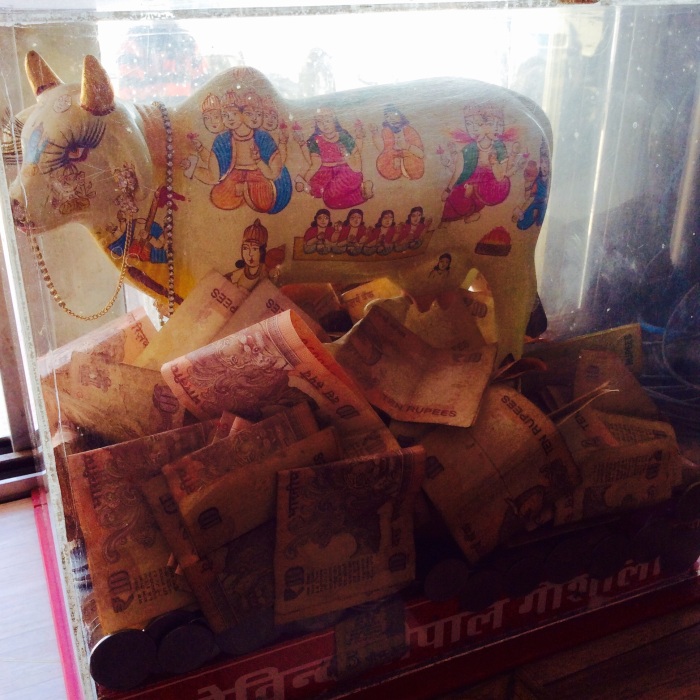
The cow looked up coyly at me through her false eyelashes. Her golden horns glinted with the light of Surya on her forehead. The various gods and sages on her flanks looked stonily at me — Brahma, Hanuman, Saraswati, Agni, Ganesha, Krishna, Shiva, Vishnu, Lakshmi… Only the sage Narada had a cheerful smile for me.

The fact that she was boxed in a transparent cage and leg deep in money did not seem to affect the cow at all.  And as for me, I stared at the cow with a touch of disbelief. You would have done the same if you saw a cow like this.

Cow in the box, donation box, Govind Gopal Goshala, Rajasthan

Continue reading “Travel Shot: Cow in the box”

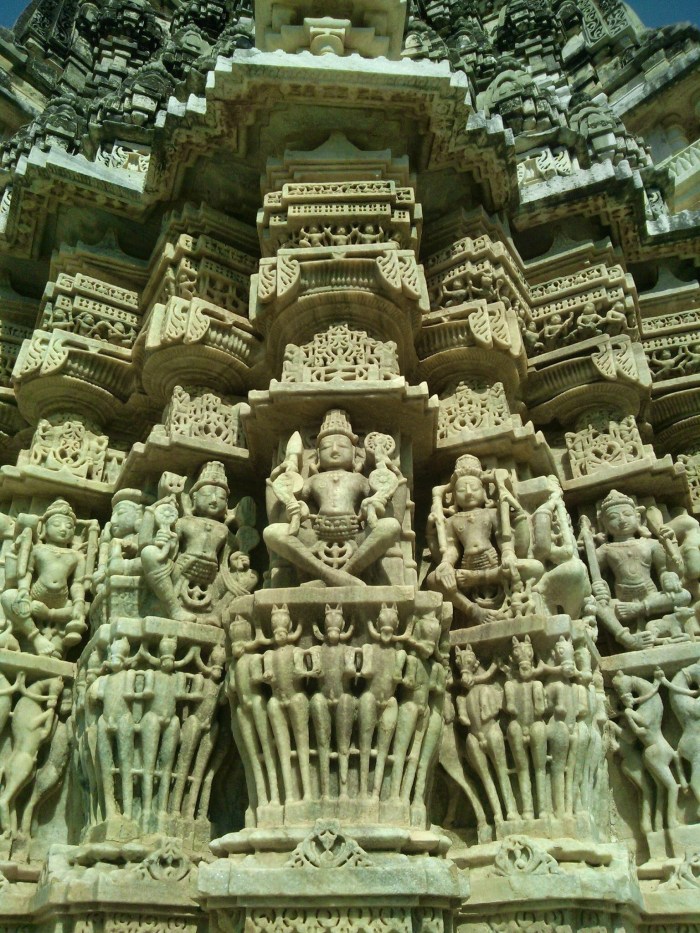
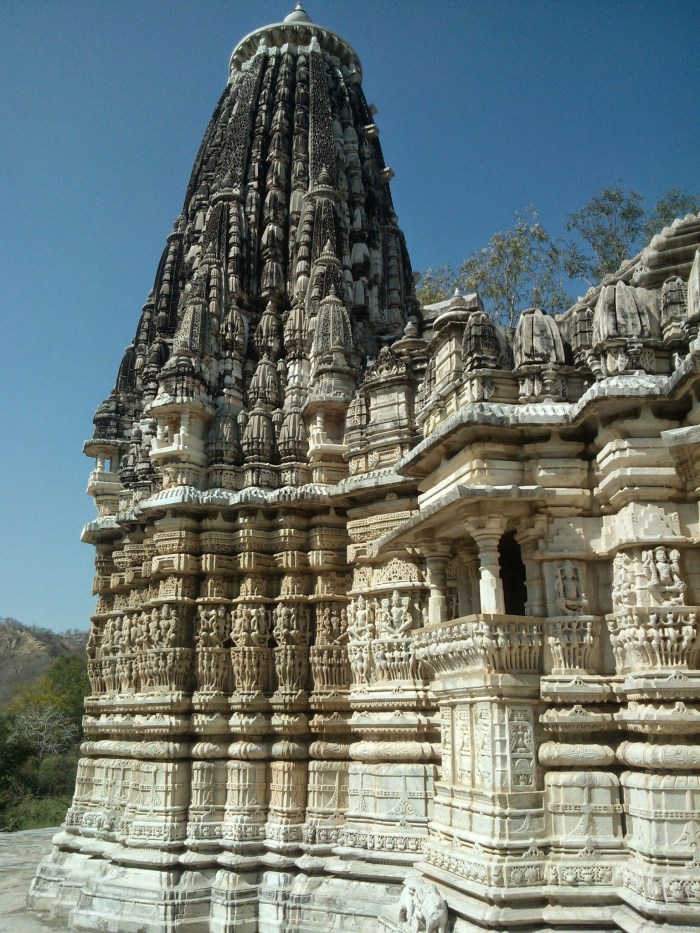
Ranakpur, Sun Temple, Suryanarayan Temple

Travel Shot: The sun temple of Ranakpur

Ranakpur in Rajasthan is synonymous with its world-famous Jain temple. So much so that another, older temple located less than half-a-kilometre from the Jain temple lies virtually forgotten, visited only by the someone who knows about it existence – the 13th century Suryanarayan Temple or Sun Temple.

Ranakpur, Sun Temple, Suryanarayan Temple

It is around 3 in the afternoon when our group arrives at the Sun Temple. Looking back, I’m still astonished that we made it to the temple for there are no signboards or markers to guide a visitor to the Sun Temple. If the manager of our tour group had not known about the Sun Temple, I doubt we would have visited it.

Built from low-grade marble, which has weathered beautifully over the centuries, the exterior of the temple is intricately carved with Surya or the Sun God seated on a chariot drawn by horses. The temple faces east, and has a sanctum topped by a shikhara in the nagara style, and an octogonal mandapa preceding the sanctum. The mandapa has some of the most exquisitely carved pillars and sculpted toranas I have seen. This is the first time I’m visiting a sun temple and I’m fascinated by the unusual motifs and iconography on the walls here.

Continue reading “Travel Shot: The sun temple of Ranakpur”