It’s a beautiful Saturday morning in Mumbai and I am standing at the foot of the stairs leading up to the Sion Skywalk at the Sion Circle exit. The skywalk’s stairs are so close to the adjacent building that they appear to be an extension or appendage of the building itself! In fact, I can just lean over and tap on the windows from the stairs if I want to.
Once on the skywalk, I just take a moment to pause and look around. I like skywalks in general as I like the pleasurable feeling of being suspended in mid-air and watching the world go by. I also like the perspective that skywalks offer, almost like a bird’s-eye view. But the first thing I notice here is not the view, but the relentless noise — a combination of the roar of traffic and incessant honking. And this is a sound that threatens to bring on a headache at 9.30 am in the morning !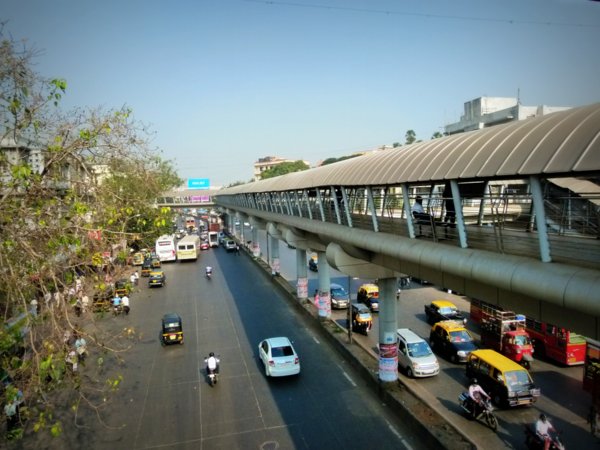
The Sion Skywalk, which stretches from Sion Circle to Sion Railway Station, is built at a major interchange, where traffic from Mumbai’s Western and Central suburbs meet. Inaugurated just over 2 years back, the Sion Skywalk is built in the shape of an exaggerated and a squiggly “Y” with 6 exits, of which one leads directly into the Our Lady of Good Counsel School (OLGCS). It was built keeping in mind the many schools, offices and commuters in the area and with the expectation that 50,000 commuters would use it everyday.
And does the Rs. 6 crore skywalk live up to that expectation? Let’s see…
Continue reading “A walk in the sky – 4: Sion Skywalk”


 I lived in London for a year (2008–2009) and though walking was my preferred mode of getting around the city, it wasn’t always possible to walk to my destination. So that’s where the Tube or the London Underground came in as the fastest, though not necessarily the cheapest, mode of travel. Travelling by the Tube made me re-look at perceiving public transport as only a means to get from point A to point B. It showed me that it could also be a place to showcase art, make a design statement, and a place that reflected the ethos/culture of the area it serviced.

 My Favourite Things