For me, police stations and hospitals are places that are to be seen only when needed and ignored when not needed. Such places are good to have nearby, but not too close, if you know what I mean.
It’s not like I’m scared of them; just that I’d like to keep my distance from them. Most of the times I pretend like they don’t exist !
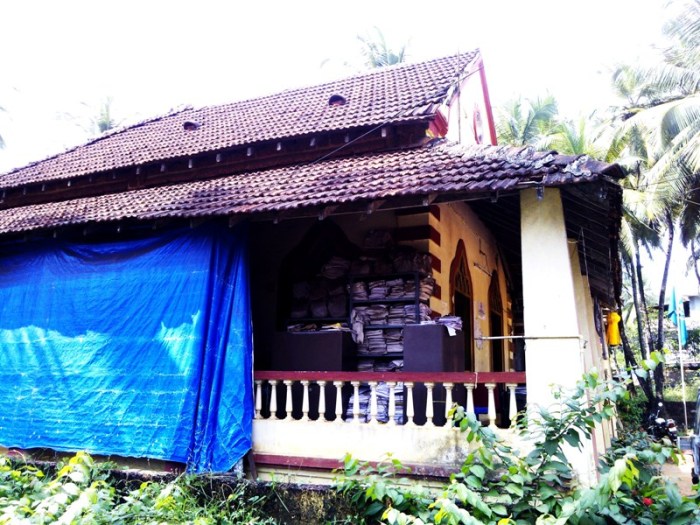
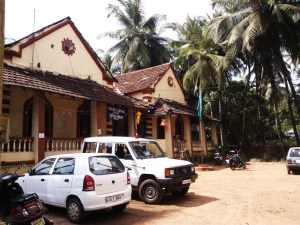
Last week was one of the times that I didn’t ignore the presence of a police station. I was in Colva (Goa) and the local police station was close to where I was staying. Housed in an old and traditional house that looked really quaint and cute, the Colva Police Station was a landmark in the area. But what caught my attention was a huge pile of papers stacked on an open shelf in the station’s verandah and clearly visible from the road.
Karcham, in the Kinnaur District of Himachal Pradesh, is a pretty ordinary looking place and one can be forgiven for dismissing it as just another Indian town. However it is not “just another Indian town” as I found out.
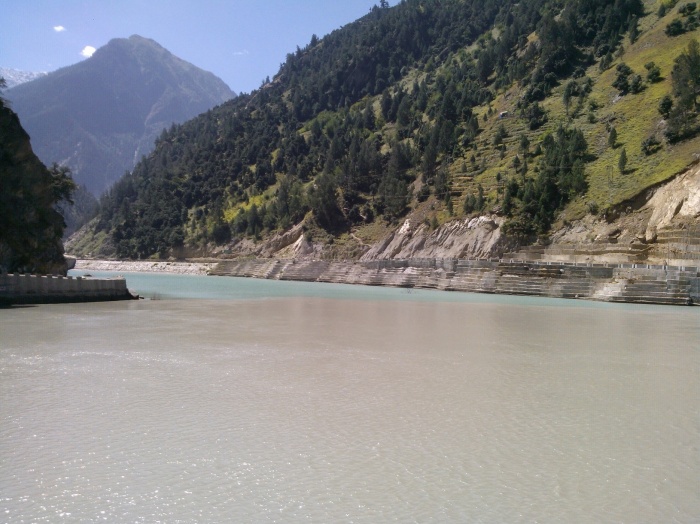
This is where the highway (or rather the dirt track that passes for one) bifurcates into two — one leads to Kalpa and the other leads to the Sangla Valley. It is here that the Karcham Wangtoo Hydroelectric Plant is situated. And it is at Karcham that the Sutlej and the Baspa rivers meet.
The blue Baspa meets the grey Sutlej at Karcham
According to a Kinnauri legend,
the rivers Sutlej and Baspa are brothers, with former being the older one. Sutlej was the more serious and sedate sibling, and Baspa the mischievous one. Like all siblings the two were rivals for everything, including whose name should be retained where their waters joined at Karcham. It was decided that whoever reached Karcham first would get the honour of lending his name to the river from that point onwards.
And so the two rivers set forth towards Karcham. Baspa, the faster of the two. He rushed forth through valleys and gorges, but was easily distracted and stopped to play with other streams and take mini diversions. On the other hand, Sutlej flowed slowly and steadily towards Karcham. And we know which type of person wins, right?
Sutlej reached Karcham first and that is how the river from Karcham onwards is known by that name even though it contains the waters of Baspa as well.
Wherever I travelled in the Kinnaur region these rivers were never too far from me. If the Sutlej was within my sight from the Kalpa side, the Baspa kept me company in the Sangla Valley. Two brothers, so different in looks and character, both heavily dammed, and yet in their own ways lifelines for the regions they flow through.
The confluence is stark and one can easily pick out the blue of the Baspa and the grey of the Sutlej. It was a sight the kept me mesmerised for a long time.
It has been almost 3 weeks since my Suryagarh trip, a trip that will go down as one of those trips of a lifetime. Being able to see the incredible monsoon desertscape, to visiting lesser known and popular sights in Jaisalmer, to the food feast laid out for us, to the pampering … everything was special.
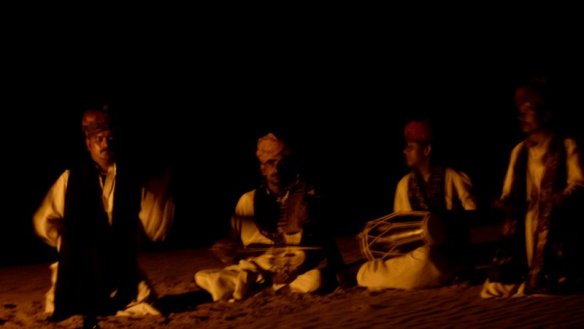
But the reason that makes Suryagarh really special was an experience that stood over and above everything else and one that remains with me even today — the incredible music I heard at Suryagarh. Right from the Padhaaro Mhaaro Desh (please click on the song to hear it being rendered by Meelu Khan and Maqsood Khan) that welcomed me to the hotel or the performance of Manganiar musicians during dinner on the first day or the Langha musicians performing during dinner on the second day or hearing Algoza for the first time or discussing Rajasthani folk music…it was music, music and more music all the way.
Langha musicians performing at the Kahnoi sand dunes
Music is a quiet passion for me. While I enjoy hearing new kinds of music and am always open to hearing different kinds of music, I rarely seek music, local or pre-recorded, during my travels and Suryagarh was no different. But music was everywhere at Suryagarh and one that enveloped me in its melodious magic. While all the music I heard was truly incredible, two performances stood out for the sheer quality and for the interaction I was able to have with the musicians concerned.
I’ll introduce them to you a little later but for now let us call them the singer at the sand dunes and the musician at the window. Because that is how I first saw them and heard their magical music. My interactions with both of them left me feeling truly blessed and like the chosen one 🙂
It has been a long, but relaxing, drive from Jodhpur and we have just crossed Jaisalmer city. Suryagarh,my destination, isstill a few kilometres away when the cab I am travelling in stops suddenly.
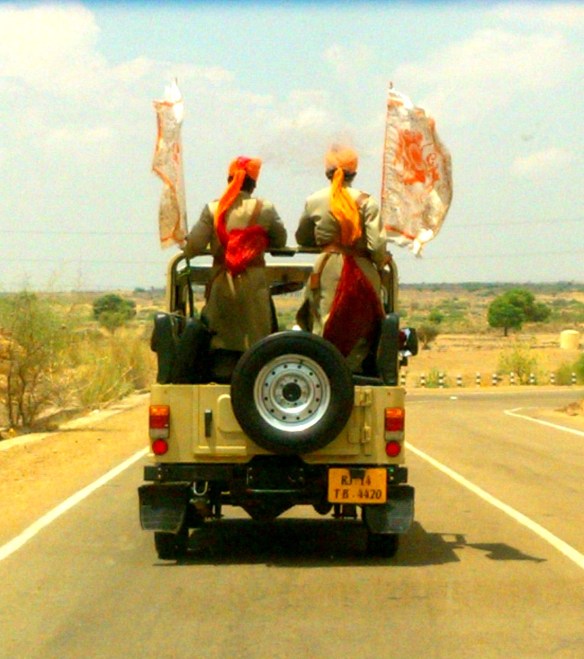
As I look around for the reason for the sudden halt, Partap Singh, the cab driver, announces grandly, “And here, madam, is your escort service,” indicating two turbaned men approaching our vehicle.
“My what?” I ask with some trepidation.
“Your escorts from Suryagarh. They will be leading the way to the hotel in an advance vehicle.”
The men approach my window and bow low with folded hands and say a warm Khamma Ghani, the traditional greeting in Rajasthan. I roll down the window and squeak out a Ghani Khamma in return with a answering smile and hope that my embarrassment at their unexpected “escort service” does not show too much.
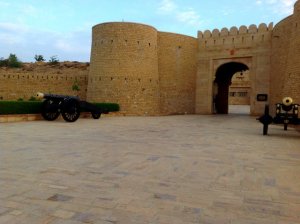
The men, with their flaming saffron turbans, get into an open jeep and lead the way and within minutes the fort-like Suryagarh is visible in the distance. Rising imposingly from the flat desert landscape, it looks like the very desert has sprouted the hotel.
I almost expect my escorts to toot a horn or a blow a trumpet announcing my arrival, but thankfully they do nothing of that sort ! At Suryagarh, I am welcomed with more warm smiles, musicians singing Padharo mharo desh, a shower of rose petals, chandan ka tikka, watermelon juice… and am shown to my room in a matter of minutes.
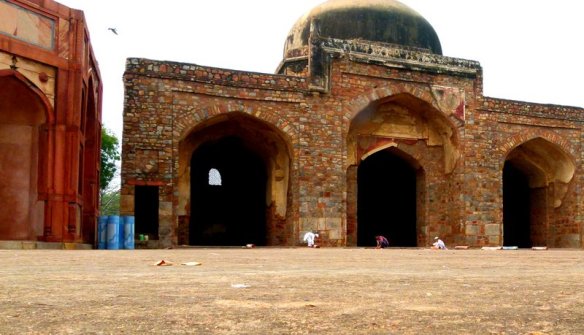
In a corner of a large walled garden, just before the main entrance to Humayun’s Tomb entrance in Delhi, is the Afsarwala Tomb and Mosque complex. I found myself outside this small complex after entering the walled garden through an enticing doorway one cold and drizzly afternoon in February
It was a Friday and the Jum’ah prayers were over. The mosque was empty except for a man and 2 boys who were rolling up the prayer mats.
Part of the Afsarwala tomb can be seen on the left. The mosque is right ahead and 3 figures can be seen rolling up the prayer mats
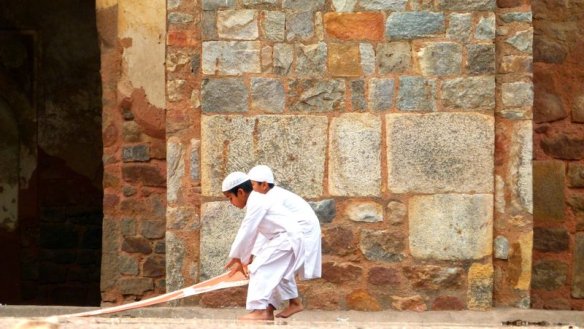
Initially all three of them were rolling mats on their own without any kind of interaction between them. Then, suddenly, the boys decided to do the task together. And amidst giggles and playful shoves, the two boys rolled up mats together, which the man then collected and put them on one side.
Two are better than one to roll a mat !
Once all the mats were rolled away, the man got down to the task of counting them. Meanwhile the boys started picking the dried leaves from the mosque courtyard in an attempt to keep it clean. But it was a windy day and the more leaves kept falling. The boys didn’t seem to mind and ran all over the courtyard chasing the leaves and each other and much gleeful laughter.
It is always wonderful to see children at play and I would have loved to linger and watch these two boys, perhaps talk to them and the man about the mosque and the service they carried out. But I had a meeting to attend as my cell phone alarm reminded me rather persistently, and I left rather reluctantly. For the remainder of the day, I was smiling away: right through the meeting, the return flight back to Mumbai that night… And I am still smiling as I type out this post.
Dear reader, tomorrow is the first day of the holy month of Ramzaan in the Indian sub-continent and I take this opportunity to wish you all Ramadan Kareem. 🙂
I had gone buy tickets for the evening sound and light show at the Palace, only to be told that the show had been cancelled. I was surprised as there was no information posted about this on the board outside the ticket office. When I asked for the reason behind the cancellation, the ticket clerk mumbled something like “a function in the palace”. And when I asked as to why there was no advance information put out, he wouldn’t even look at me. When I asked if the sound and light show would be on the next day, he only gave a non-committal shrug, which could have meant anything. I had to be satisfied with that and leave disappointed.
My second visit was different.
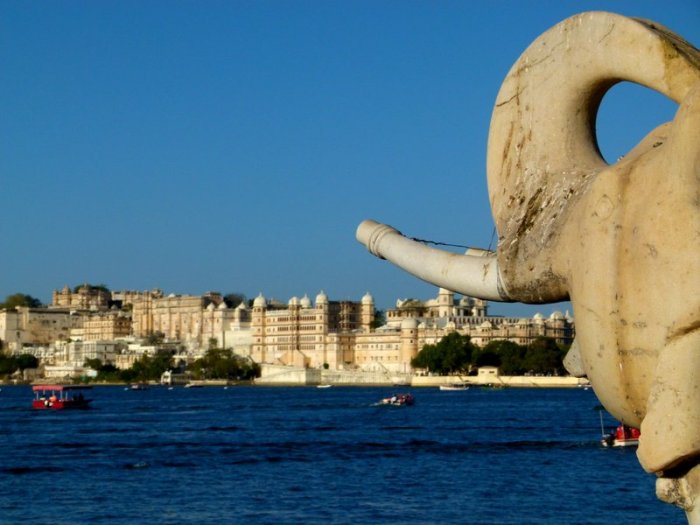
I was back at the City Palace next day morning, this time to explore the areas accessible to a visitor. So, once I had paid for the entrance fee, the museum fee, the camera fee, and the audio guide fee and collected the various tokens, I set off for the palace complex with the hope that this visit would at least take away some of the disappointment of the previous evening.
 For me, police stations and hospitals are places that are to be seen only when needed and ignored when not needed. Such places are good to have nearby, but not too close, if you know what I mean.