The clock tower at Jijamata Udyan

It’s quite amazing, you know, of the things one notices, but does not really see. Take for instance the subject of this post. I must have passed it a countless number of times, glancing at it idly but mostly ignoring it. You might have noticed it too, if you are travelling on the Lalbaug flyover towards Byculla, which looms up about 100 metres before the exit on your left.

That day, when I was passing by this structure I felt I was seeing it for the first time. And indeed I was for the slender and elegant clock tower glowed in the mid-morning winter sun in spite of the very obvious look of neglect that it had and stones blackened due to pollution.
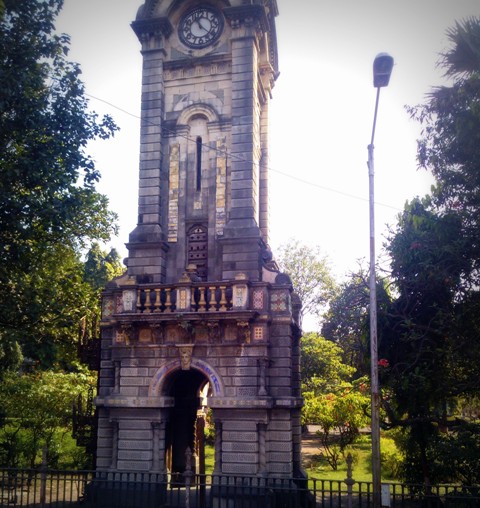
Clock Tower, Rani Bagh, Victoria Gardens, Mumbai, Jijamata Udyan
The Clock Tower at the entrance to Jijamata Udyan and photographed from the Lalbagh flyover

Situated at the entrance to the Jijamata Udyan (formerly known as Victoria Gardens and also known as Rani Baug) and among trees, this beautiful clock just begs to be explored. When I attempted to do just that, I found that it is closed to the public with a several “Keep Out” signs placed all around. There is no information board on the clock tower and I had to be content walking around the barrier erected and look at the details through my camera lens. And what did I find? Continue reading “The clock tower at Jijamata Udyan”

Travel Shot: The orange smiley

A rainy day in September 2011. It is mid-morning and I have just completed a climb of the Pavagadh Hill to visit the Mahakalika Temple on its summit. It has been a tough and painful climb, partly because of the steep steps, and partly because of a sprained ankle. By the time I finish with the darshan at the temple, I am quite bad-tempered with pain and just want to get back to my hotel room and rest my ankle.

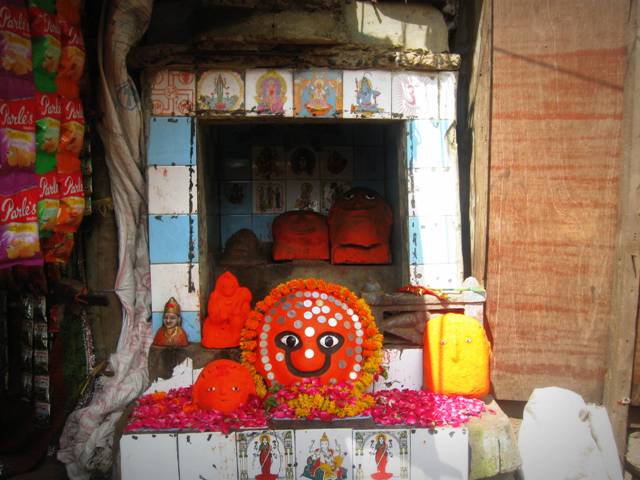
I decide to take the cable car back to the base and as I make my way to the cable car station, I see something that stops me. It is a smile. A beautiful smile beaming away at me from a small roadside shrine built under a tree. It is a smile that literally shines and sparkles amidst other expressionless, almost dour faces surrounding it. It is an open, wide and  happy smile, and one so infectious that I forget my painful ankle and smile back in turn.

Roadside shrine, Pavagadh

Continue reading “Travel Shot: The orange smiley”

Discovering Roman Britain

I was introduced to Roman Britain quite unexpectedly on a cold, windy day in October 2008 in London. I had been in London for about 3 weeks then and was already head over heels in love with this beautiful city. Each day was a new day of exploration and between settling into a new city and classes at the university, there was always something wonderful to discover and delight over.

That afternoon, I took a path leading off from Tower Bridge Tube station, a path that led me past a hotel and then, quite suddenly into a walled dead-end. I was about to turn back, when I saw an information board there and walked over to read it. Good thing I did that as this turned out to be the most interesting dead-end !

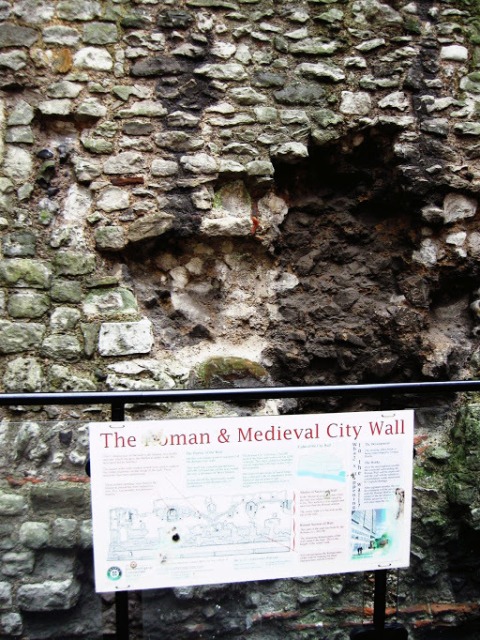
Part of the original wall surrounding the Roman city of Londinium or London

The information board announced that this was no ordinary wall, but a slice of London’s history. Built by the Romans in 190–220 AD, this wall used to run around the city of Londinium, the Roman name for London. About 9 ft thick at the base and about 20 ft. in height, it was one of the most important and expensive developments in the city at that time. (By medieval times, the height of the wall was increased and though it is not evident in the photograph, the colour of the mortar distinguishes the two sections of the wall.)

My first reaction was, “Wow! So Asterix and Obelix wasn’t an exaggeration; the Romans were really here. Dear old Julius Caesar was really here !” For the rest of the day, I walked around in a kind of daze as the Roman fever took hold. It was a fever that refused to go away and one that I had great pleasure in indulging when I visited erstwhile Roman cities in the UK and explored a part of history that I thought only existed in comic books ! 🙂

So join me on my journey of discovering Roman Britain through visits to Camulodunum (present day Colchester), Aquae Sulis (present day Bath), and Verulamium (present day St. Albans) in England. (Strangely, the wall remained my only encounter with Roman Britain in London.) It was a journey that left me breathless, awestruck, and delighted in turn, but always richer in having gained knowledge of something new, and of having discovered a whole new world.

Continue reading “Discovering Roman Britain”

The three directional dilemma

The Guest Post Series on “My Favourite Things” has contributions by those sharing my interests in travel, books, photography, music, and on issues that I am passionate about. Though the guest posts are not always by fellow bloggers, the guest authors are always those who have interesting experiences to share.

Today’s guest author is Raghav Modi, who writes four blogs —The Traveling TickerTicker Talks Film, Ticker Prints, and Ticker Talk. I admire the passion with which Raghav writes and his ability to juggle his many interests so effortlessly. I like all that he writes, but my favourite post has to be the one on a museum of pens in Birmingham. Raghav is also the founder of Movie Talk on Sunday (#MTOS), and The Sunday Book Club (#TSBC). In today’s guest post, Raghav’s three primary passions in Films, Travel and Photography converge to create unique serendipitous moments.

Ever get the feeling that you are being pulled in three different directions at the same time? I do. Every time I have a moment to spare, I feel like my interests/passions/hobbies all gang-up and pull me towards their individual selves. Films and Travel have always occupied the highest tier on my activities table. Photography was recently added to this knocking down books and food to the under-appreciated second tier. So now when the weekend rolls in I am never sure what to do, which eventually leads to me doing absolutely nothing.

But, just once in a while, something magnificent happens. Everything falls perfectly in place and I end up with a photograph, a memory, or in some cases my vivid imagination wherein all my interests amalgamate. Searching through countless photographs (thank you digital camera technology) I ended up with these few instances wherein my lust for cinema met with my passion for travel to collaborate into a unique photo.

Continue reading “The three directional dilemma”

Travel Shot: The Mechanical Clock

The gentle whirring and the polite clicking sounds coming from the… contraption was fascinating. What is it, I wondered, as I walked around it. What were the ropes for, ropes that ascended to the ceiling? And the slowly moving wheels? And why was it cordoned off with a “Please do not touch” sign?

That July afternoon of 2009, I was at Salisbury Cathedral wondering what this contraption was all. A simple information plaque on one side enlightened me and I did a double take when I read it. This… contraption was a clock? A clock without a face? And that too 700 years old?

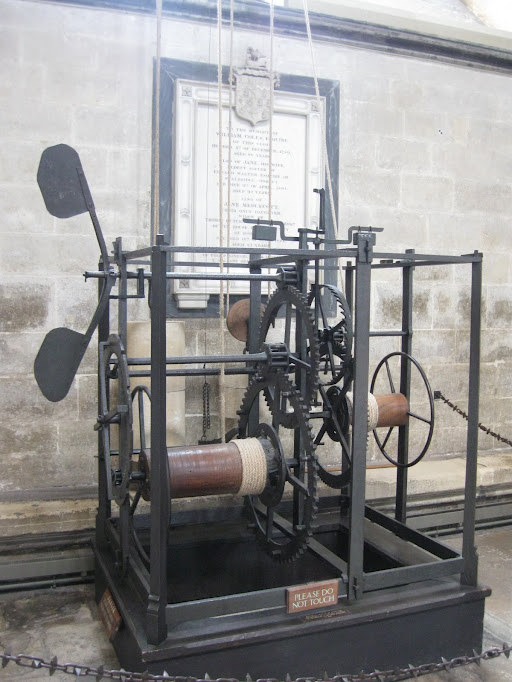
The Mechanical Clock. One of the stone weights can be seen hanging on the left, behind the clock. Note the ropes going out of the frame of this  photo—these are attached to a bell, which strike at the hour every hour.

I was standing before the oldest Mechanical Clock in Europe. There are even claims to this being the oldest working mechanical clock in the world. Dating back to 1386, this clock was re-discovered in the Cathedral in 1928 and restored back to working condition in 1956. Most of the parts of the clock are original as is its wrought iron frame.

A single-strike clock, i.e. it makes one strike for every hour of the day, the power to run it is supplied by two large stone weights. As the weights descend, ropes (which are attached to a bell) unwind from the wooden barrels. Before the weights reach the floor, they have to be wound back up again. For more technical details on the working of the clock, please click here.

Though the Salisbury Cathedral had many other attractions on offer—an impressive 400 feet tall spire and an original copy of the Magna Carta, among others—it is the simple (?) mechanical clock that remains with me after 3 years. A clock that works even today after so many centuries and is accurate to within 2 minutes.

Not bad for a 700-year old clock, eh? 🙂

PS: For more photographs of Salisbury, please click here.

The Stolen Coffee Room

“The what? What did you say was the name of the coffee shop?” I asked with some amount of disbelief.

The Stolen Coffee Room,” Deepa repeated patiently, with barely suppressed excitement. “You heard it right the first time.”

“The. Stolen. Coffee. Room.” I repeated slowly. “What an intriguing name.”

“It’s an intriguing name for an intriguing place,” ” Deepa declared. “You know Sudha, I didn’t want to leave this place at all and if the kids hadn’t been there with me, I probably wouldn’t have. You will love this place.”

Now I was more than intrigued. “Tell me more about this place.”

“I’m not going to tell you anything. You have to visit it and see it and experience it yourself. In fact, let’s go there together,” said Deepa.

So that’s how I came to be standing outside The Stolen Coffee Room (TSCR) with Deepa one rainy evening in July. The bright blue entrance glowed in a welcoming manner as did the neon red “Open” sign. And with a mix of anticipation and delight, I stepped inside.

Entrance to The Stolen Coffee Room

Continue reading “The Stolen Coffee Room”