Museum Treasure: The gold helmet

Helmets, chain mail, daggers, guns, arms, ammunition and other macho stuff are not really my kind of thing and it is this section in a museum that I breeze through or prefer to give a miss. So that day at the British Museum in London, should actually have seen me ignoring Meskalamdug’s helmet, but for two things—it was made of gold, and it had the cutest ears I had ever seen. 🙂

The gold helmet of Meskalamdug

This helmet, dates back to about 2600-2400 BC and was found in the tomb of Meskalamdug, a Sumerian prince, in the ancient city of Ur (now in present day Iraq). The top of the helmet has a wavy design (probably to mirror hair) and at the back is a little hollow bump, perhaps to accommodate Meskalamdug’s hair bun. And yes, the helmet also has these really cute and life-like ears and ear holes carved on them. Though the helmet is designed to look like a battle helmet, it was reportedly worn by Meskalamdug for only ceremonial purposes. Gold symbolises strength and power, and Prince Meskalamdug had both.

Meskalamdug’s helmet at the British Museum London is an electrotype of the original which is or rather was at Iraq Museum in Baghdad. In the pillaging and sacking of the city that followed the fall of the Saddam Hussein government, the gold helmet was one of the many artefacts looted from the Iraq Museum.

When I saw this artefact in London, the enormity of the fact that the original had been lost, perhaps for ever, did not sink in. It’s only as I write this post that I realise that the electrotype at the British Museum may be the only piece available for the world to view and admire.

A very sobering thought indeed !

The Museum Treasure Series is all about artifacts found in museums with an interesting history and story attached to them. You can read more from this series here.

The perfect Melbourne trip

Melbourne is on my mind these days. A lot.

You see, ever since Indiblogger announced its latest travel writing contest, I’ve been thrown into a bit of a tizzy because of the contest guidelines which say: “Tell us about the experiences you would love to bring back from Melbourne . . . . ” Normally, writing about my travels has never been a problem. But this time I’m stumped — how do I write about a place that I have never visited?

When I whined about told this to Neena, a friend, colleague and someone who’s been to Melbourne, she said, “So what if you have not been to Melbourne. Just use your imagination and let the anticipation of visiting a new travel destination shape your words; the rest will follow.” And that is just what I did. With some help from Google, Melbourne-specific websites, a couple of books, and chats with friends who have been to Melbourne.

This post is all about that perfect trip to Melbourne born out of my imagination and based on the activities I would love to do there keeping in mind my interests. Read on about what my trip to Melbourne will be like, the sights I will see, and the activities I will undertake to experience the history, heritage, art, architecture and contemporary culture that Melbourne has to offer, as well as its unique and famed natural history. So without further ado, presenting to you a no-holds barred account of how I want to experience Melbourne unhampered and unhindered by budgetary or tour itinerary constraints, but fuelled by my imagination 😉

The Melbourne skyline as viewed from the Rialto Observatory on Collins St.
Source: Diliff, wikimedia.org

Continue reading “The perfect Melbourne trip”

Travel Shot: A view of Greenwich from the river Thames

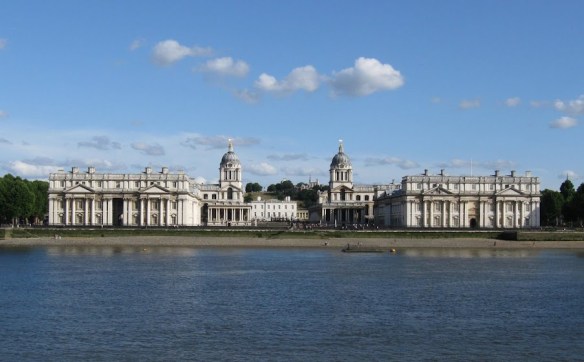
Sometimes, it takes a larger view for things to fall into perspective. Literally. Viewing the former Royal Naval College in Greenwich (pronounced Gren-itch) from across the Thames was one such experience.

I had spent a lovely day spent at Greenwich as part of a guided walk through Maritime Greenwich, a UNESCO World Heritage Site. Of particular interest to me were the two buildings of the former Royal Naval College, which was designed by Christopher Wren, and captured by the famous Italian painter, Giovanni Antonio Canal, better known as Canaletto. Throughout my explorations there, I kept searching for that one view that captured the beauty, simplicity and symmetry of Wren’s design, but in vain.

It wasn’t till I crossed the river Thames to the opposite bank to take the DLR back to London that I realised that I had been searching for Canaletto’s view from the wrong side. When I emerged from the underground foot tunnel, this was the beautiful sight that greeted me.

A view of the former Royal Naval College, Greenwich, from the River Thames

Continue reading “Travel Shot: A view of Greenwich from the river Thames”

Blue, green, yellow, red and white…

Recently, Anu Shankar of A Wandering Mind tagged me in the Capture the Colour contest organised by TravelSupermarket.com. The contest brief is, well, quite brief and simple:

… to publish a blog post with a photo that captures the following 5 colours – Blue, Green, Yellow, White and Red.

Hmmm… till about 4 years back I didn’t even give colours a second thought or glance. I took it for granted as growing up in India, they were always around me. But a year’s stay in London showed me how much colours mattered to me, and changed my very perception and understanding of colours.

I arrived in London at the onset of winter and its (in)famous winter weather. But the grey and damp weather didn’t bother me; neither did the sunless days affect me. But a monochromatic London of black and grey coats, hats, scarves, gloves and boots drove me crazy. That’s when I started noticing colours in the world around me, rather than only on people. Colourful shop fronts, buildings, pub exteriors, cars, tube stations, a stained glass window … took on a whole new meaning. I learnt to look at, appreciate and enjoy colours in a very different way.

It had to convince myself to participate in the contest as I don’t really consider myself as a photographer. But the idea of digging into my digital photo library was tempting and I had a great time choosing 5 of them—one for each contest colour. So presenting my blue, green, yellow, red and white photographs as well as my take on each of them. Continue reading “Blue, green, yellow, red and white…”

The Docklands Light Railway and the London Docklands

The London Docklands is the name given to some areas of eastern and south-eastern London. Till the middle of the 20th century, the Docklands was where the various docks and dockyards used to be. Though the docks were originally built and managed by a number of private companies (for example, East India, West India, etc.), it was not till 1909 that it all came under the management of the Port of London Authority.

Redeveloped London Docklands near Canary Wharf. For those used to seeing a predominantly Georgian London, this view of the city can come as a bit of a surprise !

Today, the area is a mix of the commercial and the residential, and old housing estates and newer steel and glass structures as a result of massive efforts at redevelopment of an area that used to be predominantly labour class. The introduction of the Docklands Light Railway or DLR in 1987 fulled the development of an area that did not have good transport connectivity. The Docklands area has always been a trade hub for centuries; today, it is a hub of a different kind—the central business district of London is located here.

Tower Gateway DLR Station

The DLR is a fully automated light metro or light rail system to exclusively serve the Docklands area of London. It is quite distinct from the London Underground, and is also part of Transport for London. During my year’s stay in London in 2008–2009, I remained ignorant of the DLR largely because the Tube Bus took care of most of my travel requirements and I rarely travelled to the Docklands area.

Then one day, while returning to Central London from a day trip to Greenwich, the DLR turned out to be the most convenient mode of travel, and to use a clichéd term, travel was never the same again. It is a trip that I still remember, as a very different London emerged through that journey, very distinct from the Victorian and Georgian London that I had come to associate London with and love.

Such was my fascination for the DLR, that on one rainy and cloudy day, I spent a few hours travelling by the DLR, getting off at stations that caught my fancy and exploring the Docklands area on foot. I saw a very different London that day. A quieter London, steel and glass apartments, residences converted from warehouses, an airport by the river, colourful buildings, and so much more.

Presenting a sampling from that lovely day of a very different London courtesy the DLR journey that I took in July 2009 ! 🙂

Continue reading “The Docklands Light Railway and the London Docklands”

The London Underground

I lived in London for a year (2008–2009) and though walking was my preferred mode of getting around the city, it wasn’t always possible to walk to my destination. So that’s where the Tube or the London Underground came in as the fastest, though not necessarily the cheapest, mode of travel. Travelling by the Tube made me re-look at perceiving public transport as only a means to get from point A to point B. It showed me that it could also be a place to showcase art, make a design statement, and a place that reflected the ethos/culture of the area it serviced.

Transport for London is the company overlooks the public transport in London through the Tube, buses, the Docklands Light Railway (DLR), trams, trains, etc. Though I used all these modes at some point during my stay in London, I loved the Tube and the DLR the most. I loved it so much that I photographed the unique aspects of the various tube stations I passed through, its various lines and routes, escalator and tube etiquette, etc. I never tired of admiring the little and big things that made each station unique and special. Even today, the Tube remains eminently gush-worthy. 🙂

About 2-3 weeks back, BBC Entertainment channel in India started airing a programme on the London Underground. This programme, which airs every Saturday at 9.00 pm, looks at “London’s 140 year-old Underground system” and “what it’s like to run the world’s most complex train network”. In other words, it is a behind-the-scenes look at the people who run and manage the Tube.

Bond Street Station

Not surprisingly, this has become my favourite television programme and has inspired me to write this blog post today. But this post is not about the efficiency or a behind-the- scenes look of the Tube; it is simply a post on the beautiful tube stations of the London Underground — the ones that caught my eye with their unique design, art or architectural element.

So are you ready for some station hopping?

Continue reading “The London Underground”