What happens when enthusiastic designers and planners go overboard about a theme or take their brief too seriously? See for yourself.
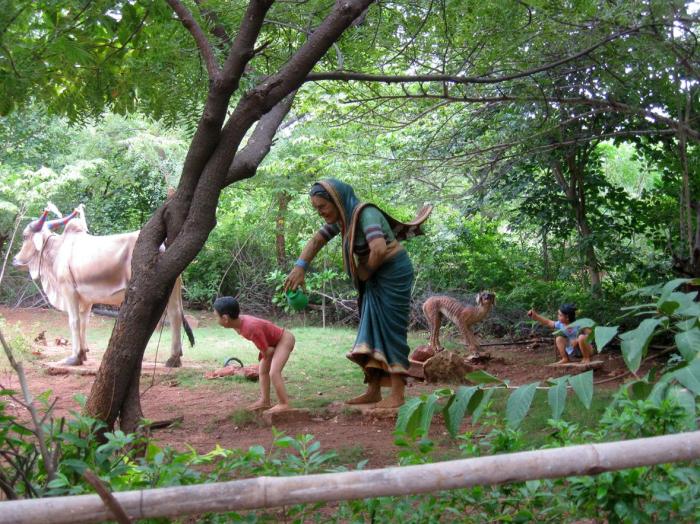
2nd September 2010: Reproduction of a village scene at the Almatti Dam Gardens
You can see the above reproduction of a village scene and other scenes as well along with, dinosaurs, birds, giant turtles and frogs, crocodiles, naked little boys, Krishna frolicking with gopikas, etc. at the Almatti Dam Gardens, in northern Karnataka. Though the large gardens are beautifully laid out, the whole effect is spoiled by placing sculptures, statues, and what-have-yous like the one above. The effect is unbelievably cheesy. You can see more such photographs here.
There is some connection between rains, ruins and me. I have always had rains for company whenever I have visited ruins. Be it Tintern or Hampi or Champaner. It is never a heavy downpour, mind you, but a gentle drizzle. So I was not really surprised when rain welcomed us on arrival at the Hyderabad airport last month. I was on a day trip to Hyderabad with Neena, a colleague, and we had arrived early in the city so that we could visit the Golkonda Fort, before getting down to business.
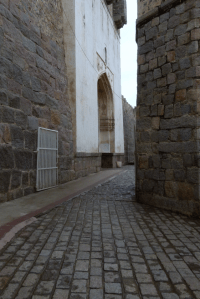
We got that first look of Golconda, rising tall and majestic in the distance from the car we were travelling in. With rain clouds in the distance, it made for an unforgettable picture. As we neared the Fort, we kept getting tantalising glimpses of the Fort, each one a little closer. By the time the car stopped at the entrance to the Golkonda Fort, we were raring to explore the Fort.
The passage leading to the entrance of Golkonda Fort
It was 9 in the morning, and with hardly any other visitors in sight and it appeared that we would have the Fort almost to ourselves. This also meant that we were swamped by a horde of guides before we even got to the ticketing office. Since we had decided not to hire a guide, we had to politely and firmly decline every offer of a guide service.
We hoped to get around the Fort with an information booklet on the Fort, which we were told was available here. To our surprise, the ticket clerk informed us that no such booklets were available for the Indian tourist, and the few copies he had were only meant for international tourists only! So we ended up walking through Golkonda Fort without a guide, without any information booklet and with only a few signposts and boards to help us find our way around. And of course, the rain !
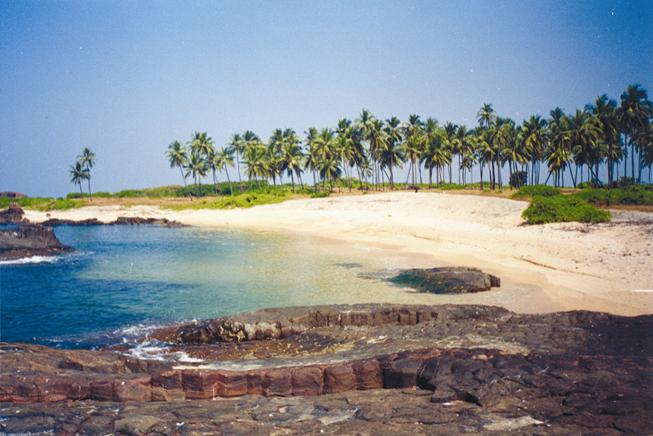
Once upon a time, ok in November 1998, a friend and I decided to travel down the West coast of India. We started in Honnavar in Karnataka and travelled all the way down to Thiruvananthapuram, hopping in and out of trains and buses. It is a trip that makes me nostalgic even thinking about it. One the places we “discovered” was St. Mary’s Island, off Malpe Beach near Udipi.
St. Mary’s Island, also called Coconut Island by the locals, is an uninhabited island with a shelly beach and clear, cool waters. This is how the local operator who ran motor boat services to the island sold the beach to us. What he did not mention was that the island was made up of columnar basalts, and that it was a geological monument.
One morning in early July of 2009, I was contemplating ways and means to avoid thinking and writing out my dissertation, a dissertation which would culminate a year’s worth of stay and study in London. It was a year in which I studied a bit and travelled a bit (though not necessarily in that order). So when I received a mail about a day trip to Wales for a very affordable sum from the travel club I was a member of, I immediately signed up for it. So desperate I was to escape my dissertation that I didn’t even look at the details of where we would be travelling to in Wales.
It was only when I got into the tour bus that I got to know that we were headed for Tintern Abbey and Chepstow Castle via Gloucester. Now while neither Chepstow not Gloucester sounded familiar, Tintern seemed very very familiar. Literarily familiar. English school book familiar. But I just couldn’t place it nor get it out of my head. Even the heavy rain, which followed us all the way to Tintern and beyond and back to London, couldn’t distract me from trying place Tintern Abbey. By the time we reached Gloucester, I could take the uncertainty no more and sent a text message to my brother back home in India, asking him why Tintern sounded so familiar.
His reply took a long time coming. The route to Tintern from Gloucester took us through the ancient and beautiful Forest of the Dean, where upon Tintern vanished from my mind to be replaced by Harry Potter ! Tintern returned to my thoughts only after we left the Forest and passed through some of the most beautiful villages imaginable.
Just as I noticed the signboard for Tintern, my cell phone beeped. It was a one word text message from my brother, which said “Wordsworth”. A single word was all that it took me to place Tintern in context.
“I couldn’t tear myself away from the image of the Maheshmurti. It was so beautiful. So mesmerising. Elephanta was so nice,” gushed Iskra, an exchange student from Bulgaria.
I listened to Iskra’s description of her visit to Elephanta Caves with part fascination and part envy. The reason? In spite of having lived in Mumbai for nearly 23 years, I had never been to the Elephanta Caves. Listening to Iskra, and that too a foreigner, rave about them needled me into resolving to visit the caves at the earliest opportunity.
And would you believe it? The opportunity presented itself to me the very next day, almost as if it was just waiting for me to make up my mind. My Facebook wall announced that Girls on the Go (GOTG), a women’s only travel club, was conducting a guided day trip to the Elephanta Caves on 13 March 2011. Would I be interested? Not one to let go of an opportunity like this, I signed up for the trip within seconds of seeing the intimation. 😀
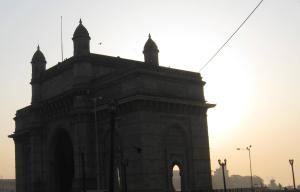
Gateway of India
So, on D-Day, I was at the Gateway of India much before the reporting time of 7.45 am. While waiting for Piya Bose, the founder of GOTG, and the rest of the group to assemble, I tried to recall what I knew about the Caves. They were … um… really old rock-cut caves, were located in Elephanta Island some distance away from Mumbai, could be accessed only by boat, and was a UNESCO World Heritage Site. In short, I knew nothing about the Caves. Of course, by the time the tour got over I was a little wiser thanks to Lakshmi Kishore, our guide, and a booklet on the Elephanta Caves that I purchased from the ticket office.
Elephanta Island has traces of habitation from 2nd century BC in the form of remains of a Buddhist stupa, reportedly built by Emperor Ashoka himself. But what the Island is really famous for are 7 rock-cut caves, whose age is not well established due to absence of written records. Various theories exist as to the age of the caves as well as to who built them, and according to the Archaeological Society of India’s (ASI) booklet, the caves were excavated during the middle of the 6th century, during the rule of the Konkan Mauryas.
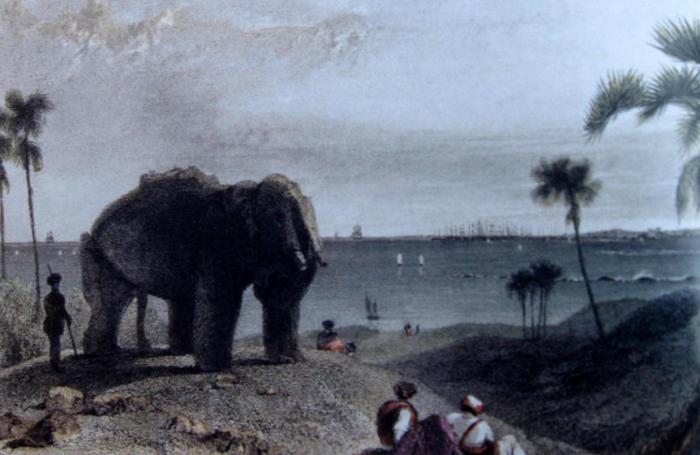
Locally, Elephanta Island is known as Gharpuri and is located about 11 km from Mumbai. It was called Elephanta by the Portuguese, who found a stone statue of an elephant at one of the entry points to the Island. Though they tried their best to destroy the statue, they only succeeded in severely damaging it and today the restored elephant is installed at the Bhau Daji Lad Museum in Mumbai.
Aquatint of the Stone Elephant by Thomas Daniell and William Daniell, 1786. Photo Courtesy: Elephanta by George Michell
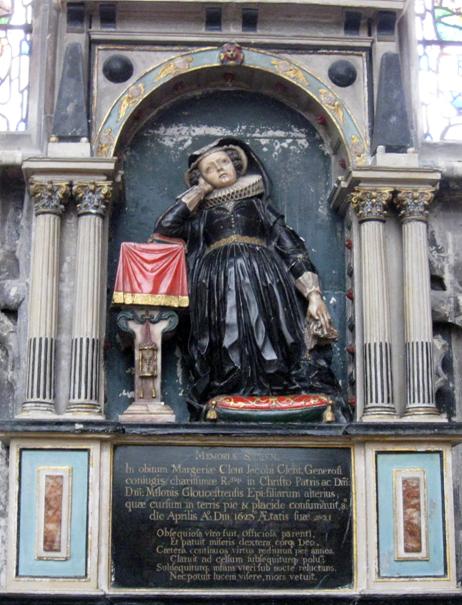
August 1, 2009: The Bored Woman of Gloucester Cathedral
The trip to Gloucester Cathedral happened by chance. Our tour group was on its way to Wales from London and Gloucester was a pit stop for the bus driver to have a smoke and stretch his legs. Since we had made good time, our tour guide generously allowed us an hour in Gloucester and suggested either exploring the Gloucester docks, or visiting the Cathedral. I opted for the latter.
A 15 minute walk and a fast trot later I was at the beautiful Gloucester Cathedral admiring its beautiful architecture, graceful columns and stunning stained glass windows, Then suddenly the above relief caught my eye. I had a tough time controlling my laughter. In a place where one comes across expressions of piety, even severity, this bored “whatever” expression was a real eye-catcher ! The inscription for this rather quirky relief was in Latin, a language I do not know. All I could figure out was that it was a memorial for a person named “Margerie” who died in April 1623.
I tried to find out more about the “bored woman” on the Cathedral website, but not find anything there. In case you do come across any information on her, you will let me know, won’t you?







 My Favourite Things