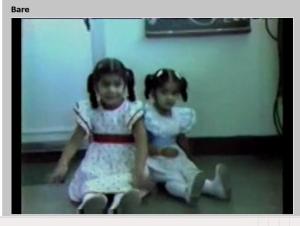
Two little girls, sisters, are seated side by side and are prompted by their dad to sing “Happy Birthday” for him, while he films them for a home movie. The sisters happily oblige. The scene changes and we see footage of the two sisters and their parents at picnics, other birthdays, on a ship (the father is in the merchant navy), etc. Watching the scenes unfold, one after the other, the viewer is led to think that these are glimpses from the life of a happy family.
This perception changes when the conversations begin—telephone conversations recorded in 2006, which are played out against the backdrop of the 20-year old footage of “happy” family memories. These are telephone conversations between the sisters, Santana and Simran; between the mother and Santana; and between Santana and the father. These conversations reveal something totally contrary to what the images convey—that this is not a happy family unit. The parents have separated and the mother does not speak to the father, and Simran also does not speak to her father and wants to have nothing to do with him. Only Santana talks to her father. Sometimes. The reason for all this is the father’s alcoholism.
The above synopsis is of a film called Bare (2006, 11 minutes), directed by Santana Issar. I watched this powerful film as part of a screening of 9 films “of family footage and home movies” curated by Pankaj Kumar on 23 February 2011. These films were part of Cinema Satsang: The Curatorial Project Film Festival organised by the Katha Centre for Film Studies, in collaboration with the India Foundation for the Arts and Alliance Francaise de Bombay.
As curator, Pankaj divided these 9 films into 4 sections: (i) Home movies as genesis of explorations (Straight 8, The Dust, These Old Frames, and Grandad with a Movie Camera; (ii) Politics of home movies (Khoob Asti Afghanistan and I for India); (iii) “Happy” home movies and strange truths (Bare and Tarnation); and (iv) Conclusion: the way ahead (Phantom Limb). The films were screened in this order and the complexity of the use of family footage in the larger narrative of the documentary film increased as we progressed from film to film, and section to section to experience a range of amazingly simple to multi-layered, complex films. Bare was the 7th film to be screened that day, and the disturbing contrast and disjunct between the visual moving image and the audio track has ensured that this film has imprinted itself on my mind. That is the reason why I began my post with that film.
Continue reading “Because the private is public: Turning home movies into documentaries”


 So, I read the book while getting my mehendi done, while helping my cousin’s trousseau to be packed, in the middle of the night under torchlight, when I couldn’t bear the collective grunts and snores of so many aunts in the hall we were sleeping in, between the many wedding ceremonies, etc. By reading a few pages at a time, I managed to finish the 100-odd pages of the book over 3 days and return it to my uncle. I was just in time to congratulate the newlyweds after the wedding ceremony, and then run out to try to obtain my very own copy of the book.
 Once upon a time in Bombay (actually, this was about a 100 years back), there lived a man called Lowji Megji. He was a cotton merchant and ran a very successful business exporting cotton. He lived with his wife, mother, 5 sons, 1 daughter, and 4 servants in a large mansion in Bombay (Note: about a 100 years back, political correctness had not crept in, so I use the words “Bombay” and “servants” in this post).

 Tomorrow is the last day of Mumbai’s much-loved and much awaited annual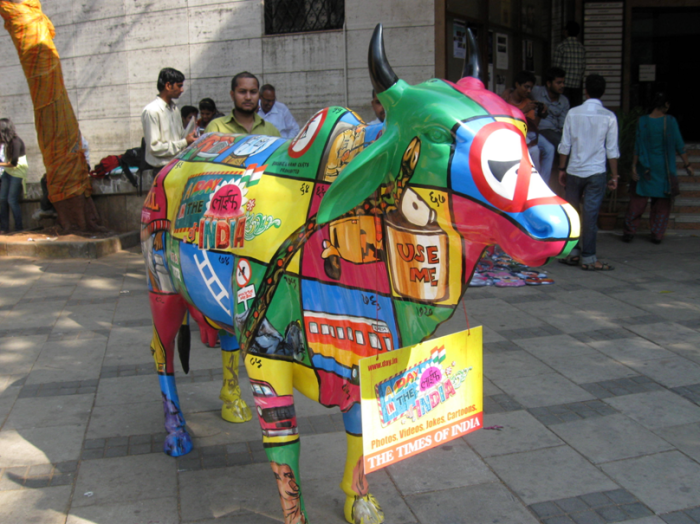

 My Favourite Things