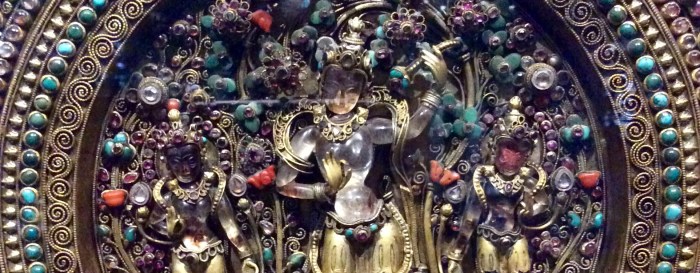
Chintamani Lokeshvara , Museum Treasure, Museum Exhibit, Himalayan Art Gallery, CSMVS, Mumbai, Nepal, 19th Century

Museum Treasure: Chintamani Lokeshvara

The Himalayan Art Gallery at the Chhatrapati Shivaji Maharaj Vastu Sangrahalaya (CSMVS) reopened earlier this year after a period of extensive renovation and restoration. For some reason, I had never entered the gallery in its previous avatar and the re-opening and ensuing write-ups in the newspapers gave me the perfect chance to remedy that.

One rainy afternoon in August this year saw me at the Himalayan Gallery, which has a collection of prayer wheels, a Buddhist shrine, sculptures, jewellery, tangkhas and more, displayed there. The gallery is bright and colourful and the soft Tibetan music played in the gallery transported me to another time and place.

Among all the exhibits on display, what caught my eye was a rectangular wooden plaque, which at first glance seemed to be heavily carved. A second, and closer, glance revealed that not only was the wooden plaque intricately carved, it was studded with gems of all shapes and sizes. The information plaque read: Chintamani Lokeshvara.
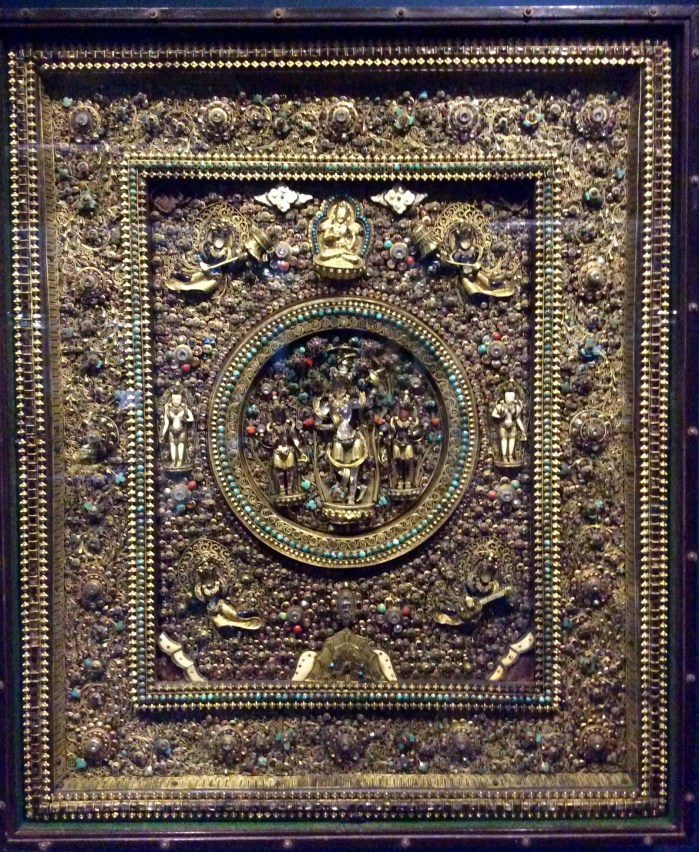
Chintamani Lokeshvara , Museum Treasure, Museum Exhibit, Himalayan Art Gallery, CSMVS, Mumbai, Nepal, 19th Century
Chintamani Lokeshvara, Jeweled Plaque, Nepal, 19th Century CE

Continue reading “Museum Treasure: Chintamani Lokeshvara”

A little bit of that, a little bit of this…

The last month or so has been quite hectic as I finished writing, editing, rewriting, editing, rewriting and finally publishing a number of long pending blogposts. Once I started and got into the rhythm and routine of writing, it was an exhilarating, though exhausting, time. While I enjoyed the buzz and the high that writing always gives, I’m glad it is over for now. Not because I don’t like writing, but because I’m travelling from today evening onwards. Read further to know where I’m headed. 🙂

I had planned to publish a short post from one of the many series I have on the blog today, but then chanced upon a post on “Taking Stock” on one of my all time favourite blogs, Making it Lovely. I loved reading it, and though I don’t write about or post stuff like that here, I was inspired to do my version of it.

After all, there is always a first time, right?

img_8006

I wrote this post from start to finish today morning and it took me a little over an hour to write it. For every word prompt, I just wrote the first thing that came to mind and I can’t tell you how much fun I had. So here goes. This is what I’m up to these days… Continue reading “A little bit of that, a little bit of this…”

The incredible music of the Thar at Suryagarh

The sight of a canopied seating and fresh juice organised by the Suryagarh team was a welcome relief after a morning spent exploring the Thar. Set up outside an abandoned human settlement, the location and timing of the ‘refreshment pitstop’ was perfect. Much as I love the desert, I was getting dehydrated pretty quickly.

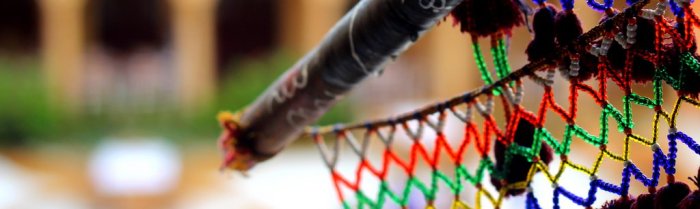
As I made my way to pick a glass of juice for myself, I heard some music being played in the distance. Music that was both familiar and unfamiliar, if not strange. It was familiar because I recognised the instrument, and unfamiliar because I had never heard it played outside of a Carnatic classical music katcheri (concert).

Juice forgotten, I changed directions and headed towards the music and the musician, Sumar Khan, who was playing the morsing or the wind harp, a wind percussion instrument.

Continue reading “The incredible music of the Thar at Suryagarh”

The temples of Kiradu

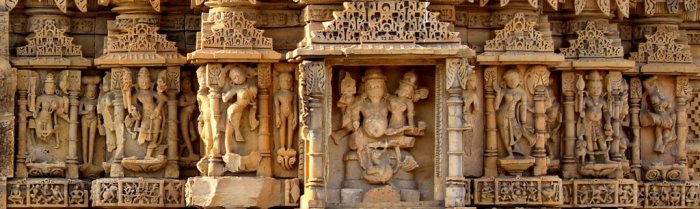
About 180 km south-west of Jaisalmer, where the Thar Desert meets some isolated outcrops of the Aravalli mountain ranges, lie the ruins of the temples of Kiradu. It is believed that there were around 108 temples on this site, but today only 5 temples remain — 4 of those are dedicated to Shiva and 1 temple is believed to have been dedicated to to Vishnu.

I first heard about the temples at Kiradu when I received an invitation from Suryagarh. The itinerary attached with the mail included a visit to these temples. I was intrigued enough to look up for more information on the internet immediately — even before I accepted the invitation. To my surprise, I found little substantive information online. This only made the temples more intriguing and mysterious for me and I couldn’t wait to see them for myself when I visited Suryagarh in July 2016.

And after lunch on my last day at Suryagarh, we set off to see the Kiradu temples. It was a beautiful, but long, drive through the Thar, through dramatic changes in the landscape from desert to hilly.

It was around 6 pm when we arrived at the Kiradu temples, which meant I had an hour or so before sunset and before the light faded. The next hour saw me racing from temple to temple, pumped with adrenaline, trying to take in as much of the details as I could and photographing whatever I thought was interesting or significant.

Temples of Kiradu, Kiradu Temples, Cursed Temples, Barmer, Heritage, Rajasthan, History,
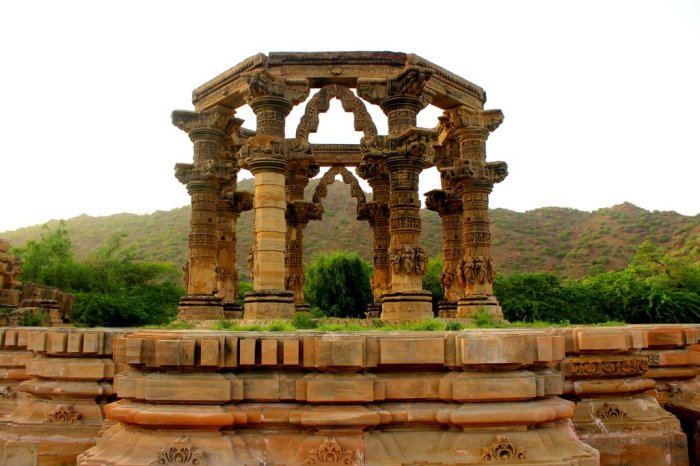
A nritya (?) mandapa with elaborately carved toranas and pillars. One of the pillars has been reconstructed as part of the restoration work undertaken by the ASI at Kiradu

Continue reading “The temples of Kiradu”

Travel Shot: After the film shoot…

It was around noon when our blogger group we reached Khaba Village near Jaisalmer city after a morning spent exploring the Thar as part of the Desert Exploration Trail organised by our hosts Suryagarh. The sight of cool drinks and light refreshments laid out for us at the village was a welcome sight in the heat.

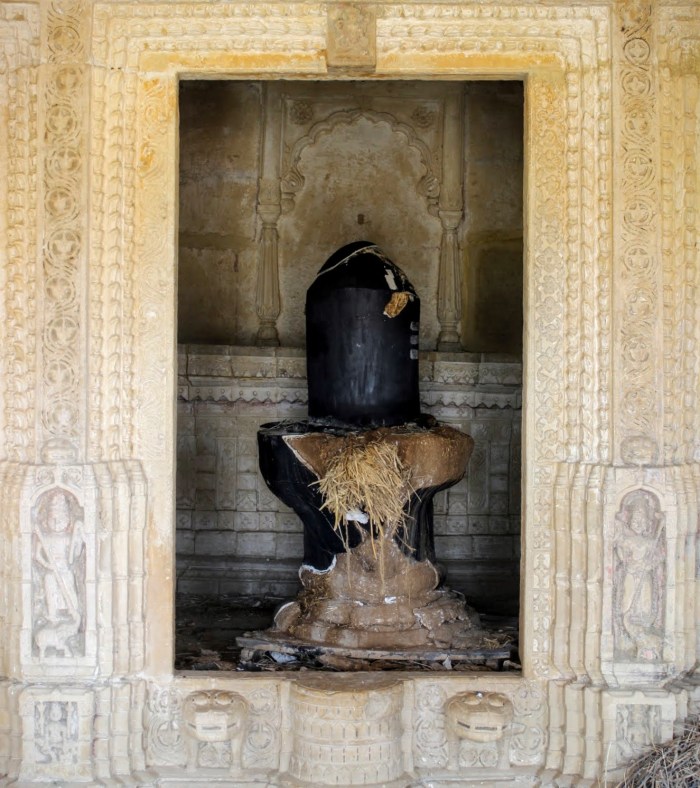
I picked up some juice and walked over to explore what looked like an old temple nearby. It seemed to be an ordinary looking temple and not in use. At least that is what it seemed like until I peeked into the garbha griha of the temple where I saw the strangest-looking shiva lingam I have ever seen — one with its innards spilling out !

Khaba, Shiva lingam, Khaba village, Jaisalmer, Rajasthan, this happens only in India
A shiva lingam with its “innards” spilling out !

The shiva lingam appeared to have been fashioned out of mud and hay, covered with some kind of a plaster or clay layer and then painted over to give the finishing touches of a lingam. It may have looked like the real thing when ‘freshly made’, but looked like something out of a horror show then.

The ‘what’, how’, ‘where’, etc. of the strange lingam would have remained a mystery, if not for the Suryagarh staff who told me how this came to be.

Continue reading “Travel Shot: After the film shoot…”

Sifting through the sands of time in the Thar

The mid-day sun in July is hot and harsh as is the landscape around. I am somewhere in the Thar Desert — about 30-40 km west of Jaisalmer city — and the ground is hard, dry, and stony in most parts with some sandy patches. It is the end of summer in this region and I scan the skies for signs of monsoon clouds, but there are none to be seen.

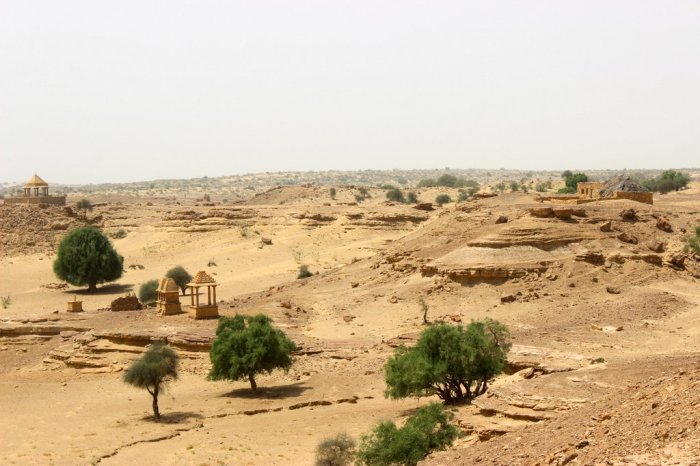
All around me are limestone and sandstone ridges with the meanders of rivers and streams that once flowed here cutting through the rock layers. In the distance, cenotaphs and memorial stones to the dead can be seen. The occasional pops of green from the desert flora provides visual relief (and shade !) in the otherwise arid and barren landscape (see photograph below).

Desert Trail, Thar Desert, Suryagarh, Jaisalmer, Geology, Travel, Rajasthan, Silk Route
Millions of years in this one frame !

It is a sight that leaves me awestruck for this one frame encapsulates millions of years of history of the region — natural as well as human. A history that is as rich as it is varied and one that has changed and evolved through space and time.

Continue reading “Sifting through the sands of time in the Thar”