Haiku: Poetry ancient and modern


“A book on haiku? You bought a book on haiku?” I asked AS, my colleague.

AS, who had just ripped open the packaging and was drooling over the book in question, looked up and answered, “Yes. Why? You don’t like haiku or what?”

“No. I don’t like haiku,” I said. And added for good measure, ” At all.”

“Why?” AS queried.”Haiku is so brilliant.”

“Maybe. It’s also too abstract for me,” I said.

“Abstract? Of course it is. It is minimally abstract and therein lies its beauty,” AS retorted.

“I don’t have a problem with minimal. Or abstract, ” I replied a tad defensively. “It’s just that the whole haiku thing is so vague.”

“I just think you’ve read the wrong type of haiku, Sudha. Here, read this. Then tell me you don’t like haiku.” Saying this, AS passed the haiku book to me.

And that’s how, dear readers, I ended up with Haiku: Poetry Ancient and Modern, an anthology edited and compiled by Jackie Hardy (2008, MQ Publications, 256 pages, Rs.325/-). Ended up holding it, opening it, flipping through it and finally reading it.

Continue reading “Haiku: Poetry ancient and modern”

I, Rama or Ayyo, Rama !

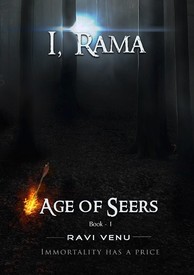
I, Rama: Age of Seers by Ravi Venu (Cratus Media, pp. 264, Rs.225) is the first book in the “I, Rama Series”. The series is a retelling of the Ramayana from Rama’s point of view.

This is His tale… let Him share His story with you…His account of the Legend. This is the story of that mighty king through His eyes, but my hand. (p.17)

I, Rama is narrated as a flashback to Rama’s twin sons Lava and Kusa, his brothers Lakshman, Bharat and Shatrughan, and his foremost devotee, Hanuman. It is not a simple straightforward flashback as there are tales within tales and flashbacks within flashbacks. So, even if it is Rama, who is narrating the tale, he narrates it through another’s voice. This volume takes the readers through the origins of the Ishvaku clan, the reign of Dashrath, the birth of Rama and his brothers, Rama and Lakshman’s sojourn to the Dandaka forest with Vishwamitra, Sita’s swayamvar and her ensuing marriage with Rama, and his encounter with Parasurama. The book ends with Rama, Sita and Lakshman being exiled from Ayodhya.

This is what I, Rama narrates, a story that anyone who has read the Ramayana will be familiar with, including me.

Now, how do I write a review of a book that is yet another retelling of the beloved Hindu legend, the Ramayana?

How do I write a review of a book that is part science fiction, part fantasy, part mythology and ends up being an uncooked khichdi of genres?

How do I write a review of a book with that is woven around a unique premise, but is written very badly?

How do I write a review of a book that was much-anticipated, but which failed to deliver?

How do I write a review of a book whose language is so archaic that it made me cringe?

How do I write a review of a book called I, Rama, but one that made me go “Ayyo, Rama”?

How do I write a review of a book that I struggled to complete and then did not want to review it?

I, therefore, decided not to write a usual review. What I have written is this…

Continue reading “I, Rama or Ayyo, Rama !”

Let’s have some humour, please

The Guest Post Series onMy Favourite Thingshas contributions by those sharing my interests in travel, books, music, and on issues that I am passionate about. These posts are not always by fellow bloggers, and the guest authors are always those who have interesting experiences to share.

Today’s guest post is by Srinayan, the infrequent blogger of The Random Walkaround. An engineer by profession, he took up blogging a little over a year ago and writes on many topics, but always with sensitive insight and understated humour. Srinayan, however, prefers to be known as a lethargic blogger who is long on intent, but somehow falls short on delivery. That is probably why I have given up on waiting for an original guest post from him and, instead, am re-posting one of his old posts. A post that I liked very much, and a post that is quite relevant for our times.

We are living in a terrible world and doomsday is just around the corner; or so we are led to believe by television, newspapers, the internet and all other oracles of wisdom. Nothing seems to going to right for humanity—Greece, the Euro crisis, Wall Street, US debt, climate change, rogue states, etc. Closer home we have inflation, falling stock markets, the Lokpal Bill, 2G and scams of every kind and size. The list is ever growing; you only have to add your pet angst to it.

Whatever happened to that wonderful therapeutic called humour? I don’t mean the stand up comic type which is in vogue today; rather, the sly poke in the ribs that reminds us that, even if all is not well with the world, we are doing fine and having a good laugh about it.

Welcome to The Little World of Don Camillo.

In the context of its time, post-World War II Europe was just as insecure and dangerous as the world is today. While the common folk grappled with economic hardship, their political leadership was preoccupied with ideological realignments or preventing them. As a farcical consequence, depending on your leanings, all problems owed their roots to communism or opposition to it. Black couldn’t get blacker and white, whiter.

The absurdity of the situation was too much for an Italian called Giovanni Guareschi. He reacted by creating two characters, a priest named Don Camillo and his communist adversary, Peppone, in a village in the Po river valley in Northern Italy. The battle between the proletariat and the bourgeoisie was truly joined and the several comic confrontation between the two reflected the pointlessness of the discourse of the time.

Continue reading “Let’s have some humour, please”

The forest of stories: A review

The background

It can be safely stated and assumed with confidence that no other story captures the imagination of Indians across caste, class, region, religion and borders like the Mahabharata. The sheer range of books, films, television serials, critiques, essays, poems, theatre adaptations, folk dances and performances based on this epic are a mind-boggling testimony to this. Each version brings with it the claim that it is a fresh re-telling or re-interpretation of the Mahabharata, a claim that is true to a certain extent. Each author/poet/director/singer/dancer brings a perspective to the story that is uniquely his/her own in their narration. And yet, each re-telling retains the essence of the story that is the Mahabharata.

Ashok Banker, the latest writer to come out a re-telling of the Mahabharata, is very clear that his version is not a “religious polemic”, or a “historical document” or “itihasa”. It is just a great story told in his voice, a story that he wanted to narrate all his life.

This is simply the Mahabharata of Krishna Dweipayana Vyasa retold by one man.

That man is me, of course. (p.xix)

The book review

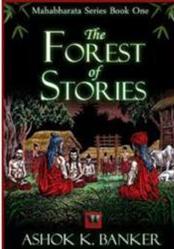
The Forest of Stories (Westland, 2012, pp. 352 + xxii, Rs.295/-) is the first of 18 books in the Mahabharata series of Ashok Banker, who prefers to call it the MBA series ! The book is divided into 9 sections or pakshas, and each paksha is further sub-divided. In addition, there is an introduction to the series/book as well as acknowledgements and some information on the forthcoming two books in the series.

The book begins with the arrival of Ugrasrava Lomarsana (also known as Sauti) at Naimisha-sharanya, a school of learning and meditation for young brahmins, which is located deep within the bowels of the hostile and dense forest, Naimisha-van. Sauti is a renowned kusalavya or wandering bard whose renditions of poems and stories and epics have made him famous all over the land. His arrival sends the ashram residents, students and teachers alike, into a tizzy of hope: that they will be fortunate to hear Sauti narrate the epic poem Jaya.

Continue reading “The forest of stories: A review”

Twitter + Literature = Twitterature?

Classics and bestsellers are rarely left to ..er.. rest on their popularity. The moment they become popular, an entire line of copycat books (which also hope to become a classic one day, or at least the next bestseller) are published. Then come the attempts to make a film or a TV serial (or both) based on the classic/bestseller. Parodies of the classics are not too far behind in getting published or filmed. Then you have the critiques and the re-interpretations of these popular books. And with the social media boom, it is not surprising that some of these books are being tailored or re-written to fit that criteria (for example, click here to read a Facebook version of the Mahabharata, and here to read a  Facebook version of the Ramayana).

With the Twitter boom, can its influence on literature be far behind? Not at all, and this is where two teenagers, Alexander Aciman and Emmet  Rensin, rewrote over 80 classics and some recent bestsellers as a series of tweets. And thus was Twitterature: The World’s Greatest Books Retold Through Twitter born.

Twitterature (Penguin Books, 2009, pp. xiv + 146) is an attempt at “facing and understanding … the greatest art of all arts: Literature” through Twitter. The authors, both 19-year-old students at the University of Chicago at the time of publication of the book, wrote it with the intention of mastering “the literature of the civilized world, while relieving [the reader of] the burdensome task of reading it” in its original form. In other words, Twitterature is a retelling of literature in the form of tweet stories in Twitter language.

Continue reading “Twitter + Literature = Twitterature?”

Happy 200th birthday, Charles Dickens !

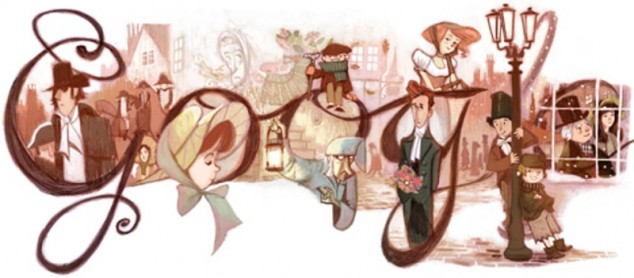
Yesterday was the 200th birth anniversary of Charles Dickens, and not surprisingly Google came up with a doodle to commemorate the occasion.

Google Doodle on 7 February 2012, in memory of Charles Dickens’ 200th birth anniversary

This charming doodle evoked the era and times of the world that the characters from Dickens’ books inhabited. Surely one can see the ghost from A Christmas Carol as well as Fagin from Oliver Twist, and Nell from The Old Curiosity Shop in the doodle? And is that an adult David Copperfield in the curve of the second ‘g’ in the doodle? Or is it Nicholas Nickleby?

I love and loathe Charles Dickens or rather his characters in equal measure. David Copperfield is one of my favourite books, and I love the curmudgeonly Miss Copperfield, just as I loathe Fagin from Oliver Twist. When I read The Old Curiosity Shop, I cried over Nell’s fate and her loneliness. I found Great Expectations tedious and Nicholas Nickleby boring and worthy of a Bollywood film ! A Tale of Two Cities was incomprehensible the first time I read it; it took me a second reading of the book to appreciate the nuances and the plot. Love him or loathe him, one can never be indifferent to Charles Dickens.

That is the reason that there are so many museums and festivals dedicated to Charles Dickens across the world. One such place is  Rochester, in the Kent region of England, which hosts a Summer Dickens Festival every May, and a Dickensian Christmas every December. The Festivals give an opportunity for the townspeople to dress up in Dickensian costumes and have a good time. There is a lot of street entertainment, folk music, Punch and Judy shows, and readings from Charles Dickens’ books. In addition to this, the Swiss chalet like house that Dickens lived in while based in Rochester is open to the public.

All this makes Rochester a perfect place for tourists to visit. I was fortunate to visit Rochester in May 2009 on the last day of the Summer Dickens Festival. Some memories from that visit: Continue reading “Happy 200th birthday, Charles Dickens !”