My ‘now’ song: Raske bhare tore nain

Do you ever have a song, an idea, a storyline, or an image stuck in your head? And it just refuses to go away? For some time at least. I have this with music—it could be a song, an instrumental piece, a jingle, etc. This becomes my ‘now’ song, and the ‘nowness’ (pardon my English here) could be for any length of time.

My now song is “Raske Bhare Tore Nain”, a thumri in Raga Bhairavi.

I first heard Heera Devi Mishra’s version of the song from the film Gaman, as an 8- or 9-year-old, when my brother got home an audio recording of Gaman’s songs. I didn’t think much of this song then, as the other songs (Seene main Jalan by Suresh Wadkar and Ajeeb sa Neha by Hariharan) were more appealing. As I grew older, it was “Raske bhare tore nain’s” sensuous music and lyrics and Heera Devi’s earthy voice that captured my imagination like no other. So much so, that I learnt this song from the audio tape and it remains in my repertoire of songs that I dare to sing in public ! Needless to say, it remains one of my all time favourite songs.

For a long time, I thought that only Heera Devi Mishra had sung this song, till quite recently I discovered versions of this song sung by Girija Devi and Bhimsen Joshi. In my opinion, both Girija Devi’s and Bhimsen Joshi’s renditions of this thumri is not as nice as Heera Devi’s.

Yesterday, I stumbled across Barkat Ali Khan’s sublime rendition of this song and I knew then that “Raske bhare tore nain” was my new “now” song. Though Khan’s mellifluous voice and Heera Devi’s earthy tones are in sharp contrast to one another, both their renditions delight in different ways — the former playful and soothing, and the latter sensuous and raw. Barkat Ali’s Khan’s version is given below.

You could take your pick as to which version you liked, or you could enjoy both of them like I did. Do let me know which one you liked. 🙂

My ‘now’ song: Phir wohi raaste

Do you ever have a song, an idea, a storyline, or an image stuck in your head? And it just refuses to go away? For some time at least. I have this with music—it could be a song, an instrumental piece, a jingle, etc. This becomes my ‘now’ song, and the ‘nowness’  (pardon my English here) could be for any length of time.

 My ‘now’ song is Phir wohi raaste sung by Shafqat Amanat Ali from the film Ramchand Pakistani.

I first heard this song on a cold, cold day in December 2008 in London. I was surfing YouTube when I came across the title of the film. That immediately caught my attention and on exploring further, I came across this song. When I heard the flawless rendition by the incomparable Shafqat Amanat Ali, I was hooked. Every part of the song appealed to me—the lyrics by Anwar Maqsood, the music by Surya Mitra, and of course the way it was sung. Since then, Shafqat Amanat Ali has become one of my favourite singers.

At that time, the appeal in this song lay in its ability to connect with my homesickness. Today, I am back home and I am not homesick. Yet, the appeal of this song endures in a way that I cannot explain or describe here. All I can say is that if you have heard this song before, why don’t you listen to it once again here? If you haven’t, then experience this song right here.

Enjoy 🙂

Kahat Kabir suno bhai saadho …

Every Indian child, at least the ones who learn Hindi, knows about Kabir—the mystic poet, saint, and philosopher. Kabir ke dohe or Kabir’s couplets were a part of my school life too. Not only did I read his poetry in my Hindi textbooks, I was also exposed to his philosophy through the Government of India initiated “National Integration Campaign” during my school years in the eighties as Kabir’s philosophy and background—which appealed to Hindus, Muslims and Sikhs alike—made him the perfect symbol of national integration.

Kahat Kabir suno bhai saadho…, which appears like a signature line in most of Kabir’s compositions, was probably the most recognised phrase during my school days. Yet, once I left school, I also left Kabir behind. Over the years, I had fleeting encounters with Kabir through a occassional article in a newspaper or magazine or through snatches of a song heard on TV or the radio.

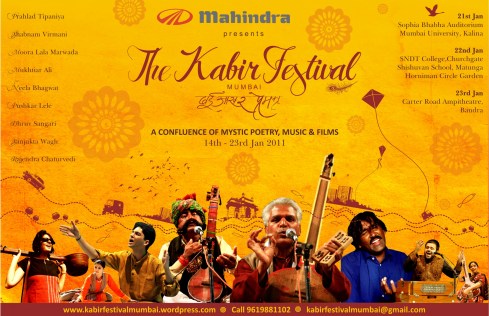
So, when I heard about the Kabir Festival being organised in Mumbai, I knew that this was a chance to renew my acquaintance with Kabir. According to the Festival’s twitter page, “The aim of The Kabir Festival Mumbai is to introduce Mumbai to the message of Kabir which is perhaps even more relevant today than it was in his time.” The Kabir Festival Mumbai is a “confluence of mystic poetry, music, dance and films”, with the main festival being held from 21–23 January, and the run-up events from 14–20 January 2011.

Continue reading “Kahat Kabir suno bhai saadho …”

My ‘now’ song: Pachelbel’s Canon in D

Do you ever have a song, an idea, a storyline, or an image stuck in your head? And it just refuses to go away? For some time at least. I have this with music—it could be a song, an instrumental piece, a jingle, etc. This becomes my ‘now’ song, and the ‘nowness’  (pardon my English here) could be for any length of time.

My ‘now’ song is Johann Pachelbel’s Canon in D and I present 2 versions here. The first version has the Canon being played by 3 violins, as it was originally meant. The second version is an adaptation of the Canon by the London Symphony Orchestra for a full orchestra. Both versions are equally beautiful.

Continue reading “My ‘now’ song: Pachelbel’s Canon in D”

A Sufiana experience for the mind, body and soul

Sufism is neither a religion nor a cult. Any person who has knowledge of both inner and outer life is a sufi.

(Hazrat Inayat Khan, Sufi philosopher and practitioner)

It is Thursday evening and I am at the NCPA Mumbai’s Tata Theatre to attend an evening of Sufi music. The above words by Inayat Khan leap out of the beautifully produced and informative programme brochure on “Sama’a The Mystic Ecstasy: Festival of Sufi Music” as I read it to familiarise myself with the programme. Though I have listened to some Sufi music over the years, I have never attended a live performance. I also do not know anything about the  history of Sufism or Sufi music, for that matter, except for the fact that music is central to the core experience of Sufism. The programme brochure states that

… music is regarded as a means for the believer to get closer to the Divine. Sufi music therefore is music of the ‘soul’ by the ‘soul’ and for the ‘soul’.

Continue reading “A Sufiana experience for the mind, body and soul”

My ‘now’ song: Abhi naa jao chhod kar

Do you ever have a song, an idea, a storyline, or an image stuck in your head? And it just refuses to go away? For some time at least. I have this with music—it could be a song, an instrumental piece, a jingle, etc. This becomes my ’now song, and the “nowness”  (pardon my English here) could be for any length of time.

My ‘now’ song is Abhi na jao chhod kar ke dil abhi bhara nahin from the film Hum Dono.

I love this duet by Mohammad Rafi and Asha Bhosle, so beautifully filmed on Dev Anand and Sadhana. Rafi’s mellow, persuasive voice and Asha’s flirtatious response makes this song an all-time favourite. It is Rafi’s 30th death anniversary on 31st July 2010 and this is my tribute to him.

Enjoy. 🙂