I love seeing students in their graduation/convocation gowns, robes, cloaks, shawls, what-have-yous that makes me go all part-sentimental, part envious. That’s because I never got to attend either of my two post-graduate convocation ceremonies—the first because the University only invited the prize winners and I wasn’t one; and the second was a degree awarded by a London-based university, and I had already returned to India by then.
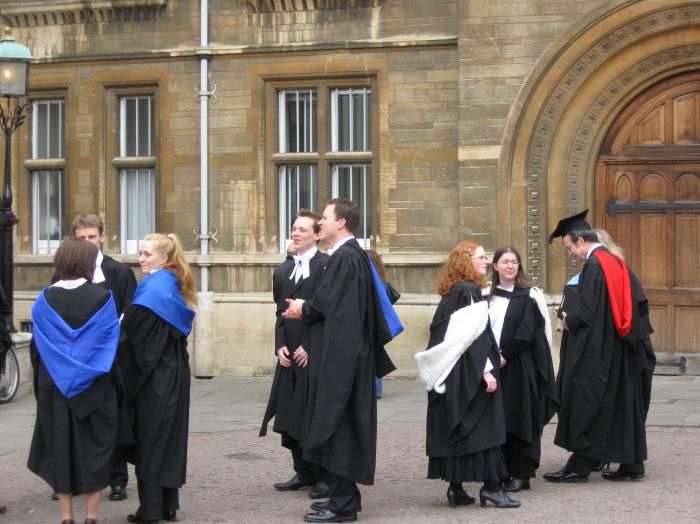
So it’s no wonder then, that 3 of my favourite photographs from my collection are around the theme of graduation day in Cambridge, when I visited this University town in April 2009. Cambridge was buzzing with excited and serious students, proud and happy parents, beaming teachers, and in the midst of all this bewildered tourists arriving by the busload every minute.
I was all set to hit the “sights” of Cambridge when I came across the graduates, dressed in their robes. And I slowed down immediately just to watch them. And yes, photograph them, too, from the ground and from the air. 😀
Graduating students in different coloured robes. Wonder what level of qualification each colour represents
Bath is a rather funny name for a city, isn’t it? I first came across the city of Bath in Charles Dickens’ The Pickwick Papers, and later in Jane Austen’s novels, Northanger Abbey and Persuasion. Over the years I “visited Bath” through other stories, essays, films, paintings and photographs, and discovered a deliciously decadent life of leisure and luxury, fashion, intrigue, matchmaking, music, dance, poetry… I further discovered Bath’s history of healing and curing through its mineral rich, hot water springs. In fact, archaeological evidence exists of the waters of Bath being used for healing purposes since pre-Roman times. In 1987, Bath was declared a UNESCO Word Heritage Site.
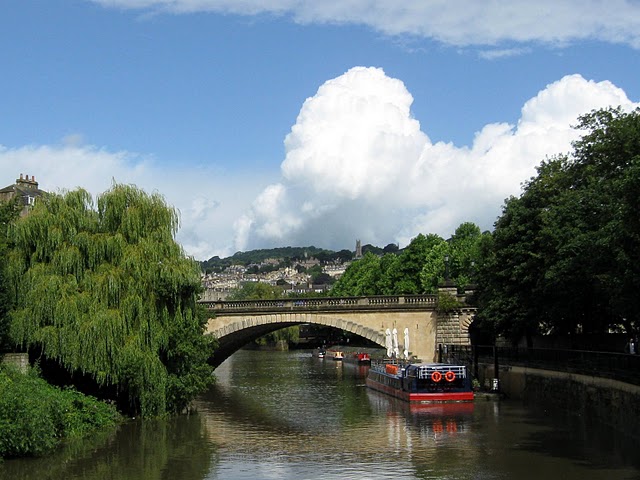
When I spent a year in London in 2008-2009, Bath was on my list of “must see places before return to India”. And on one beautiful July day in 2009, I set off for a day trip to Bath, organised by London Walks. It was a day that the English, rather mistakenly, call an Indian summer’s day—pleasantly sunny with a cool breeze and intermittent light showers. A lovely day to travel and have a bath in walk around Bath. 🙂
Located in the green and gold Somerset countryside of England, my first impression of Bath, or Bath Spa as the city is called now, was that it did not look or feel like England at all—it had a very European air about the place. The River Avon flows through Bath and it is the first thing that you see when you come out of the station.
“I couldn’t tear myself away from the image of the Maheshmurti. It was so beautiful. So mesmerising. Elephanta was so nice,” gushed Iskra, an exchange student from Bulgaria.
I listened to Iskra’s description of her visit to Elephanta Caves with part fascination and part envy. The reason? In spite of having lived in Mumbai for nearly 23 years, I had never been to the Elephanta Caves. Listening to Iskra, and that too a foreigner, rave about them needled me into resolving to visit the caves at the earliest opportunity.
And would you believe it? The opportunity presented itself to me the very next day, almost as if it was just waiting for me to make up my mind. My Facebook wall announced that Girls on the Go (GOTG), a women’s only travel club, was conducting a guided day trip to the Elephanta Caves on 13 March 2011. Would I be interested? Not one to let go of an opportunity like this, I signed up for the trip within seconds of seeing the intimation. 😀
Gateway of India
So, on D-Day, I was at the Gateway of India much before the reporting time of 7.45 am. While waiting for Piya Bose, the founder of GOTG, and the rest of the group to assemble, I tried to recall what I knew about the Caves. They were … um… really old rock-cut caves, were located in Elephanta Island some distance away from Mumbai, could be accessed only by boat, and was a UNESCO World Heritage Site. In short, I knew nothing about the Caves. Of course, by the time the tour got over I was a little wiser thanks to Lakshmi Kishore, our guide, and a booklet on the Elephanta Caves that I purchased from the ticket office.
Elephanta Island has traces of habitation from 2nd century BC in the form of remains of a Buddhist stupa, reportedly built by Emperor Ashoka himself. But what the Island is really famous for are 7 rock-cut caves, whose age is not well established due to absence of written records. Various theories exist as to the age of the caves as well as to who built them, and according to the Archaeological Society of India’s (ASI) booklet, the caves were excavated during the middle of the 6th century, during the rule of the Konkan Mauryas.
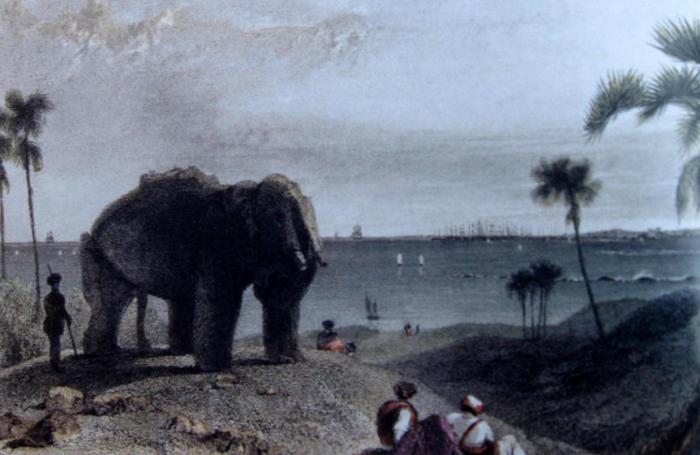
Locally, Elephanta Island is known as Gharpuri and is located about 11 km from Mumbai. It was called Elephanta by the Portuguese, who found a stone statue of an elephant at one of the entry points to the Island. Though they tried their best to destroy the statue, they only succeeded in severely damaging it and today the restored elephant is installed at the Bhau Daji Lad Museum in Mumbai.
Aquatint of the Stone Elephant by Thomas Daniell and William Daniell, 1786. Photo Courtesy: Elephanta by George Michell
1 August 2009: Newly weds at a photo shoot at Chepstow Castle, Wales
One rainy and damp day in August 2009, I was at Chepstow Castle, Wales, walking around and delighting in its various nooks and crannies, when I came across a newly married couple having their photographs taken. During my year-long stay in London and my forays to other places in England and Wales, it never happened that I visited some historical place or park and came away without seeing a newly wed couple having a photo shoot there. When I first saw such a shoot, I thought it was a professional shoot for some bridal paraphernalia ! It was only later that I figured out that it was a tradition for newly married couples to have a photo shoot at a nearby historical site or park.
This couple at Chepstow Castle was oblivious to the rain and the muddy trails on the bride’s gown, as they laughed and giggled and posed for the camera. I waited for them to finish, so that I could pass through the door to the other side. While waiting, I couldn’t help noticing the different textures of stone, wood, metal and fabric , not to mention the fresh green of the grass in an otherwise almost monochromatic frame. Even though I felt like I was trespassing on the couple’s privacy, I could not resist taking a photograph.
As they finished, and the photographer beckoned me to come through, I heard the bride asking the photographer,
“Rhys, you’re sure the mud on my gown won’t show in the photos?”
“100% sure, darling. What’s Photoshop for?” replied the photographer.
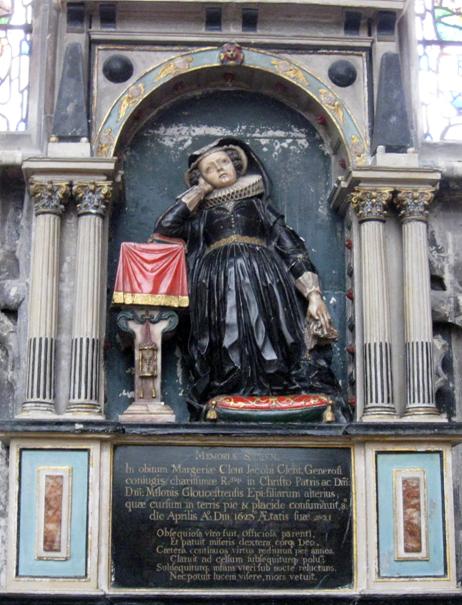
August 1, 2009: The Bored Woman of Gloucester Cathedral
The trip to Gloucester Cathedral happened by chance. Our tour group was on its way to Wales from London and Gloucester was a pit stop for the bus driver to have a smoke and stretch his legs. Since we had made good time, our tour guide generously allowed us an hour in Gloucester and suggested either exploring the Gloucester docks, or visiting the Cathedral. I opted for the latter.
A 15 minute walk and a fast trot later I was at the beautiful Gloucester Cathedral admiring its beautiful architecture, graceful columns and stunning stained glass windows, Then suddenly the above relief caught my eye. I had a tough time controlling my laughter. In a place where one comes across expressions of piety, even severity, this bored “whatever” expression was a real eye-catcher ! The inscription for this rather quirky relief was in Latin, a language I do not know. All I could figure out was that it was a memorial for a person named “Margerie” who died in April 1623.
I tried to find out more about the “bored woman” on the Cathedral website, but not find anything there. In case you do come across any information on her, you will let me know, won’t you?
This post won the Indiblogger Cleartrip “My Purpose” Contest. 🙂
It is 5.20 am on a rainy May morning in 2009 and I am at Geneva Railway Station. My train to Milan is due in 10 minutes, and with me is Karim, a friend and my travel companion for the trip. I am so full of anticipation and barely suppressed excitement that I pace the platform and check the station clock every 15 seconds or so. As the clock strikes 5.30, our train rumbles into the station with legendary Swiss precision. We get into our compartment, find our pre-booked seats, settle down with wide grins at each other, and then we’re off.
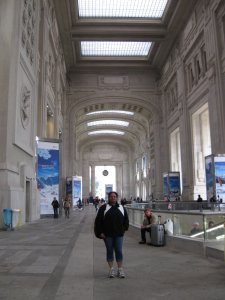
At the Milan Centrale Stazione
This is to be a day trip to Milan, with both of us returning to Geneva that evening itself. Considering that we have only a few hours in Milan, my focus and purpose for the trip is to see the Milan Cathedral, and to view da Vinci’s “The Last Supper” in its original form. Anything else that we see would be a bonus.
The train ride from Geneva to Milan is very picturesque on both the Italian and Swiss sides, and we pass through some of the most beautiful and colourful towns and cities that I have seen. It is raining throughout our journey, but our enthusiasm at the prospect of a day in Milan is unaffected by such mundane things. 😉
It is 9.30 am when we get off the train at the Milano Centrale Stazione. We quickly orient ourselves with a map and decide to head to the Piazza del Duomo, where the Milan Cathedral is located. All major sights are within walking distance from the Piazza, including that of “The Last Supper”. After a 15-minute metro rail ride from Centrale Stazione, we are at the Piazza del Duomo.
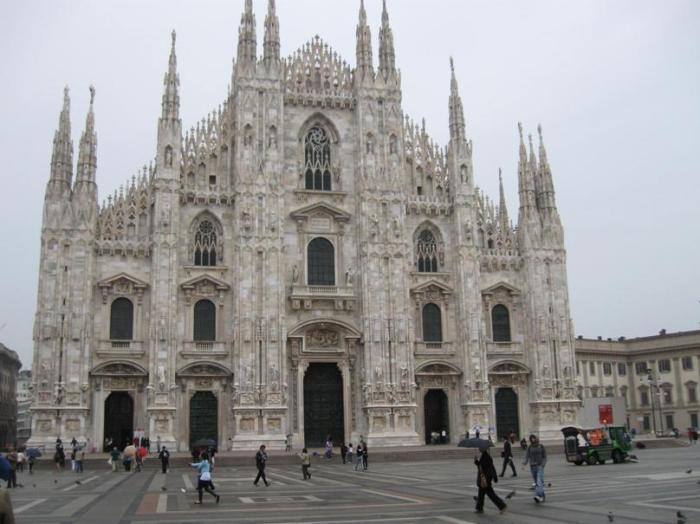
It is 10 am when we get off the metro. As I climb the stairs to exit the station and enter the Piazza, the Cathedral comes into view little by little. With each step that I climb, a little more of the Cathedral is revealed. This unveiling of the Duomo di Milano or the Milan Cathedral is something that will stay with me for ever.
The front façade of the Milan Cathedral as viewed from the subway exit






 My Favourite Things