The Udaipur experience

Udaipur was my last stop as part of a 10-day trip of Rajasthan that took me through sandy Bikaner and Jaisalmer, arid and rocky Jodhpur, and mountainous Kumbhalgarh. And when I arrived in the cool, green lake city of Udaipur, I was in for a bit of a shock. A pleasant shock, I must hasten to clarify. Part of the shock was how different it was from the image that comes to mind when one imagines Rajasthan, and part of the reason was how much Udaipur looked like the pictures I had seen of the city. 🙂
Udaipur, City of Lakes, Lake Pichola, City Palace
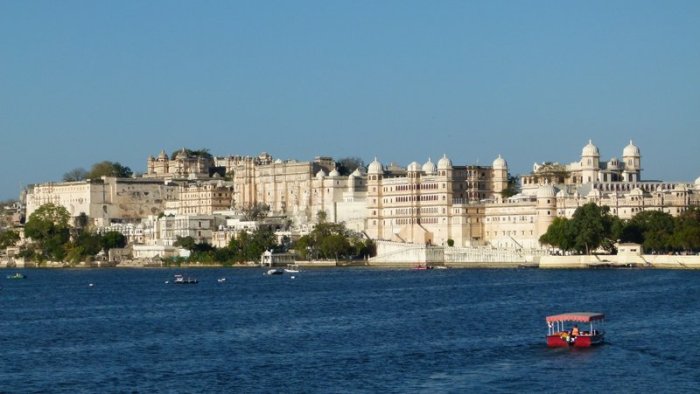
View of the City Palace from the Jagmandir Palace across Lake Pichola

Udaipur was established in 1559 by Maharana Udai Singh as the new capital of Mewar as Chittorgarh, the previous capital, was deemed too vulnerable due to repeated attacks by the Mughals. The next 400 years saw Udaipur fighting for independence from the Mughals, repelling their attacks, signing peace treaties with them, facing attacks from the Marathas, alternately supporting the British or rebelling against them; and finally agreeing to join other Rajput kingdoms in forming the state of Rajasthan after Independence.

The 400 years also saw the city developing into one of India’s prettiest cities with artificial lakes, royal palaces for every season and weather, mansions, gardens, and what not. Having visited it now, I can understand why many foreigners consider this city as a wedding destination. Surrounded by hills on all sides, plenty of lakes, palaces on hire, and a salubrious climate, this is a just about as perfect a location as one can get. Add to this the allure of royals and local Rajput history, and you have the perfect exotic quotient that appeals to many.

I spent a couple of days exploring Udaipur, wandering in the alleyways of its old city, touring the famous City Palace on the banks of the Lake Pichola, visiting memorials and gardens, stuffing myself with sweets, picking souvenirs and bandhini dupattas, going on boat rides… Presenting some images from my wanderings in Udaipur 🙂

Continue reading “The Udaipur experience”

Forts of Rajasthan – 4: Kumbhalgarh Fort

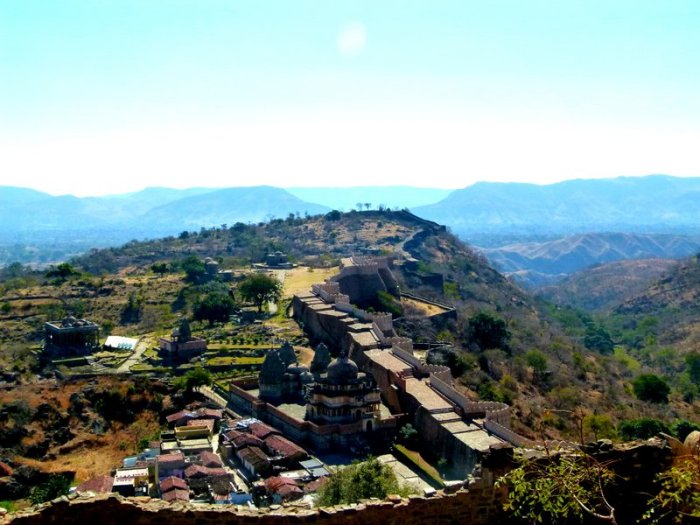
It is a cool and crisp February morning at the Kumbhalgarh Fort.

The mild warmth of the winter sun and a gentle breeze make it the perfect weather for exploring it, and the mesmerising panoramic vista tempts me to stop now and then and admire the view. The blue haze of the distant mountain ranges, birdsong and the ringing of bells from the various temples within the Fort complex adds to the general sense of peace and calm all around.

Kumbhalgarh Fort, Rajasthan, Travel, Forts of Rajasthan Though there is some activity in the settlement below and few early bird tourists like me, it feels like the Kumbhalgarh Fort is all mine, and only mine, to explore. As I stop at one point to look at the view once again, I recall how different the Fort looked the previous evening, when I attended the sound and light show.

The sun was setting when I had arrived at the Kumbhalgarh Fort. I had just enough time to buy the ticket, reach the venue, find a seat and switch off my mobile, when the show began with the rather clichéd, but oh-so-effective, voice-over saying, “Main Kumbhalgarh hoon” [I am Kumbhalgarh], setting the tone for the narration of the story of Kumbhalgarh Fort.

Continue reading “Forts of Rajasthan – 4: Kumbhalgarh Fort”

3 years, 283 posts, 2,07,006 words…

3rdBirthday… later, its blogversary time. Yes, My Favourite Things turned 3 years old today and I feel a mix of pride, surprise, relief and so many other emotions right now.

You see, writing is not instinctive for me like music and art are. For me, writing is a laborious process and I have spent almost my entire lifetime avoiding writing beyond the essentials — homework, school essays, reports, letters, dissertations, etc. have been sincerely done. But that’s about it. I’ve never maintained a diary, even an appointment diary !

I must confess here that I’m quite envious of people who declare that they always knew they wanted to write, and also those bloggers who declare that it took them “just half-an-hour” to write a blog post.

So why did I start blogging? Mainly because I wanted to prove a point to myself by doing something out of my comfort zone, but also because I was bored. So Year 1 of blogging was all about getting comfortable with writing, exploring and experimenting with topics and writing styles, etc. Though writing still did not come easily to me, I had fun conceptualising and then writing post after post. It was hugely satisfying to see my thoughts take shape in the words I wrote.

Continue reading “3 years, 283 posts, 2,07,006 words…”

The Jain Temples of Rajasthan: Bhandasar, Jaisalmer, Lodhrava & Ranakpur

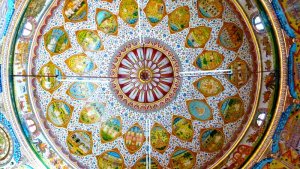
The painted ceiling at the kaner, Rajasthan, Travel
The painted ceiling at Bhandasar Temple, Bikaner

“Look at the ceiling and see the beautiful gold leaf work,” the priest-cum-guide at the Jain Temple urges our group.

Everyone obediently looks up at the ceiling appreciatively. Some of them, including yours truly, try to see the finer details of the paintings on the ceiling by zooming their camera lens on it.

“What are the images depicted on the ceiling all about?” I ask.

“Those are our Jain stories,” says the priest-cum-guide.

“What do they say?”

The priest-cum-guide smiles, “Madam, you will not find them interesting. You look at the beautiful frescoes and painted pillars and take beautiful pictures.”

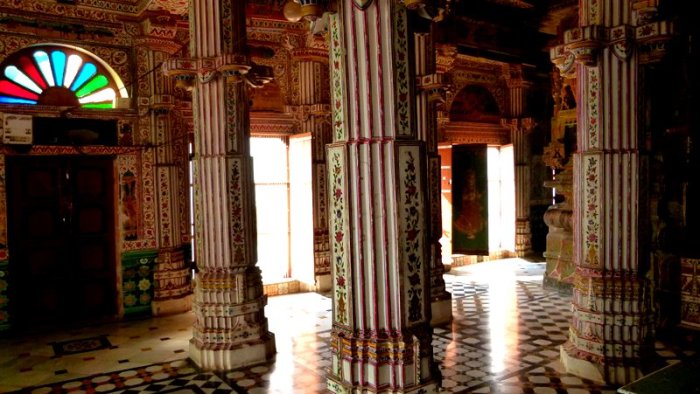
Bhandasar Jain Temple, Bikaner
Painted pillars at the Bhandasar Jain Temple, Bikaner

“But how will I know what I’m looking at if I cannot understand what I’m seeing?” I protest.

“You are a non-Jain and these stories are not important for you. Admiring the beauty of the temple is more than sufficient for you,” calmly responds the priest-cum-guide.

I am rendered speechless with indignation and outrage at this statement. And as I discover during the course of my Rajasthan trip in February this year, it is only the beginning. I have conversations like this at all the Jain temples I visit. There are slight degrees of variations, but all visits go something like this: I am warmly welcomed in (for a fee, of course), have the history of the temple narrated to me, urged to look around and take photographs (except of the sanctum sanctorum), have a tikka applied… But the moment I ask details as to what the art and symbolism of the icons and sculptures mean, there would be these very indulgent and polite refusals to elaborate.

Absence of any kind of literature or accompanying audio guide at the temples only added to the general frustration. While I can say that I have visited certain Jain temples in Rajasthan and know the history associated with it, I have no clue as to what I really saw or know the story behind what I saw.

To write this post, I have tried to recollect what I saw, read the notes I had scribbled, and went through the photographs I had taken. The result is a blogpost that is part rant, part sketchy information, part photo essay, and part observation of some of the Jain temples I visited in Rajasthan: Bhandasar Temple (Bikaner), Parsvanath Temple (Jaisalmer), Parsvanath Temple (Lodhrava or Lodarva or Lodrava), and Ranakpur Temple.

Continue reading “The Jain Temples of Rajasthan: Bhandasar, Jaisalmer, Lodhrava & Ranakpur”

The creepy & beautiful cenotaphs of Rajasthan

It is an hour to sunset when I arrive at Devi Kund Sagar in Bikaner that February evening. I have just arrived from Mumbai earlier that day and this is one of the first sites I am visiting in Bikaner. Never having seen cenotaphs for Hindus before, I am very curious and intrigued about this visit and am not sure what to expect when I walk into the complex. (I didn’t know then that Devi Kund Sagar is only the first of the many Hindu cenotaphs I will be seeing during the course of my Rajasthan trip).

Located about 8 km from Bikaner, Devi Kund Sagar has been the cremation ground for the royal family of Bikaner and generations of kings, queens, princes and princesses of Bikaner have a memorial to their names here. According to the information board at the entrance to the complex, the oldest cenotaph at the Devi Kund Sagar is that of Rao Kalyanmal Ji (1539-1571 AD).

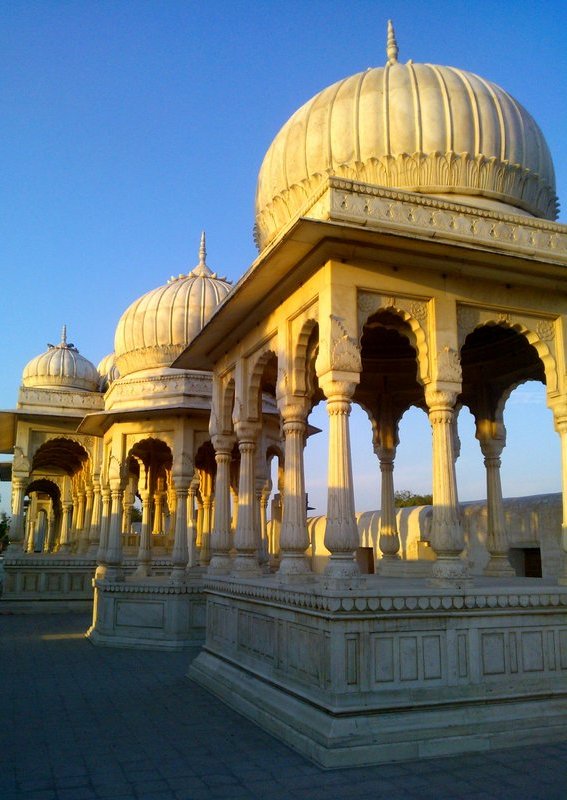
Rows upon rows of pillared and open-sided domed cenotaphs are spread out before me when I enter the L-shaped enclosure after removing my footwear. The place is empty, save for the caretaker and a couple of children playing hide and seek between the various structures. The base of each of these domed and pillared structure is mostly square, and sometimes hexagonal or rectangular. Locally, the cenotaphs are called chhatris due to the domes, which look like umbrellas (chhatris).

Cenotaphs, chattris, Rajasthan, Hindu
Cenotaphs at Devi Kund Sagar, Bikaner

Continue reading “The creepy & beautiful cenotaphs of Rajasthan”

Photostory: A red-canopied welcome

“I think someone important is coming.”

“Do you think it is SRK?”

“No, it must be the Maharaja himself.”

“I’m telling you it must be some firang (foreigner).”

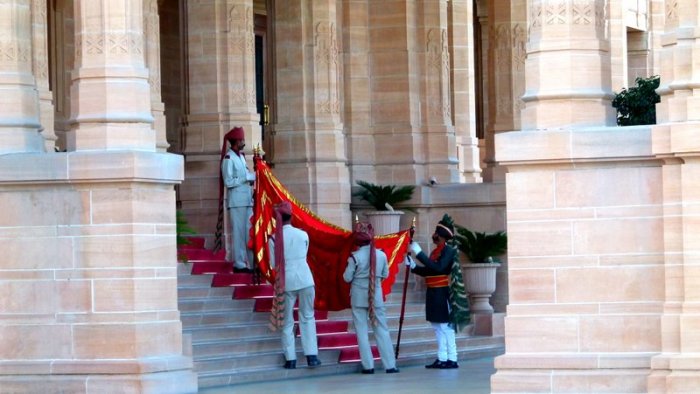
I can’t help overhearing this excited chatter and squeals of anticipation as I step out of the Museum of the Umaid Bhawan Palace, Jodhpur. A group of 20 somethings is standing to one side and craning their necks over a barricade to see something that I cannot. I am intrigued and join them as do some other tourists. And soon we are looking at the entrance to the Umaid Bhawan Palace Hotel, which was abuzz with some activity. What happened next is not really an unusual sight in a 5-star hotel, but as a tourist in a touristy place, I couldn’t help be one myself. 😀

A bright red silken canopy is being unfurled and readied.Who is the visitor, I wonder? So do others and the guesses are flowing fast and thick.

Umaid Bhavan Palace Hotel, Jodhpur

Continue reading “Photostory: A red-canopied welcome”