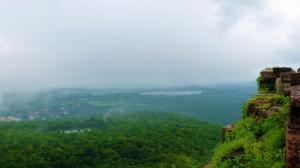
The town of Champaner is situated at the base of Pavagadh Hill, which is a sudden rise in an otherwise gently undulating landscape. A climb up Pavagadh Hill reveals a heady mix of interesting geology, mythology, religious confluence, history, strategic military brilliance and foresight, clever design and architecture, rainwater harvesting systems, sustainable measures, a hidden valley of flowers, etc.
Geologically, Pavagadh Hill is quite different from Champaner. The Hill is composed of rhyolite, a volcanic rock, while Champaner is almost entirely sandstone, a sedimentary rock. It is this volcanic feature which made Pavagadh an important and strategic location for whoever ruled it. About 830 m high, it descends or ascends (depending on your point of view) in five plateaus, each of which are separated by steep cliffs. This feature enabled fortifications to be built at vantage points around the hill in a circular manner, making it indefensible and non-breachable. And also confusing for the visitor/tourist.
“It has not rained in Champaner for 2 years, and then it rains like this. When it rains…” the guide’s voice trailed off mournfully.
About 20 pairs of suspicious, skeptical eyes looked at the muddy, slushy path that seemed to worsen as it wound its way to apparently nowhere. But according to Manoj, the guide, the path led to 2 mosques, one of them with the most beautiful embellishments imaginable on its walls.
Maybe Manoj did not sound convincing enough, or maybe it was the mud, but most of the owners of those eyes decided to forego seeing those two mosques. But some did agree to go with the guide and see the mosques. I was one of them.
Our tour group was in Champaner for a 2-day visit. We had arrived that morning from Mumbai to a cloudy, rainy and wet day, in the wettest rainy season that Champaner was experiencing in a long time. We were to see the ruins of the medieval city of Champaner, which included many mosques in various stages of restoration or disrepair, depending on one’s point of view. I wondered how many we would be able to see with the heavy rains having made the access roads paths almost impossible to negotiate. (There are reportedly 18 such mosques, and we managed to see about 5 of them.)
Once upon a time there was a prince. He wasn’t particularly a happy prince or, for that matter, an unhappy prince; but he was an ambitious prince. He wanted to be remembered for posterity for his conquests, and his rule. The prince wanted to be like his grandfather, who had founded a great city and named it after himself. But the prince had to first become the king. And one day, he became the king.
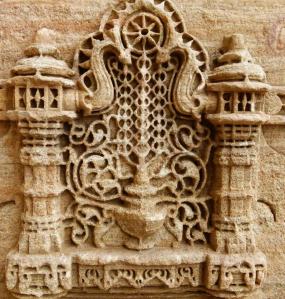
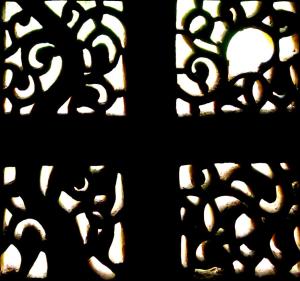
Detail of a window at the Jami Masjid
The prince, now the king, set his eyes on a neighbouring kingdom, which was very well fortified and was known to have an impregnable defence system. The king’s advisers and soldiers urged him to consider some other kingdom to conquer.
But he declined; it had to be this kingdom. The king’s strategy was not to engage in a battle or a war; he captured the lower fortifications of this hilly kingdom, and then laid siege to it and cut off supplies.
Cloisters of the Jami Masjid
The kingdom’s ruler was amused and offered the king money, women, and jewels, but the king was not enticed. He was firm about his intentions—he wanted the kingdom. Nothing else. To show that he meant business, the king laid the foundations for his palace and a place of worship for his soldiers just outside the fortifications and at the base of this hilly kingdom.
If Hampi was the showpiece of the Vijayanagara Empire, then the Vittala Temple is undoubtedly the showpiece of Hampi. Everything about the Vittala Temple is designed to make a statement—right from its settings and surroundings to its architecture to the temple complex itself. Everything. It is for this reason that the Vittala Temple is the most visited monument in Hampi, thereby making it the most talked about or written about or photographed monument. It is also the reason why our tour group was standing outside the Vittala Temple complex at 8.00 am one Saturday morning last month. Doreen, our tour organiser, was insistent that we visit the Vittala Temple before any other monument that day to avoid the tourist hordes. It was a good thing too, as the tourists started arriving in waves as we were leaving.
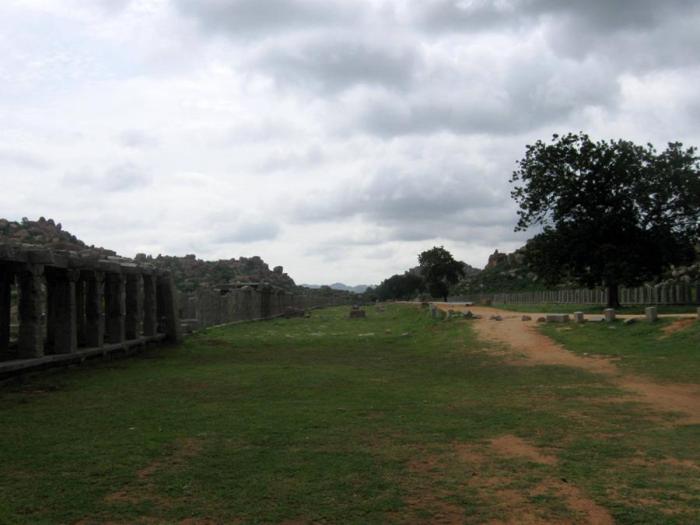
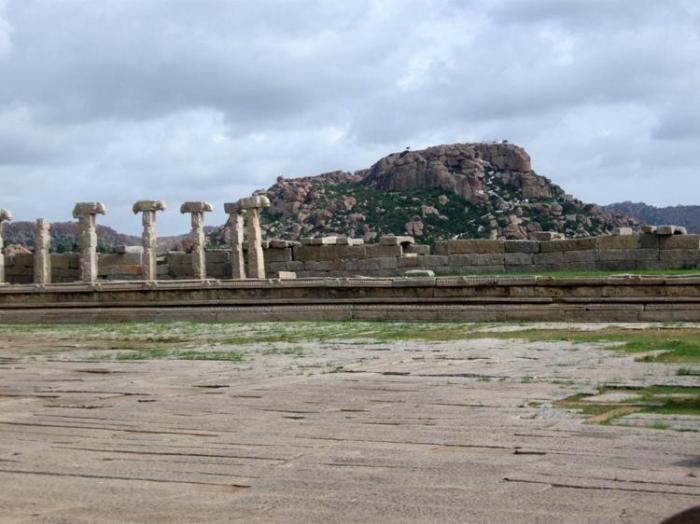
Located on the banks of the Tungabhadra with Anegundi on the opposite river bank, the approach to the Temple is through the stone ruins of a bazaar. We also passed a water tank and some manadapa-like monuments.
Bazaar outside the Vittala Temple
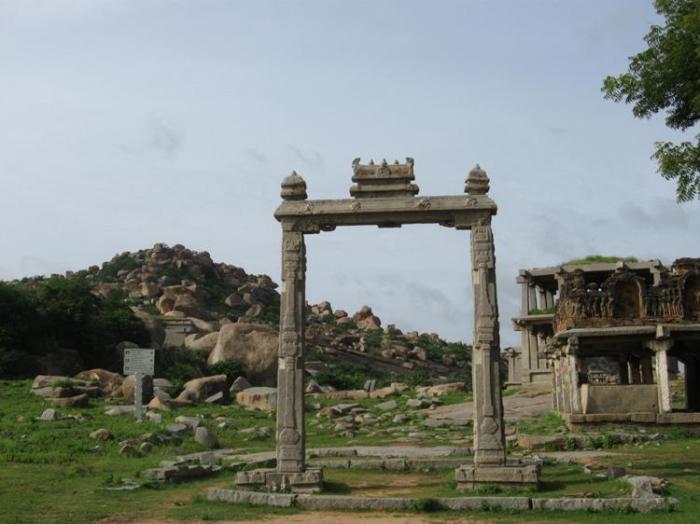
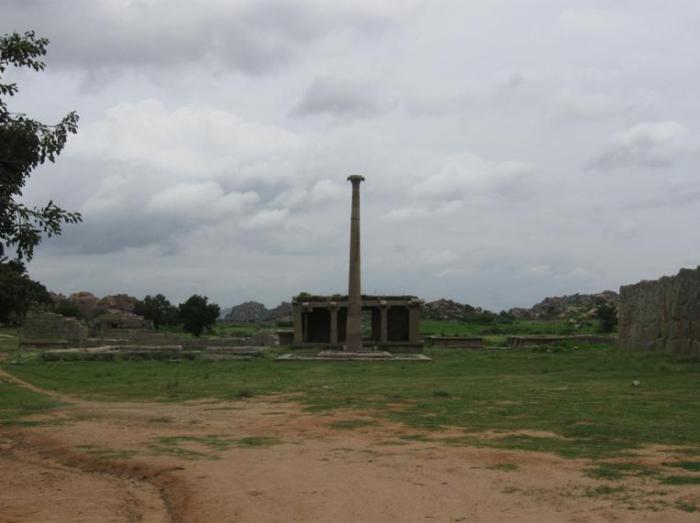
I also saw what looked like an enormous, narrow gateway, sans surrounding walls/ fortifications, a misconception that was clarified as I got nearer. The stone beam placed on two carved pillars was not a gate — it was the remains of a giant scale or a tulabharam. The ruling kings of Vijayanagara used to be weighed against gold, precious stones, food grains, etc., which would then be distributed to the poor and needy. At least this is what our guide told us, but I think that the gold and precious stones would have gone to the temples and the food grains to the poor and needy.
The stone frame of the King’s Balance or Tulabharam is all that remains of the original structure
As one nears the Vittala Temple, the burnt entrance tower captured my attention. The rulers of the Vijayanagara Empire were quite open to experimenting with building materials and styles. While experimenting with building styles seemed to be reserved for their royal buildings, their temples were experimented upon with regard to building material — at least for the temple towers. Brick towers replaced the heavier granite towers seen in the Virupaksha Temple at Hampi. While this made the temple towers easier to build, it also made them vulnerable to destruction by fire. Which is what happened when Hampi was sacked after the loss of the Vijayanagara Empire at the Battle of Talikota.
Entrance to the Vittala Temple
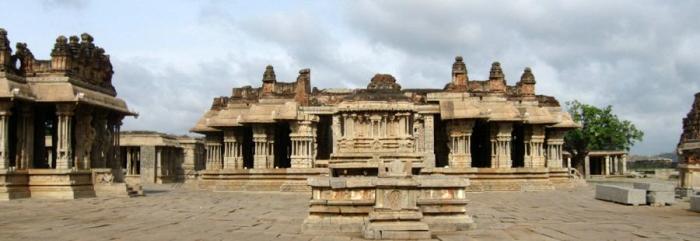
When I entered the Vittala Temple complex, the first thing that struck me was the geometric precision of the layout of the various structures within.
Inside the Vittala Temple ComplexInside the Vittala Temple Complex. Part of the Mahamandapa is visible on the right, while part of the Kalyana Mandapa is visible on the left. One of the burnt temple towers is also visible in the background
It was difficult to concentrate on the guide’s orientation talk, as my eyes kept straying all over seeking details and delighting in the beauty around me. Once his talk was over, I set out to explore the Vittala Temple complex in greater detail, making the most obvious and best known structure there—the Stone Chariot—my first halt.
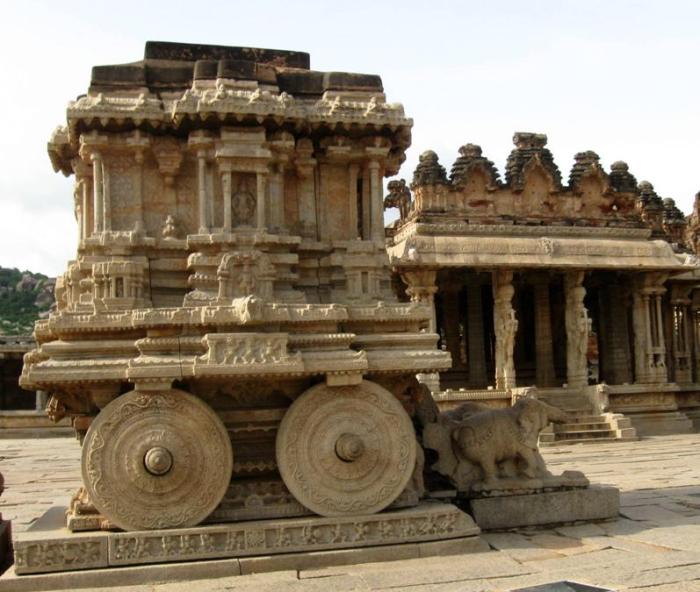
The Stone Chariot is built on a rectangular stone platform and its inner chamber once enshrined a Garuda idol. The Stone Chariot was originally drawn by 2 stone horses (now destroyed), and are currently drawn by 2 stone elephants brought from some other place. The Stone Chariot looks so amazingly real, right down to its stone wheels, that I felt all it needed was a tap or two with a magic wand for it to come alive! I’ve got goosebumps on my arm even as I am typing this out.
The Stone Chariot at the Vittala Temple
The Vittala Temple complex is also known for its hall of musical pillars. When I first heard about the musical pillars in Hampi, I imagined a long, seemingly endless, hall along which tall pillars would be lined up. These pillars would resonate with musical notes when struck gently. Nothing was further from this imagined structure of mine!
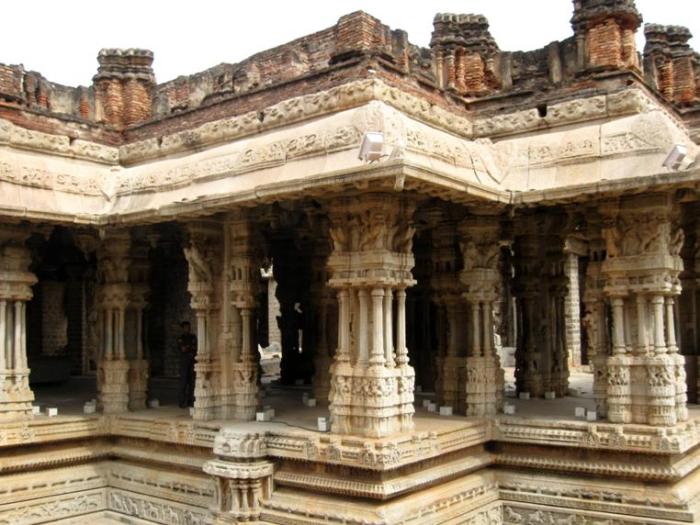
The Mahamandapa of the Vittala Temple, which contains the hall of musical pillars, is a many angled structure. Like the Stone Chariot, this too stands on an ornate platform, decorated with bas reliefs of traders, animals and floral motifs. There are 5 halls within this Mahamandapa corresponding to the four cardinal directions and a central hall, which does not have a roof, thereby leaving it open to the elements.
The temple pillars are composite pillars, with each individual pillar made up of many smaller and slender pillars (see photo below). The Eastern Hall of the Mahamandapa is the Hall of Musical Pillars. Each of these pillars are carved with figures of musicians, musical instruments, and dancers.
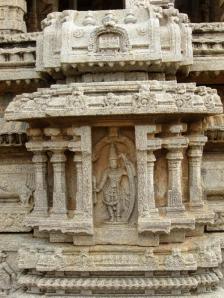
Details of the pillars of the MahamandapaA miniature temple on the walls of the Mahamandapa
Unfortunately for us, but fortunately for the pillars, we could not test out the musical quality of the pillars. Over the years, too many people had tested the musical prowess of the pillars culminating in one of the pillars actually breaking a few years back. This resulted in the Mahamandapa being kept out-of-bounds for tourists. Eagle-eyed and strict guards are posted in the Mahamandapa to prevent tourists and tourist guides from testing the pillars. You can see one such guard lurking behind a pillar in photograph above.
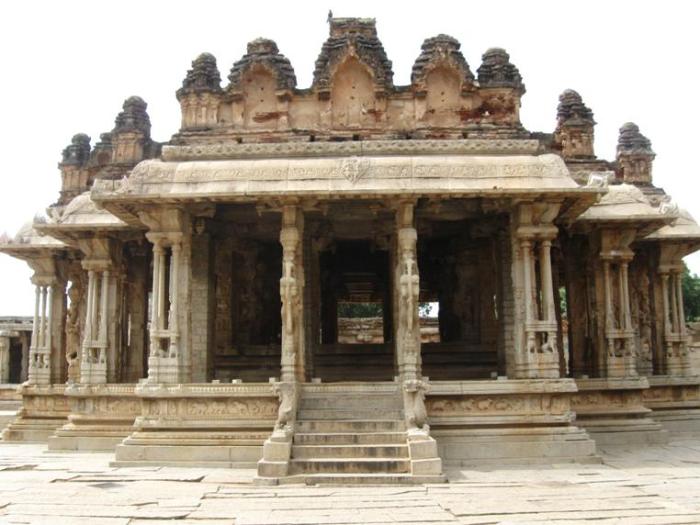
This is probably a good thing as tourists can look at the beautiful carvings on the walls and pillars of the Mahamandapa, instead of only tap-tapping the musical pillars. I saw some particularly stylish carvings of miniature temples with a deity, on almost every side of the temple (see photo on the left). The Vittala Temple complex also has other attractions like the Kalyana Mandapa or the ceremonial marriage hall, a many (100?) pillared hall, as well as another mandapa whose name I forget now. Photographs of these attractions are given below.
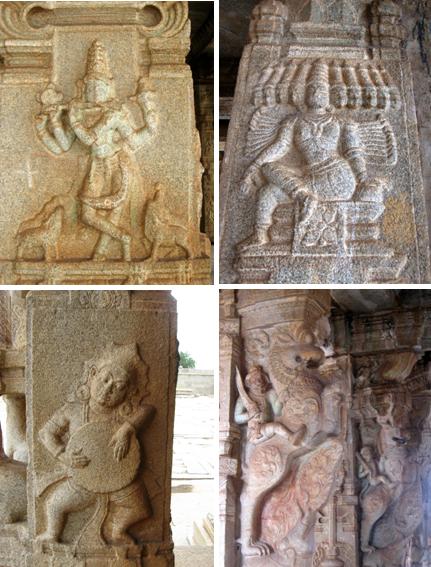
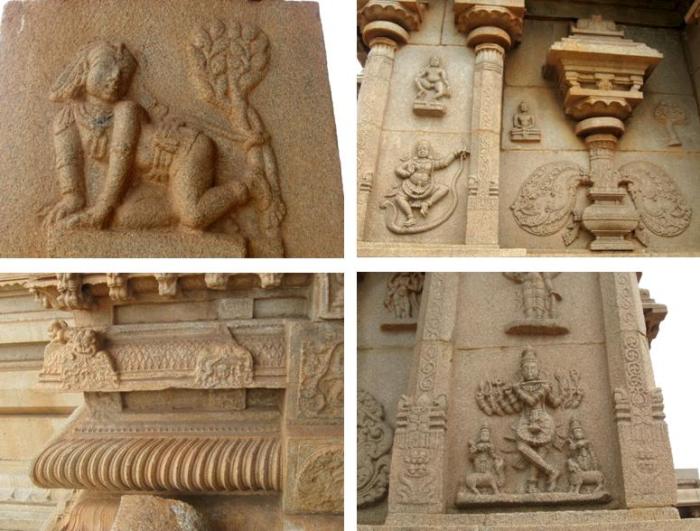
The perfectly proportioned Kalyana MandapaA sampling of carvings from the Vittala Temple. Clockwise from top left: Krishna, with traces of the original painting still evident; a rare carving of Ravana; armed men on a mythical creature with a tiger’s legs, horse’s body, hare’s ears, and lion’s head; a drummer is rapt in his music.
One of the last things we saw at the Vittala Temple is the inner sanctum, which used to have an idol of Vittala (a form of Krishna). The idol is no longer there and our guide was not sure as to where and when the idol had disappeared from there. I wondered if it was destroyed during the sacking of Hampi or if was it shifted to another temple.
The Anjanedri Hill as viewed from Vittala Temple Complex
As we leave the Temple, I take one last 360° look around the complex and spot the Anjanedri Hill at Anegundi. From my explorations earlier in the day, I know that the Tungabhadra and the submerged Purandara Dasa Mandapa is somewhere close by. This was place where the saint-composer Purandara Dasa spent his last years in Hampi singing and composing songs dedicated to Krishna. More specifically, he composed songs dedicated to Vittala and signed all his compositions with “Purandara Vittala”.
And some things suddenly became clear to me. Purandara Dasa’s Vittala was the Vittala of this temple, and not the Vittala of the Pandharpur temple (in Maharashtra) as I had thought for all these years. At that point, I felt really blessed to be at the place that was an inspiration for the compositions of Purandara Dasa, one of my favourite composers. His simple, fresh and timeless compositions appeal to me like no other. Though most of his compositions are in Kannada, a language I can just about comprehend, I can somehow understand his compositions (you can listen to one of his compositions here).
I left the Vittala Temple with the hope that some of the inspiration rubs off on to my own creative pursuits.
P.S.: This visit was part of a tour organised by Doreen D’Sa of Doe’s Ecotours. She can be contacted at does_ecotours@yahoo.co.in.
♦ ♦ ♦ ♦ ♦ ♦
Read more about my trip to Hampi through the following posts:
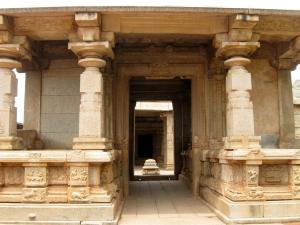
The simple and elegant entrance to the Hazara Rama Temple
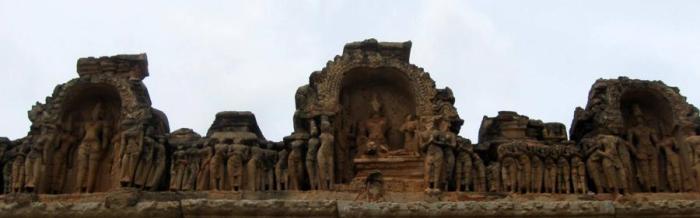
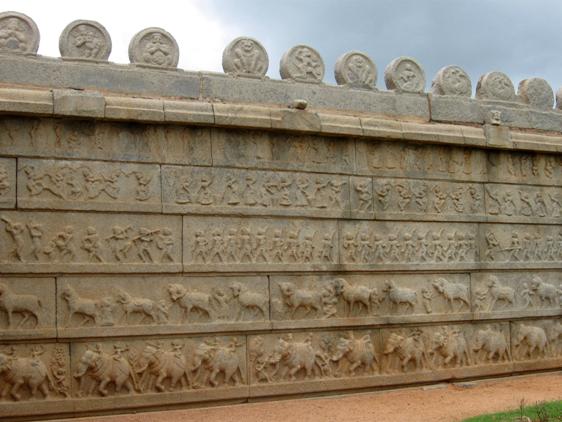
For me, the Hazara Rama Temple is right on top of the list of temples I liked in Hampi. This is not one of the biggest or the grandest of temples in Hampi, but it is certainly the most intimate temple, a temple which felt like my own personal space. It is also the temple with the most intricate carvings, which begin with the outer walls of the temple complex itself.
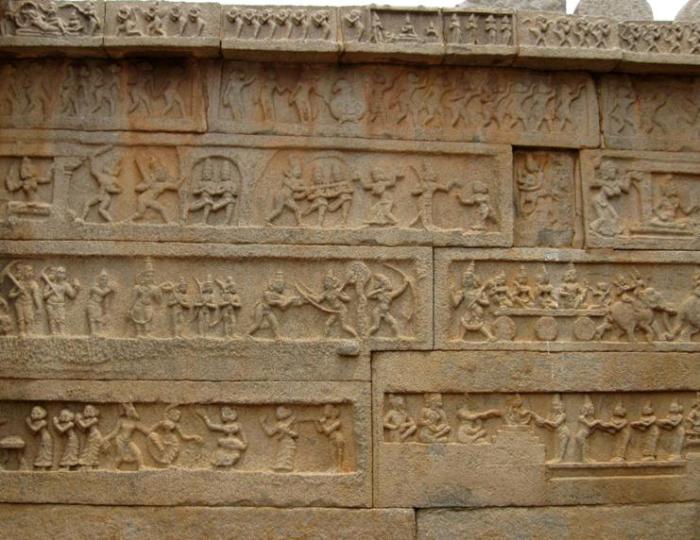
Inside, the temple is no less ornamental. It is full of bas reliefs from the life of Rama or Krishna, both avatars of Vishnu. I was very proud of myself for being able to recognise the various characters in the panels and reliefs and the stories that were trying to convey. All thanks to the stories that my grandmothers and my mother narrated to me in my childhood. And of course, Amar Chitra Katha!
Carving above the entrance to the Hazara Rama TempleThis wall panel at the Hazara Rama Temple depicts hunting scenes, foreign traders, and dancing womenSculpted friezes on the walls of the main shrine at the Hazara Rama Temple
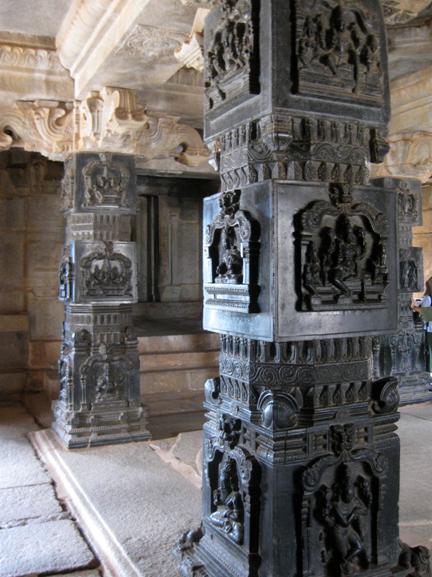
All monuments in Hampi have been built out of granite, the local stone. Only in two places have other stones been used and that too for decorative purposes, rather than as a building stone per se. The first instance is at the Mahanavami Dibba where a green schist has been used as a cladding stone. The second instance is at the Mahamandapa of the Hazara Rama Temple, where 4 pillars made from black Cuddapah stone—brought all the way from present day Andhra Pradesh—have been installed. The carvings on these pillars are also from the lives of Rama and Krishna and are simply awesome. The gleam of the black pillars in the cool, dim light of the Mahamandapa is indescribable.
Intricately carved pillars made of the black Cuddapah Stone in the Mahamandapa of the Hazara Rama Temple
The Hazara Rama Temple is located somewhere between the Royal Enclosure and the Zenana Enclosure, and historians consider that this temple was built for the exclusive use of the royal family.
I do not buy this theory simply because of the nature of the bazaar outside the Temple. Like all the main temples in Hampi, the Hazara Rama Temple too had a bazaar outside its premises—the Paan-Supaari Bazaar. Now tell me, why would a bazaar outside the so-called Royal Temple, be selling paan (betel leaf) and supaari (betel nut)? If the bazaar had been selling precious stones and gold and silver items, I might have been willing to consider the fact that the Hazara Temple was exclusively meant for the Vijayanagara Royal Family.
The Paan-Supaari Bazaar outside the Hazara Rama Temple
What do you think?
P.S.: This visit was part of a tour organised by Doreen D’Sa of Doe’s Ecotours. She can be contacted at does_ecotours@yahoo.co.in.
♦ ♦ ♦ ♦ ♦ ♦
Read more about my trip to Hampi through the following posts:
Royal Hampi is almost synonymous with Krishna Deva Raya, Vijayanagara Empire‘s best known king, who ruled from 1509–1529. Though there were many kings before him and a few after, most people associate everything with the Empire to Krishna Deva Raya. Lokesh, our local tour guide, was no exception—after a general introduction to Hampi and the Vijayanagara Empire, all his stories began and ended with Krishna Deva Raya!
Royal Hampi is instantly distinguishable from the other ruins at Hampi, largely due the different design elements used (for example, the Indo-Islamic architectural style of the Queen’s Bath), the delicate embellishment (for example, the Lotus Mahal), and of course, the royal size (for example, the Mahanavami Dibba).
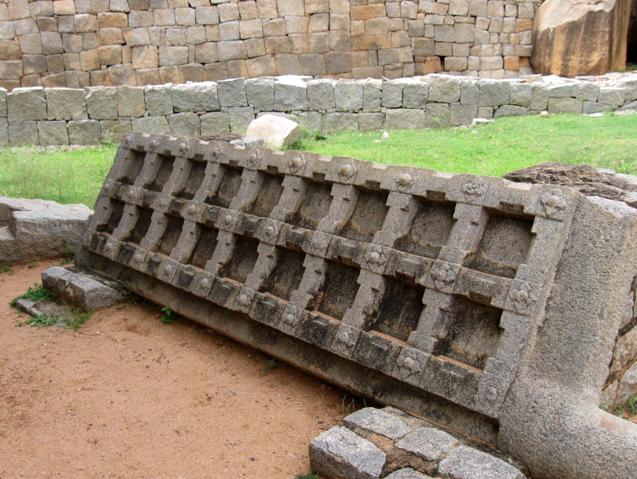
When our group disembarked at the Royal Enclosure from our vehicles, I don’t think many of us were sure as to what we were going to see beyond a high wall in front of us and some large blocks of stones lying here and there. As our group gathered around Lokesh for his orientation talk to the Royal Enclosure, none of us paid much attention to those blocks of stones. I was too busy looking around here, there, everywhere—except at my feet, which were just inches away from the massive “block of stone” shown in the picture below.
 The town of Champaner is situated at the base of Pavagadh Hill, which is a sudden rise in an otherwise gently undulating landscape. A climb up Pavagadh Hill reveals a heady mix of interesting geology, mythology, religious confluence, history, strategic military brilliance and foresight, clever design and architecture, rainwater harvesting systems, sustainable measures, a hidden valley of flowers, etc.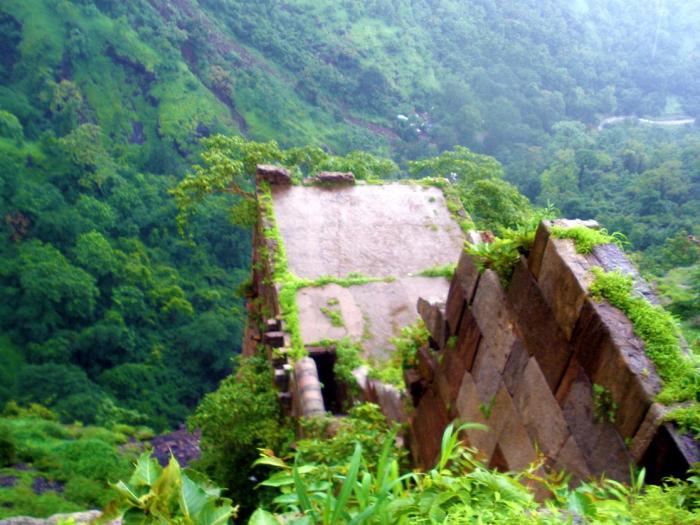










 My Favourite Things