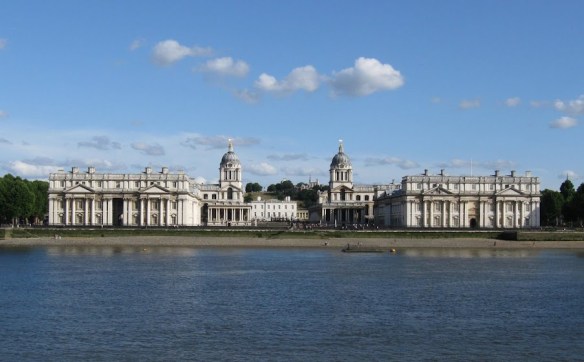
Sometimes, it takes a larger view for things to fall into perspective. Literally. Viewing the former Royal Naval College in Greenwich (pronounced Gren-itch) from across the Thames was one such experience.
I had spent a lovely day spent at Greenwich as part of a guided walk through Maritime Greenwich, a UNESCO World Heritage Site. Of particular interest to me were the two buildings of the former Royal Naval College, which was designed by Christopher Wren, and captured by the famous Italian painter, Giovanni Antonio Canal, better known as Canaletto. Throughout my explorations there, I kept searching for that one view that captured the beauty, simplicity and symmetry of Wren’s design, but in vain.
It wasn’t till I crossed the river Thames to the opposite bank to take the DLR back to London that I realised that I had been searching for Canaletto’s view from the wrong side. When I emerged from the underground foot tunnel, this was the beautiful sight that greeted me.
A view of the former Royal Naval College, Greenwich, from the River Thames
… to publish a blog post with a photo that captures the following 5 colours – Blue, Green, Yellow, White and Red.
Hmmm… till about 4 years back I didn’t even give colours a second thought or glance. I took it for granted as growing up in India, they were always around me. But a year’s stay in London showed me how much colours mattered to me, and changed my very perception and understanding of colours.
I arrived in London at the onset of winter and its (in)famous winter weather. But the grey and damp weather didn’t bother me; neither did the sunless days affect me. But a monochromatic London of black and grey coats, hats, scarves, gloves and boots drove me crazy. That’s when I started noticing colours in the world around me, rather than only on people. Colourful shop fronts, buildings, pub exteriors, cars, tube stations, a stained glass window … took on a whole new meaning. I learnt to look at, appreciate and enjoy colours in a very different way.
It had to convince myself to participate in the contest as I don’t really consider myself as a photographer. But the idea of digging into my digital photo library was tempting and I had a great time choosing 5 of them—one for each contest colour. So presenting my blue, green, yellow, red and white photographs as well as my take on each of them. Continue reading “Blue, green, yellow, red and white…”→
It is the year 1678 in London and an uneasy religious calm and simmering tensions prevails in the city. Indeed, this is the prevalent mood across England and Wales. Though it has been 150 years since the English Church split from the Roman Catholic Church bitter differences remain between the Protestant majority and Catholic minority. The reigning monarch, Charles II, is a worried man as his successor and brother, James II is a Roman Catholic.
On the morning of 12 October, the magistrate of Westminster and strong supporter of Protestantism, Sir Edmund Berry Godfrey receives a report of an alleged Catholic plot to assassinate the King. On October 17, Godfrey’s body is found on Primrose Hill; it is automatically assumed that he has been killed by the Catholic plotters. This discovery sets off a wave of anti-Catholic sentiments and a chain of arrests and executions follow.
This event, which becomes part of the larger Popish Plot, is widely documented and recorded. One of the more unusual ways it has been documented is in a pack of cards now displayed at the British Museum, London !
The suit of spades from a pack of Popish Plot playing cards
The London Docklands is the name given to some areas of eastern and south-eastern London. Till the middle of the 20th century, the Docklands was where the various docks and dockyards used to be. Though the docks were originally built and managed by a number of private companies (for example, East India, West India, etc.), it was not till 1909 that it all came under the management of the Port of London Authority.
Redeveloped London Docklands near Canary Wharf. For those used to seeing a predominantly Georgian London, this view of the city can come as a bit of a surprise !
Today, the area is a mix of the commercial and the residential, and old housing estates and newer steel and glass structures as a result of massive efforts at redevelopment of an area that used to be predominantly labour class. The introduction of the Docklands Light Railway or DLR in 1987 fulled the development of an area that did not have good transport connectivity. The Docklands area has always been a trade hub for centuries; today, it is a hub of a different kind—the central business district of London is located here.
Tower Gateway DLR Station
The DLR is a fully automated light metro or light rail system to exclusively serve the Docklands area of London. It is quite distinct from the London Underground, and is also part of Transport for London. During my year’s stay in London in 2008–2009, I remained ignorant of the DLR largely because the Tube Bus took care of most of my travel requirements and I rarely travelled to the Docklands area.
Then one day, while returning to Central London from a day trip to Greenwich, the DLR turned out to be the most convenient mode of travel, and to use a clichéd term, travel was never the same again. It is a trip that I still remember, as a very different London emerged through that journey, very distinct from the Victorian and Georgian London that I had come to associate London with and love.
Such was my fascination for the DLR, that on one rainy and cloudy day, I spent a few hours travelling by the DLR, getting off at stations that caught my fancy and exploring the Docklands area on foot. I saw a very different London that day. A quieter London, steel and glass apartments, residences converted from warehouses, an airport by the river, colourful buildings, and so much more.
Presenting a sampling from that lovely day of a very different London courtesy the DLR journey that I took in July 2009 ! 🙂
I lived in London for a year (2008–2009) and though walking was my preferred mode of getting around the city, it wasn’t always possible to walk to my destination. So that’s where the Tube or the London Underground came in as the fastest, though not necessarily the cheapest, mode of travel. Travelling by the Tube made me re-look at perceiving public transport as only a means to get from point A to point B. It showed me that it could also be a place to showcase art, make a design statement, and a place that reflected the ethos/culture of the area it serviced.
Transport for London is the company overlooks the public transport in London through the Tube, buses, the Docklands Light Railway (DLR), trams, trains, etc. Though I used all these modes at some point during my stay in London, I loved the Tube and the DLR the most. I loved it so much that I photographed the unique aspects of the various tube stations I passed through, its various lines and routes, escalator and tube etiquette, etc. I never tired of admiring the little and big things that made each station unique and special. Even today, the Tube remains eminently gush-worthy. 🙂
About 2-3 weeks back, BBC Entertainment channel in India started airing a programme on the London Underground. This programme, which airs every Saturday at 9.00 pm, looks at “London’s 140 year-old Underground system” and “what it’s like to run the world’s most complex train network”. In other words, it is a behind-the-scenes look at the people who run and manage the Tube.
Bond Street Station
Not surprisingly, this has become my favourite television programme and has inspired me to write this blog post today. But this post is not about the efficiency or a behind-the- scenes look of the Tube; it is simply a post on the beautiful tube stations of the London Underground — the ones that caught my eye with their unique design, art or architectural element.
The British Museum‘s exhibits can delight a layperson, a history buff and a museum junkie at the same time. One of its more impressive exhibits is a set of stone panels known as the Lachish Reliefs. In its original form, the Lachish Reliefs (700-692 BC) would have been vividly painted. But the soft sepia tones that the frieze has acquired today (and enhanced by the lighting in the room) makes the viewer feel that is watching a documentary, albeit one etched in stone.
The Lachish Reliefs
Lachish (present day Tell ed-Duweir) is about 40 km south-west of Jerusalem. In 700 BC, Lachish was a heavily fortified hill town in the Kingdom of Judah and was strategically located on an ancient trade route that linked Mesopotamia to the Mediterranean and the riches of Egypt. At the end of the 8th century BC, Hezekiah, the King of Judah, rebelled against the Assyrians, who had built an empire that stretched from Iran in the East to Egypt in the West, and who controlled the region. Naturally, this rebellion did not go down very well with the Assyrians, whose King Sennacharib led and won a campaign against Lachsih.


 I lived in London for a year (2008–2009) and though walking was my preferred mode of getting around the city, it wasn’t always possible to walk to my destination. So that’s where the Tube or the London Underground came in as the fastest, though not necessarily the cheapest, mode of travel. Travelling by the Tube made me re-look at perceiving public transport as only a means to get from point A to point B. It showed me that it could also be a place to showcase art, make a design statement, and a place that reflected the ethos/culture of the area it serviced.


 My Favourite Things