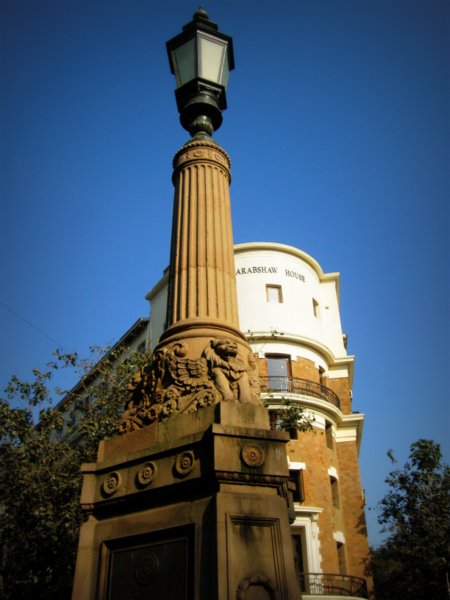
Mumbai Lens: St. Thomas and the Archangels

The moment I enter St. Thomas’ Cathedral in the Fort area of Mumbai, I am transported to England. Everything about the Cathedral from the cool white-washed interiors to the simple wooden pews to its polished brass memorials and wall plaques, and its many stained glass windows reminds me of the Anglican churches of England.

St. Thomas’ Cathedral is the first Anglican church in Mumbai and is also believed to to the oldest British building in this city. Though construction of the Cathedral of St. Thomas began in 1676, it was abandoned and remained neglected for nearly 40 years, when it was “adopted by an East India Company Chaplain in 1710. It was opened for worship as a church on Christmas Day in 1718″ (for details click here). St. Thomas’ was consecrated as a cathedral in 1837 and was selected for the UNESCO Asia-Pacific heritage conservation award 2004.

I love stained glass windows and spend quite a while admiring the many windows in the Cathedral. But the one window that completely captivates me is one that I almost missed. It is to one side and in a niche: a stained glass window of St. Thomas, flanked by two archangels St. Michael and St. Gabriel in a single frame.
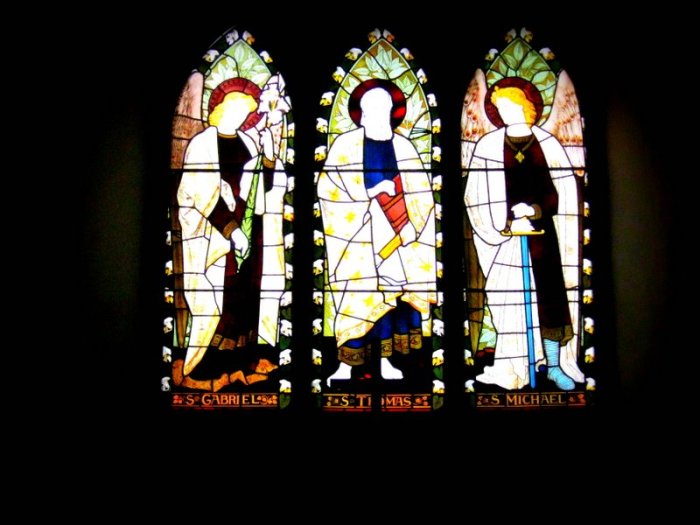
St. Thomas Cathedral, Stained Glass, Mumbai
The stained glass window at the St. Thomas Cathedral, Mumbai. From L to R St. Gabriel, St. Thomas and St. Michael

Continue reading “Mumbai Lens: St. Thomas and the Archangels”

The Elephant of Elephanta

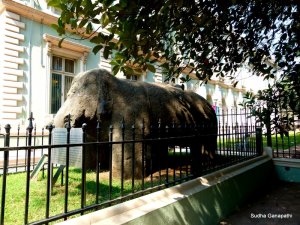
Elephanta Elephant, Mumbai, Bhau Daji Lad MuseumIn a fenced enclosure outside the Dr. Bhau Daji Lad Mumbai City Museum (formerly known as Victoria & Albert Museum) at the Jijamata Udyaan (formerly known as Victoria Garden) in Mumbai, is an Elephant. Not a flesh and blood elephant, mind you, but a stone elephant with a long and interesting history to share.

Carved in the 6th century from a single piece of rock at one of the many entrances to the island known as Gharpuri, the Elephant saw many a king come and go for over a 1000 years. Then one day, in early 16th century, the Elephant saw the first European colonisers — the Portuguese — to the region. The Portuguese were so awed by him that they promptly named the Gharpuri after him — the Elephanta Island, a name it has been known as since then.

When the Portuguese relinquished their rights over the region to the British 150 years later, the Elephant was witness to this as well. The new colonisers were also impressed and awed with him. In fact, the English were so impressed with the Elephant, that they wanted to take him home to England. But this was no easy task and it took them nearly 200 years to put their wish in action.

On a sunny day in 1864, a crane was brought to the Island to lift the Elephant from his rocky home and transport him to ship that would then take him to a new home at a museum in England. This was no easy task and the local people and the English Officers directing this operation watched with bated breath as the crane huffed and puffed, and finally managed to lift the Elephant.

And as the arm of the crane swung around with its elephantine cargo, disaster struck. The crane snapped sending the Elephant crashing down and breaking him into pieces.

Continue reading “The Elephant of Elephanta”

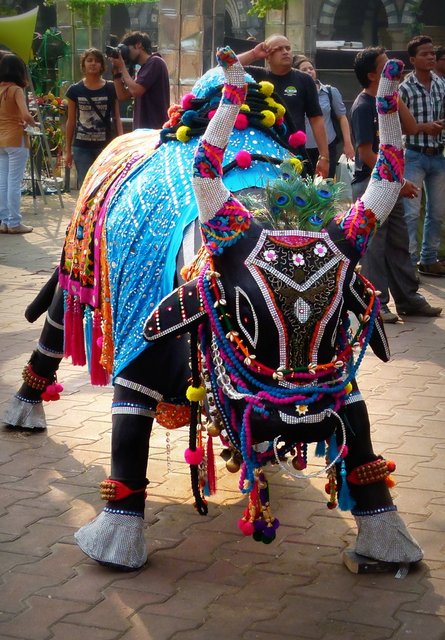
The Kala Ghoda Arts Festival 2013

Today was the last day for 2013 edition of the Kala Ghoda Arts Festival (KGAF). Even as I get ready to publish this post, the handicrafts stalls must be getting dismantled as the area has to be clear for regular traffic by tomorrow morning. The installation and street art too would be dismantled (I wonder where they go). Most Mumbai-based bloggers have already published posts and photographs on the KGAF 2013. And now, it’s my turn to share my thoughts and perspective on this one-of-a-kind art and cultural festival in Mumbai.

I have been visiting KGAF since its inception and have seen it grow to the extremely popular and iconic event that it has become today. While I enjoy all the events on offer at the KGAF, it is the installation and street art that I look forward to every year. To be honest, I didn’t start of as a fan of installation art, but the creativity that is showcased is something that I find it hard to ignore. And this year, the installation art at the 2013 version of the KGAF was a sensory delight.

Kala Ghoda Arts Festival 2013 3Bangles, metal wires, insulated wires, plastic bottles, paper, papier-mache, clay, cloth, CDs, assorted hardware from computers, plastic mugs, corrugated cardboard sheets, metal pipes, spectacle frames, coins, photo frames, metal chains, cardboard cartons, plywood, PoP, jute sacks, cane, bamboo, marble, glass bottles, plastic tuns, cars, rickshaws, a bicycle, petrol tanks, dolls, living plants, driftwood … just about every material imaginable was used for the installation art at KGAF 2013. I had a hard time stopping myself from reaching out and touching or climbing onto many of the artworks clearly signposted with “Do not Touch” or Do not Climb”.
And though most of the installation art fit into themes similar to previous years — Mumbai city, social issues (corruption, violence against women, child sexual abuse), broader environmental issues, cinema — there were also those that did not fit into any of the themes and managed to hold their own. A selection of some of the installations that appealed to me are given below.

Continue reading “The Kala Ghoda Arts Festival 2013”

The clock tower at Jijamata Udyan

It’s quite amazing, you know, of the things one notices, but does not really see. Take for instance the subject of this post. I must have passed it a countless number of times, glancing at it idly but mostly ignoring it. You might have noticed it too, if you are travelling on the Lalbaug flyover towards Byculla, which looms up about 100 metres before the exit on your left.

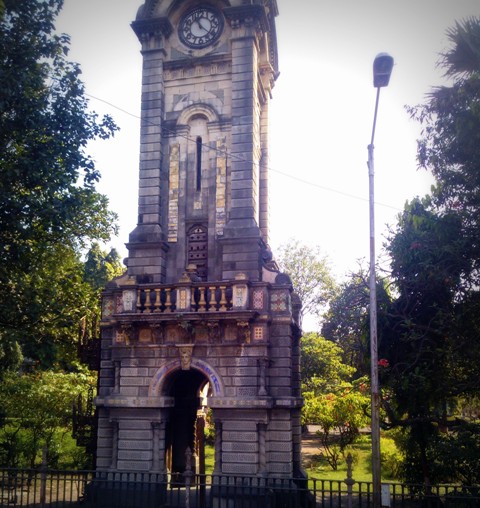
That day, when I was passing by this structure I felt I was seeing it for the first time. And indeed I was for the slender and elegant clock tower glowed in the mid-morning winter sun in spite of the very obvious look of neglect that it had and stones blackened due to pollution.

Clock Tower, Rani Bagh, Victoria Gardens, Mumbai, Jijamata Udyan
The Clock Tower at the entrance to Jijamata Udyan and photographed from the Lalbagh flyover

Situated at the entrance to the Jijamata Udyan (formerly known as Victoria Gardens and also known as Rani Baug) and among trees, this beautiful clock just begs to be explored. When I attempted to do just that, I found that it is closed to the public with a several “Keep Out” signs placed all around. There is no information board on the clock tower and I had to be content walking around the barrier erected and look at the details through my camera lens. And what did I find? Continue reading “The clock tower at Jijamata Udyan”

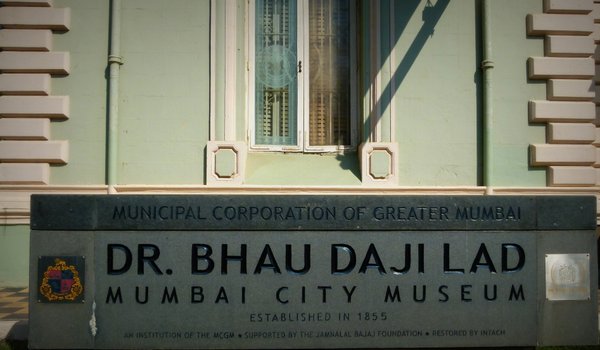
The Bhau Daji Lad Mumbai City Museum

I love museums, and I can spend hours inside them pottering about and looking at their varied collections. And yet strangely, for some inexplicable reason, I have never really explored the museums in my city of Mumbai. Of course, I have visited them as a child but not really visited them, if you know what I mean.

Bhau Daji Lad Museum 2So one rainy day in August last year, I took the afternoon off from work to see the Bhau Daji Lad Mumbai City Museum (BDLM). This was a museum that I had never visited, but one that I had heard about a lot from Appa. I went without a camera as I automatically assumed that, like most Indian museums, photography was not allowed. Big mistake. Non-flash photography was allowed in the Museum, though they don’t really advertise the fact.

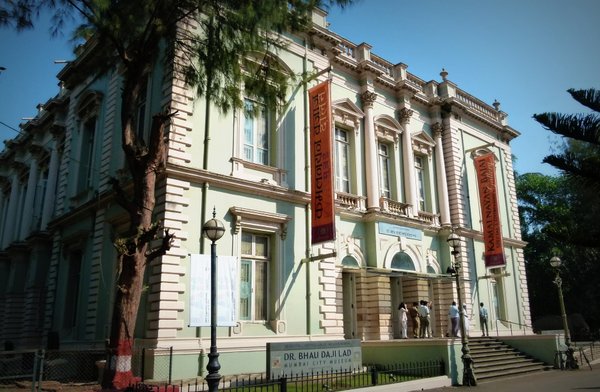
The dazzling 3-hour BDLM visit was a visual treat all the way — right from the stately Museum building to its grand interiors (that reminded me of a ballroom) to its tastefully displayed collection — and one that stayed with me longer than the time I spent there. I knew that I didn’t just want to write about the BDLM’s artefacts in my Museum Treasure series, but write an entire post on the Museum itself. And since I wanted to include photographs, I had to wait for an opportunity to visit the BDLM once again. And last month, I got that chance and when the Museum opened it’s doors that Friday morning, I was the first to enter with a big smile and my camera. 🙂

Bhau Daji Lad Museum, Mumbai
The entrance to the Bhau Daji Lad Mumbai City Museum

Continue reading “The Bhau Daji Lad Mumbai City Museum”

Mumbai Lens: The war memorial at Ballard Estate

♦ This blog post was featured in the “Around the Blog” section of the DNA newspaper published on January 14, 2013 (pg.6) 

At a road junction in the busy Ballard Estate area of Mumbai, and near two landmarks of the area — Cafe Britannia and Old Customs House — stands a memorial.

World War I Memorial at Ballard Estate, Mumbai

This memorial commemorates the employees of the Bombay Port Trust (now Mumbai Port Trust) who fell during World War I (1914-1918) and also Port Trust’s contribution to the war effort. A brass plaque on the memorial reads:

Continue reading “Mumbai Lens: The war memorial at Ballard Estate”