Somewhere in Basra, c. 1831
The room was dark and the only light, feeble as it was, came from a flickering oil lamp placed in a corner of the room. But it was enough for the fortune-teller to recognise the man being ushered in by his son.
“Salaam, Master,” the fortune-teller greeted the robed man.
“You know who I am, ” the robed man said. It was a statement and not a question.
“Who doesn’t know you, Master?” said the fortune-teller. “Everyone knows you and about you.”
“Then you also know why I have come here.”
“I can guess, Master,” the fortune-teller bowed.
“I have no choice but to leave this region. Where should I go? London? China? Where does my future lie?”
The fortune-teller was silent for a long time. Just when the man was about to ask him again, the fortune-teller said.
“Your should leave immediately for Bombay in Al-Hind [Arabic for India]. A bright future and fortune lies awaits you there.”
The robed man was surprised with the response, but he knew better than to ignore the fortune teller’s advice. After paying him handsomely and thanking him, the robed man left. His mind was already planning for the move to Bombay.
And sometime later in 1832, the man arrived in Bombay and over the next 32 years made a phenomenal contribution to the city that Bombay was developing into. That man was David Sassoon
Continue reading “The Jewish heritage of Mumbai”



 In a fenced enclosure outside the
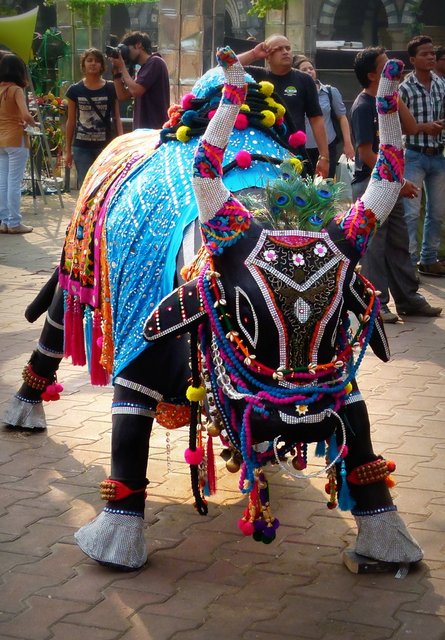 Bangles, metal wires, insulated wires, plastic bottles, paper, papier-mache, clay, cloth, CDs, assorted hardware from computers, plastic mugs, corrugated cardboard sheets, metal pipes, spectacle frames, coins, photo frames, metal chains, cardboard cartons, plywood, PoP, jute sacks, cane, bamboo, marble, glass bottles, plastic tuns, cars, rickshaws, a bicycle, petrol tanks, dolls, living plants, driftwood … just about every material imaginable was used for the installation art at KGAF 2013. I had a hard time stopping myself from reaching out and touching or climbing onto many of the artworks clearly signposted with “Do not Touch” or Do not Climb”.

 My Favourite Things